Fernando Pessoa
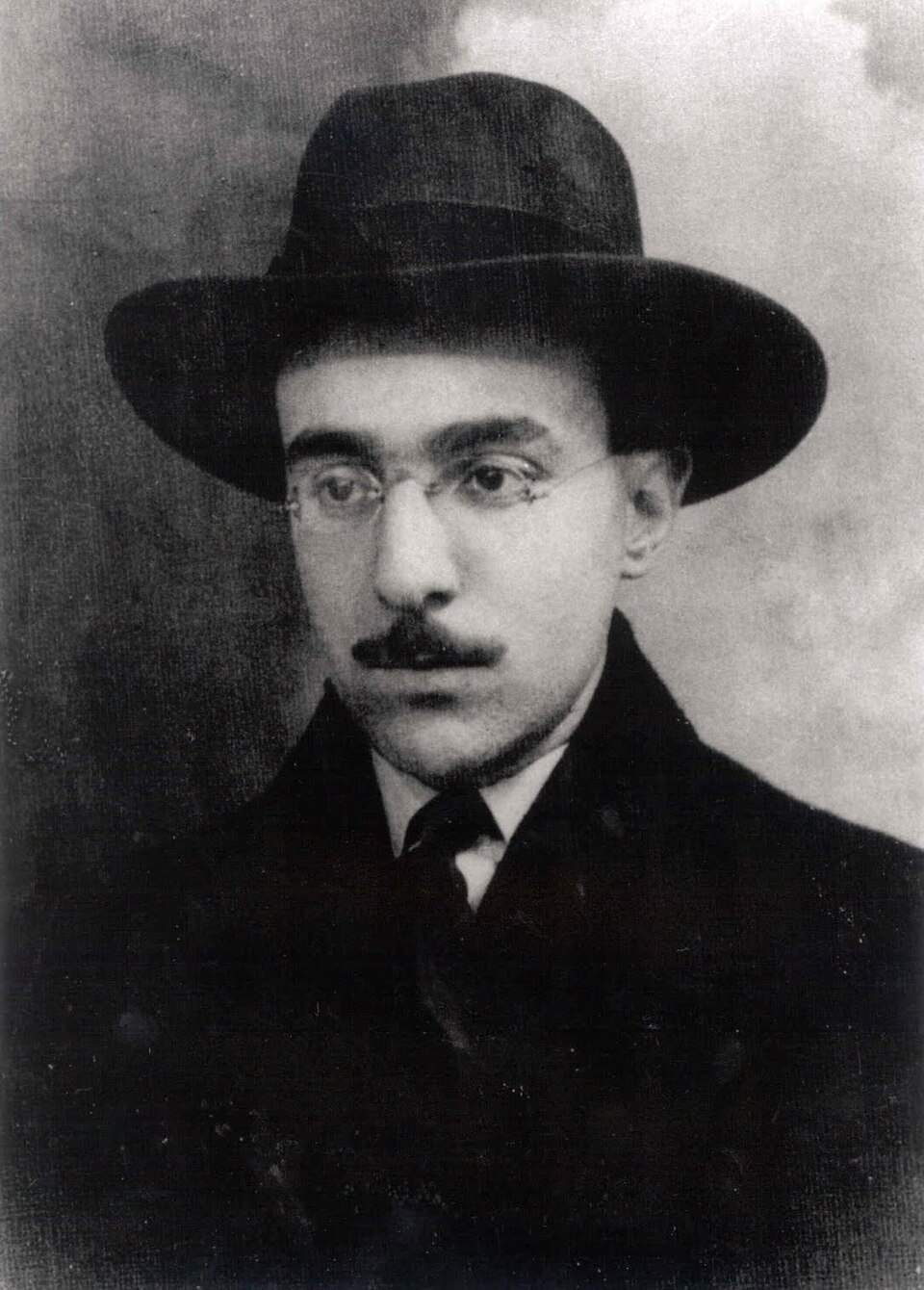
A poet who populated his work with fully realised fictional authors, each with their own biography, philosophy, and style, making the question of who was actually writing as alive as anything on the page.
Fernando Pessoa is one of the most significant literary figures of the twentieth century and the central figure of Portuguese modernism. He did not simply write under pen names — he invented entire persons, complete with birth dates, astrological charts, and philosophical outlooks, and he assigned his poetry to them as if editing the work of others. The resulting body of writing, much of it unpublished in his lifetime, was found after his death in a trunk containing some twenty-five thousand manuscript pages.
Childhood between two worlds
Pessoa was born in Lisbon on 13 June 1888. His father died of tuberculosis when Fernando was five years old, and his mother remarried the Portuguese consul in Durban, South Africa. The family moved to Durban in 1896, and Pessoa received much of his schooling there, in English, at the Durban High School. He grew up bilingual in Portuguese and English and absorbed the literature of both traditions — Shakespeare, Milton, Keats, and Poe alongside the Portuguese canonical poets. He returned to Lisbon in 1905 at the age of seventeen, enrolled briefly at the Curso Superior de Letras, and then settled into a life of modest employment as a commercial translator of business correspondence — work he would continue, in various forms, for the rest of his life.
The heteronym project
The central fact of Pessoa's literary career is the invention of heteronyms: not pseudonyms, which are masks over a real author, but fully autonomous fictional beings who wrote in their own voices. The three principal heteronyms were developed in a creative crisis he later described as arriving all at once on 8 March 1914, when he wrote dozens of poems in a single session.
Alberto Caeiro is the master — a rural, largely uneducated shepherd who claims to have no philosophy at all, only sensations. His poems refuse abstraction with a stubborn literalism that is itself a philosophy. Ricardo Reis is a neo-classical Latinist, a monarchist physician who cultivates Horatian odes with formal precision and Stoic resignation. Álvaro de Campos is the most volatile of the three: an engineer educated in Glasgow, a futurist, given to long sprawling odes of industrial ecstasy and existential exhaustion; his poem Tabacaria (Tobacco Shop) is one of the most celebrated poems in the Portuguese language.
Pessoa himself also wrote as "Fernando Pessoa ortónimo" — the orthonym — in a quieter, more introspective key, and he cast himself as the disciple and editor of these figures he had created.
Published work in his lifetime
Despite the scale of what he was producing, Pessoa published remarkably little. He contributed poems and essays to Portuguese modernist journals — most importantly Orpheu (1915), the two-issue magazine he co-founded with Mário de Sá-Carneiro that is regarded as the founding document of Portuguese modernism. His English-language 35 Sonnets appeared in 1918. His only book-length publication in Portuguese during his lifetime was Mensagem (Message), a collection of forty-four poems structured around the mythology and history of Portugal, published in 1934. The book won the Antero de Quental Prize in the Segundo Grémio (second category) of a national literary competition.
The trunk and what it contained
Pessoa died on 30 November 1935 in Lisbon, of what was diagnosed as hepatic colic — likely related to heavy drinking. He left behind a tin trunk packed with manuscripts: approximately twenty-five to thirty thousand pages of poetry, prose, philosophy, letters, and ephemera in Portuguese, English, and French.
The most significant posthumous publication drawn from this archive is Livro do Desassossego (The Book of Disquiet), a fragmentary prose work attributed to the semi-heteronym Bernardo Soares — an assistant bookkeeper in Lisbon whose observations on tedium, consciousness, and the unreality of the self accumulate without plot or argument into something resembling a twentieth-century pensées. Edited and published in various forms from 1982 onward, it became the work through which Pessoa reached a global readership.
I'm the gap between my desire and what life has made of me.