Frantz Fanon
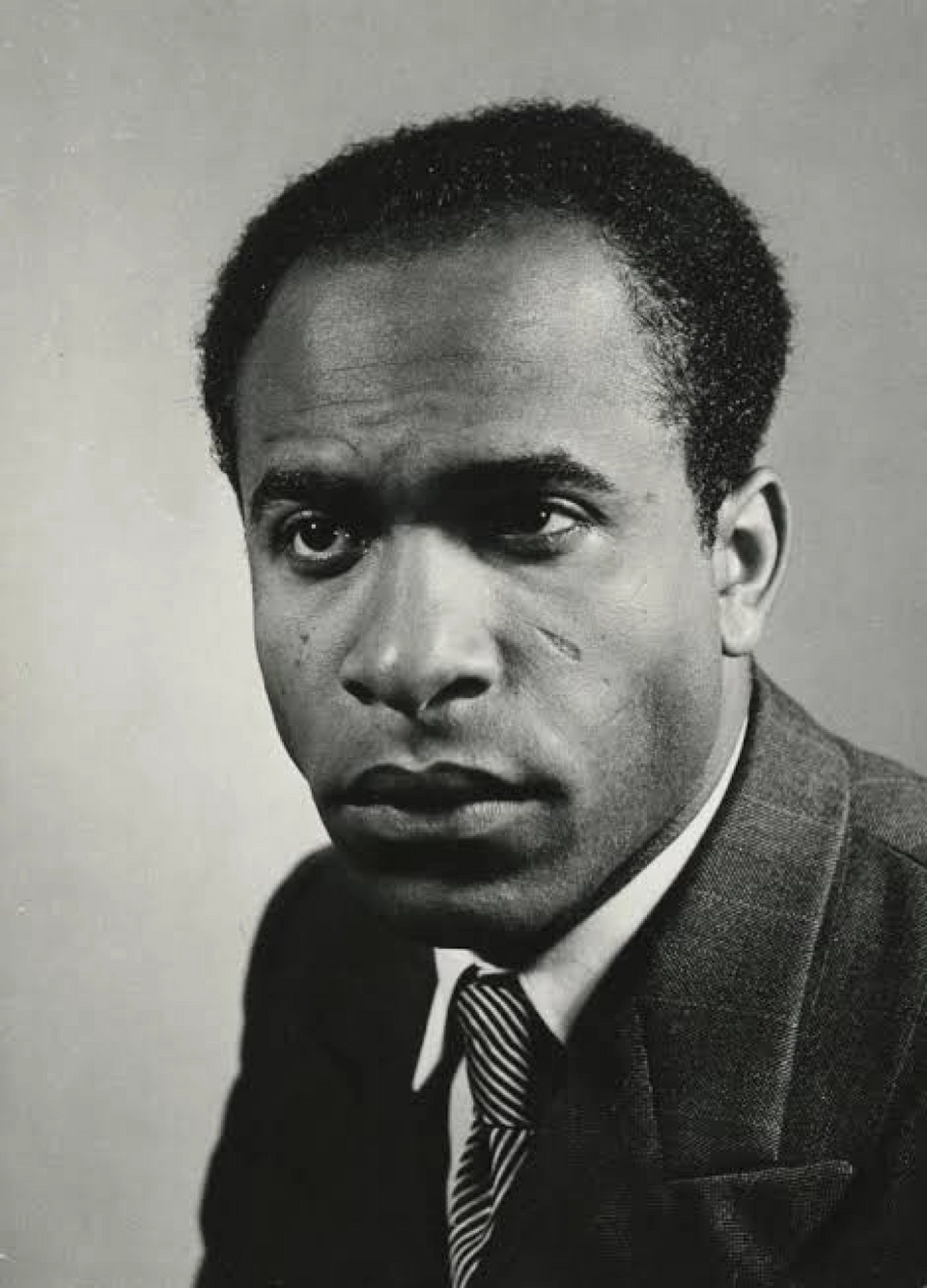
The psychiatrist who diagnosed colonialism as a pathology and gave the decolonising world a language for its wounds.
Frantz Fanon arrived at the theoretical problems of colonialism through the clinic. Trained as a psychiatrist in Lyon, posted to Algeria at the height of French rule, he watched colonialism produce suffering in bodies and minds with clinical precision — and concluded that the condition was systemic, not individual. In two books written at the outer limit of his short life, he supplied the decolonising movements of the twentieth century with their most penetrating account of what domination does to the self and what liberation must demand.
Formation: Martinique, War, Lyon
Born in Fort-de-France, Martinique in 1925 into a middle-class Antillean family, Fanon grew up as a colonial subject of France who was simultaneously educated to identify with France. At seventeen he left Martinique to fight with the Free French forces in World War II, an experience that exposed the gap between the Republic's stated ideals and its treatment of Black soldiers. He returned to Martinique, studied under the poet and political theorist Aimé Césaire — a founding figure of the Négritude movement — then crossed to Lyon to study medicine and psychiatry.
His 1951 doctoral thesis, reworked and published in 1952 as Black Skin, White Masks, drew on psychoanalysis, phenomenology, and lived experience to describe the psychological damage of racial hierarchy. Writing in the first person alongside theory, Fanon showed how colonial racism forces the Black subject to see themselves through the coloniser's gaze — producing a fractured consciousness he described as an internalized inferiority that no individual act of achievement could resolve.
Algeria: The Clinic as Political Ground
In 1953 Fanon was posted as head of the psychiatry department at the Blida-Joinville Hospital in Algeria — then a French département. He arrived three years before the outbreak of the Algerian War, and worked to reform the hospital along humane, community-based lines. As the war escalated after 1954, Fanon treated both French soldiers and Algerian patients whose trauma bore the marks of colonial violence and counter-insurgency torture.
By 1956 he had resigned his position and joined the Algerian National Liberation Front (FLN), subsequently working as a political writer and diplomat for the provisional Algerian government. He contributed to the FLN newspaper El Moudjahid and represented the provisional government at conferences across Africa, where Pan-African solidarity was becoming a political force.
The Wretched of the Earth
Diagnosed with leukemia in 1960, Fanon dictated Les Damnés de la Terre — published in Paris weeks before his death in December 1961, with a preface by Jean-Paul Sartre. Where Black Skin, White Masks had focused on the colonial subject's psychic life, The Wretched of the Earth addressed the structural and political conditions of decolonisation at scale.
Fanon argued that colonialism is a total system — not merely economic exploitation but a spatial, social, and psychological ordering that assigns the colonised to a zone of non-being. Decolonisation, he insisted, is by definition a violent rupture, because the colonial order is itself founded on violence. The book's clinical chapters — case studies of mental illness produced by the Algerian War — were among the first sustained psychiatric analyses of torture's consequences.
The work was immediately read as a manifesto by liberation movements across Africa, the Caribbean, and the Americas. It became foundational for the Black Power movement in the United States, the anti-apartheid movement in South Africa, and Palestinian political thought, among others.
Colonialism is not a thinking machine, nor a body endowed with reasoning faculties. It is violence in its natural state, and it will only yield when confronted with greater violence.