Franz Kafka
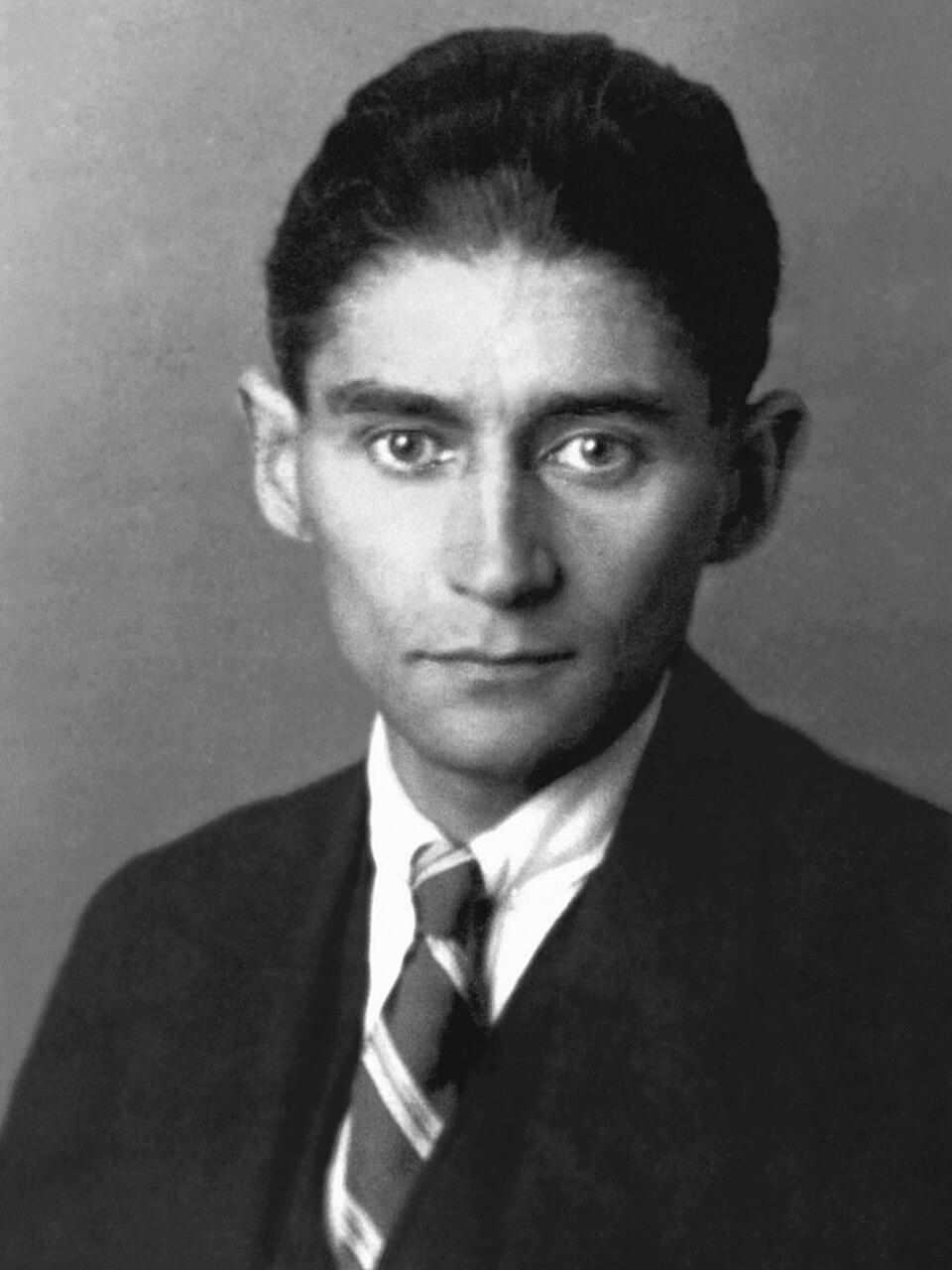
The Prague writer whose nightmare fictions of bureaucracy, guilt, and transformation gave the twentieth century one of its essential adjectives.
Franz Kafka wrote in German in Prague, worked in insurance, published almost nothing in his lifetime, and asked his friend Max Brod to burn his manuscripts when he died. Brod did not. What survived is among the most influential writing of the modern era — fiction that fuses the logic of dreams with the language of bureaucratic procedure to produce a register of experience that has shaped literature, philosophy, and the everyday vocabulary of modernity.
Prague, German, and the Kafka Family
Kafka was born in 1883 into a German-speaking Jewish family in Prague, then part of the Austro-Hungarian Empire. His father Hermann was a domineering self-made merchant; the relationship between them, characterised by inadequacy, guilt, and failed communication, was the emotional engine of much of Kafka's work. The famous Letter to His Father (written 1919, never sent, published posthumously) is an extraordinary document of this impasse — at once confession, accusation, and formal analysis of a power dynamic that shaped a life.
He studied law at the German Karl-Ferdinand University, completing his doctorate in 1906, and worked for most of his adult life at the Workers' Accident Insurance Institute in Prague. His insurance work, handling occupational safety claims and workplace injury, gave him an intimate knowledge of bureaucratic procedure that saturated his fiction.
The Fiction of Impossible Reckoning
Kafka wrote mostly at night and in fragments. His first major work to find a publisher was The Stoker (1913), later incorporated as the opening chapter of the unfinished novel Amerika. But the work that established his singular voice was The Metamorphosis (1915), in which travelling salesman Gregor Samsa wakes to find himself transformed into a monstrous insect. The story is narrated with administrative calm, as if metamorphosis were a workplace problem requiring practical management.
The same deadpan logic governs his two major novels, left unfinished at his death. In The Trial (1925), bank clerk Josef K. is arrested and prosecuted without ever learning his charge. In The Castle (1926), a land surveyor called K. attempts to gain access to the authorities who have summoned him to a village, and fails, in ever-more-elaborate ways, to reach them. Both novels have the structure of bureaucratic nightmares: the protagonist seeking contact with a system that is simultaneously omnipresent and inaccessible.1
| Work | Year published | Form |
|---|---|---|
| The Metamorphosis | 1915 | Novella |
| In the Penal Colony | 1919 | Short story |
| The Trial | 1925 | Novel (posthumous) |
| The Castle | 1926 | Novel (posthumous, unfinished) |
| The Complete Stories | 1971 | Collection |
The Afterlife of Kafkaesque
Kafka died of tuberculosis in 1924 at a sanatorium near Vienna, aged forty. He had published a handful of short prose pieces and one novella in his lifetime. Max Brod, his closest friend and literary executor, defied his instructions and arranged the posthumous publication of the novels and collected stories.
The adjective "Kafkaesque" — denoting bureaucratic labyrinthine procedures, arbitrary authority, and the absurdity of institutional power — entered general circulation and has rarely been applied inaccurately. His influence on the literature of the twentieth century is pervasive: from Camus to Beckett, from Borges to Coetzee, writers have engaged with the territory he mapped.
A book must be the axe for the frozen sea inside us.
Footnotes
- Kafka himself never completed either novel, and both exist in states of textual incompleteness. The chapter order of The Trial was established by Max Brod, and The Castle ends in mid-sentence. Both facts seem curiously appropriate to their subject matter. ↩