Friedrich Nietzsche
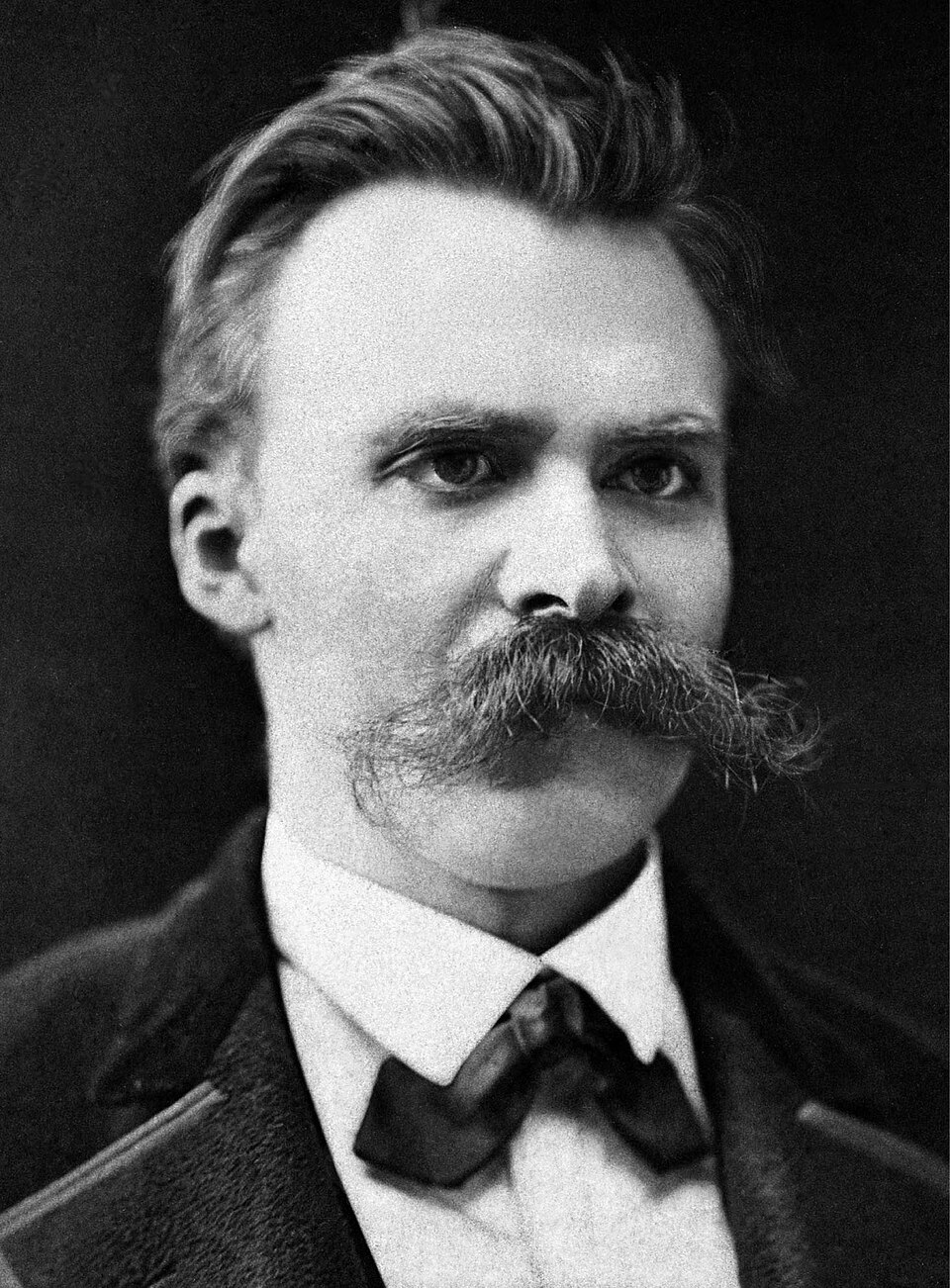
Appointed Basel's youngest-ever philosophy professor at twenty-four, Nietzsche resigned a decade later to write in solitude — producing a body of work that dismantled inherited morality and reoriented modern thought.
Friedrich Nietzsche published the bulk of his philosophy between 1878 and 1888 — ten years of sustained, nomadic writing produced in poor health and near-poverty, between rented rooms in Switzerland, Italy, and southern France. By the time the work reached a broad audience, he was already beyond knowing it had. He had collapsed in Turin in January 1889 and never recovered his mind.
Formation
Nietzsche was born on 15 October 1844 in Röcken, Saxony, a village in the Kingdom of Prussia. His father, a Lutheran pastor, died when Nietzsche was four. He was raised in Naumburg by his mother and sister, and proved a gifted classical scholar — so gifted that the University of Basel offered him a full professorship in classical philology in 1869, when he was twenty-four and had not yet completed his doctorate. Leipzig awarded the degree on the strength of his published work. He was the youngest person ever to hold the Basel chair.
During his years at Bonn and Leipzig he had encountered the philosophy of Schopenhauer and formed a close friendship with Richard Wagner. Both relationships proved decisive, and both eventually broke.
Break and departure
His first book, The Birth of Tragedy (1872), argued that Greek culture rested on a tension between Apollonian reason and Dionysian instinct — a framework that also served as a manifesto for Wagnerian opera. Classical scholars largely dismissed it; the friendship with Wagner it celebrated did not survive the decade. Human, All Too Human (1878) marks the break clearly: its cool, aphoristic style abandoned German Romanticism for French scepticism and targeted the metaphysical consolations Nietzsche now regarded as evasions.
Chronic illness — severe migraines, failing eyesight, recurring vomiting episodes — forced his resignation from Basel in 1879. He spent the following decade moving between Switzerland, Italy, and southern France, living frugally on a small pension, dictating when he could not write.
Core philosophy
The decade of independent writing, 1879–1888, produced the concepts for which Nietzsche is known. The Gay Science (1882) introduced the declaration that "God is dead" — not as celebration but as diagnosis of a cultural crisis requiring new values. Thus Spoke Zarathustra (1883–85) developed the Übermensch as a figure who creates values rather than inheriting them, and articulated the doctrine of eternal recurrence: the thought experiment that one should live as if every moment would recur infinitely. Beyond Good and Evil (1886) and On the Genealogy of Morality (1887) anatomised what Nietzsche called slave morality — the historical inversion by which the weak reframe their weakness as virtue and power as sin.
Throughout, he attacked nationalism, antisemitism, and German chauvinism with explicit contempt. His sister Elisabeth, who later controlled his literary estate, suppressed this and selectively edited unpublished manuscripts to produce a version of Nietzsche compatible with the ideology he had ridiculed.
Collapse and aftermath
In January 1889, in Turin, Nietzsche suffered a complete neurological breakdown. He spent his remaining eleven years first in his mother's care, then his sister's, in total mental incapacity. He died on 25 August 1900. The distorted image Elisabeth cultivated was corrected by scholars across the twentieth century; the authentic texts established a different legacy — as the most searching philosophical diagnostician of nihilism, and a persistent challenge to any system that grounds morality in metaphysics or habit.
"Man would rather will nothingness than not will."