Fritz Lang
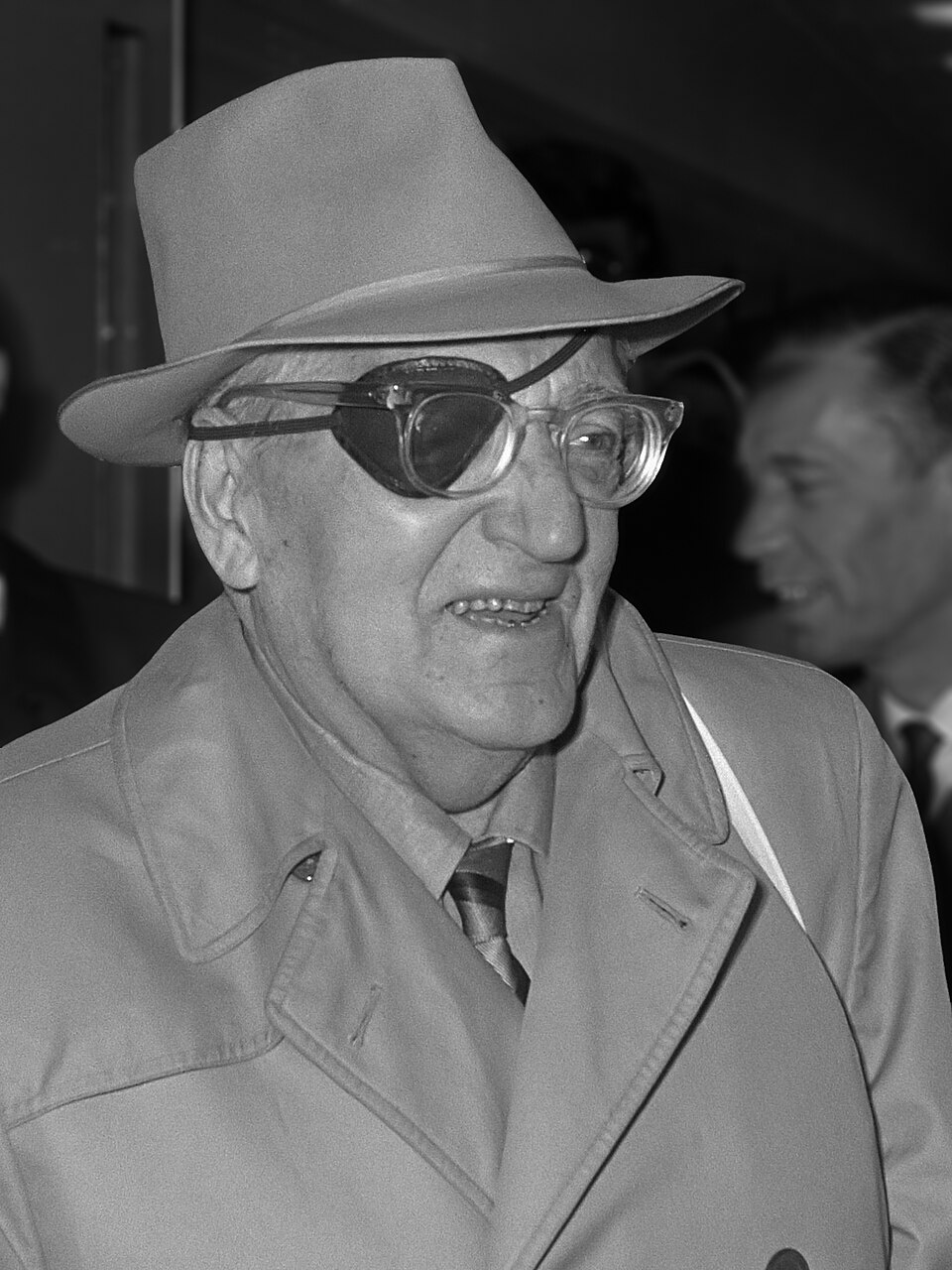
The Austrian director who shaped Expressionist cinema in Weimar Germany and carried its dark geometry into Hollywood, becoming one of the most influential filmmakers of the twentieth century.
Fritz Lang directed across two continents and three decades, turning the anxieties of Weimar Germany — tyranny, surveillance, mob violence — into a visual language so precise it became the grammar of film noir. He arrived in America a refugee and left it a canonical figure.
Formation and early career
Lang was born in Vienna in 1890. He studied architecture and later fine art in Vienna and Munich, developing a spatial rigour that would mark his mise-en-scène throughout his career. He served in the First World War and was wounded; by its end he had begun writing scripts in Berlin. His early silent films moved quickly from adventure serials to more ambitious projects. Dr. Mabuse, der Spieler (1922) introduced the criminal mastermind as a figure of total social manipulation — a projection of post-war German anxiety about power. Die Nibelungen (1924), in two parts, demonstrated an extraordinary command of monumental composition and geometric crowd choreography.
Metropolis and M
Metropolis (1927) remains the landmark of the silent period: a city of the future cleaved vertically between workers underground and elites above, with a female robot at its centre. Its imagery — the Tower of Babel, the machine rooms, the illuminated clock face — passed directly into the visual culture of science fiction. The film was the most expensive German production to that point.
M (1931), Lang's first sound film, is arguably the tighter achievement. Peter Lorre plays Hans Beckert, a child murderer hunted simultaneously by police and the Berlin underworld. Lang used sound not merely as dialogue but as counterpoint and commentary; Beckert's habit of whistling Grieg became one of cinema's most unsettling motifs. The film's final sequence — a criminal tribunal in a basement — condenses in about fifteen minutes every question the century would ask about justice, law, and the crowd.
Exile and the American period
After the Reichstag fire of 1933 Lang left Germany for France, then emigrated to the United States. He worked steadily within the Hollywood studio system without ever fully acceding to it. Fury (1936) addressed mob violence and wrongful imprisonment. You Only Live Once (1937) established the wronged-fugitive couple as an American archetype. The 1940s brought tighter, harder films: The Woman in the Window (1944) and Scarlet Street (1945), both with Edward G. Robinson and Joan Bennett, were pure noir — ordinary men destroyed by desire and circumstance. The Big Heat (1953), with Glenn Ford, is among the bleakest films made inside the studio era.
Return and legacy
Lang returned to Germany in the late 1950s to direct Der Tiger von Eschnapur and Das indische Grabmal (both 1959), adventure films that revisited material from his early career. His final film, Die 1000 Augen des Dr. Mabuse (1960), closed the circle with his first criminal mastermind. He spent his last years in Beverly Hills. The black monocle he wore — covering a damaged eye — became as inseparable from his public image as the camera behind which he stood. The British Film Institute named him the Master of Darkness; the designation holds.
Film is not a slice of life. It is a slice of cake.