Galileo Galilei
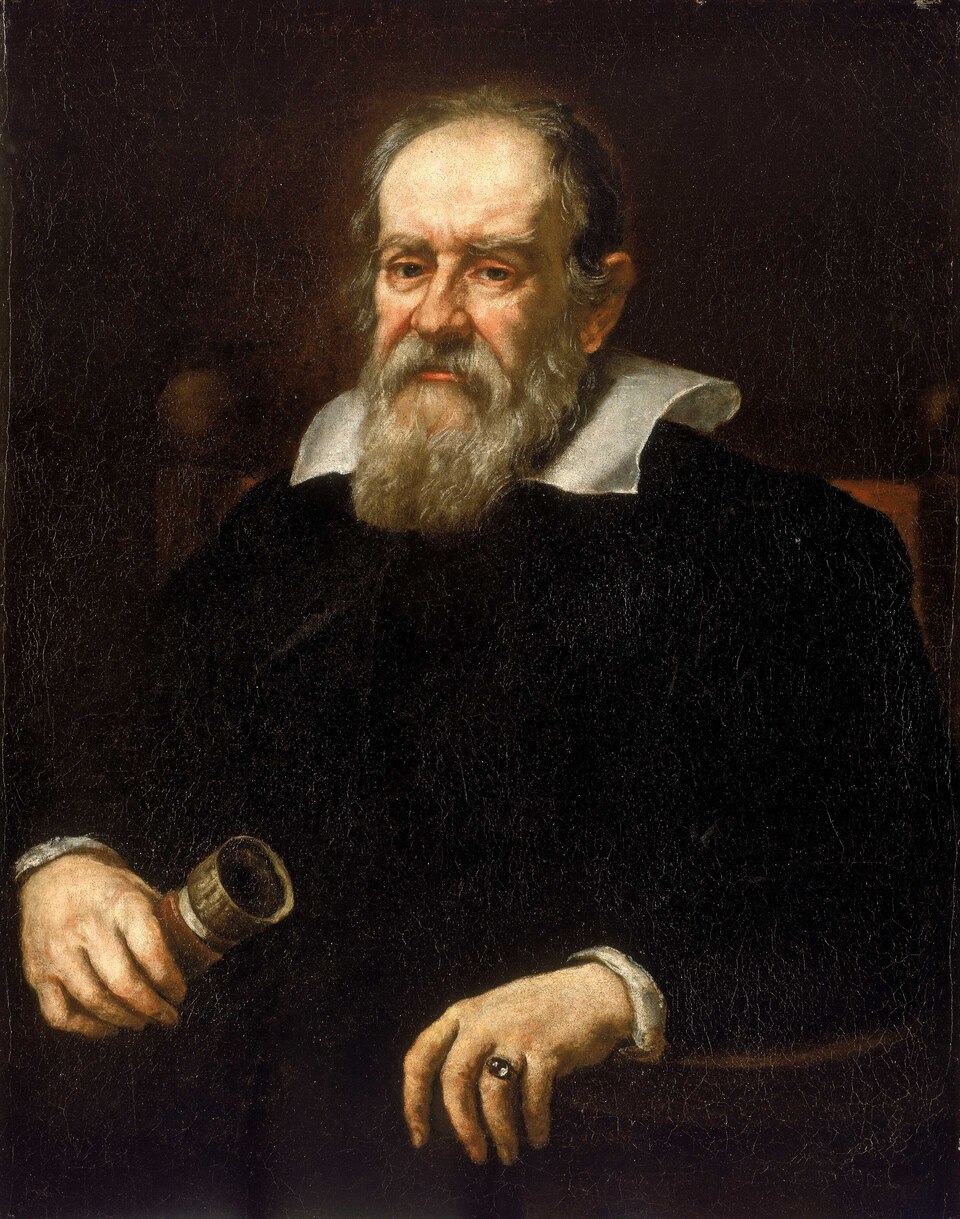
The Pisan who pointed a telescope at the sky and found that the universe did not revolve around us — and spent the last years of his life under house arrest for saying so.
Galileo Galilei transformed natural philosophy into what we now call physics and astronomy. He improved the telescope, turned it skyward, and published findings that dismantled the Aristotelian cosmos. The Inquisition silenced him. His mechanics survived, and laid the ground on which Newton would build.
From Medicine to Mathematics
Galileo was born in Pisa on 15 February 1564, the eldest son of Vincenzo Galilei — a lutenist and music theorist whose empirical approach to acoustics left a visible mark on his son's habits of mind. The family moved to Florence; Galileo enrolled in medicine at the University of Pisa but defected early to mathematics, finding in Euclid and Archimedes the precision that anatomy could not offer. He became professor of mathematics at Pisa in 1589 and moved to the University of Padua in 1592, where he remained for eighteen years and later described as the happiest of his life.
At Padua he investigated motion experimentally. His inclined-plane experiments demolished the Aristotelian claim that heavier bodies fall faster, and his analysis of projectile trajectories — combining uniform horizontal motion with uniformly accelerating vertical fall — laid the foundation for classical kinematics.
The Telescope and the Sky
In 1609 Galileo learned of a Dutch magnifying instrument and independently improved it to a power some thirty times greater than the naked eye. He was not the first to build a spyglass, but he was the first to systematically aim one at the heavens and publish the results. Sidereus Nuncius (The Starry Messenger, 1610) reported findings that shook European learned culture: the Moon was not a perfect sphere but scarred with craters; the Milky Way resolved into individual stars; and Jupiter had four moons of its own — bodies orbiting something other than the Earth.1
He subsequently observed the phases of Venus, which could only be explained if Venus orbited the Sun, and tracked sunspots, confirming that the Sun itself was not incorruptible. The four Jovian moons — Io, Europa, Ganymede, Callisto — bear the collective name Galilean moons today.
The Medici grand duke Cosimo II, to whom the Sidereus was dedicated, appointed Galileo chief mathematician and philosopher to the Florentine court. Galileo left Padua in 1610 and moved to Florence, trading academic independence for prestige and patronage.
Dialogue and Trial
Galileo had long favoured the Copernican heliocentric model. In 1632 he published the Dialogue Concerning the Two Chief World Systems, a conversation between advocates of the Ptolemaic and Copernican systems. Despite a nominal pretence of impartiality, the Copernican case is won convincingly; the defender of Ptolemy is named Simplicio. Pope Urban VIII, who had granted permission for the book, believed the character was a caricature of himself. The Inquisition summoned Galileo to Rome.
At his trial in 1633, aged 69 and in poor health, Galileo recanted his support for heliocentrism. He was condemned to indefinite house arrest at his villa in Arcetri, outside Florence. He never recovered his freedom.
Final Years and Legacy
Blind by 1638, Galileo dictated his last major work — Discorsi e dimostrazioni matematiche (Two New Sciences) — which was smuggled to Leiden for publication in the Dutch Republic. The Discorsi codified his work on mechanics and the strength of materials; it is the book that directly influenced Newton.
Galileo died at Arcetri on 8 January 1642. Isaac Newton was born the same year. The Church formally acknowledged the error of the 1633 condemnation in 1992.
I do not feel obliged to believe that the same God who has endowed us with senses, reason, and intellect has intended us to forgo their use.
Footnotes
- The discovery of Jupiter's moons was crucial as a rebuttal to the objection that if the Earth moved, the Moon would be left behind: here were four moons keeping pace with a moving planet. ↩