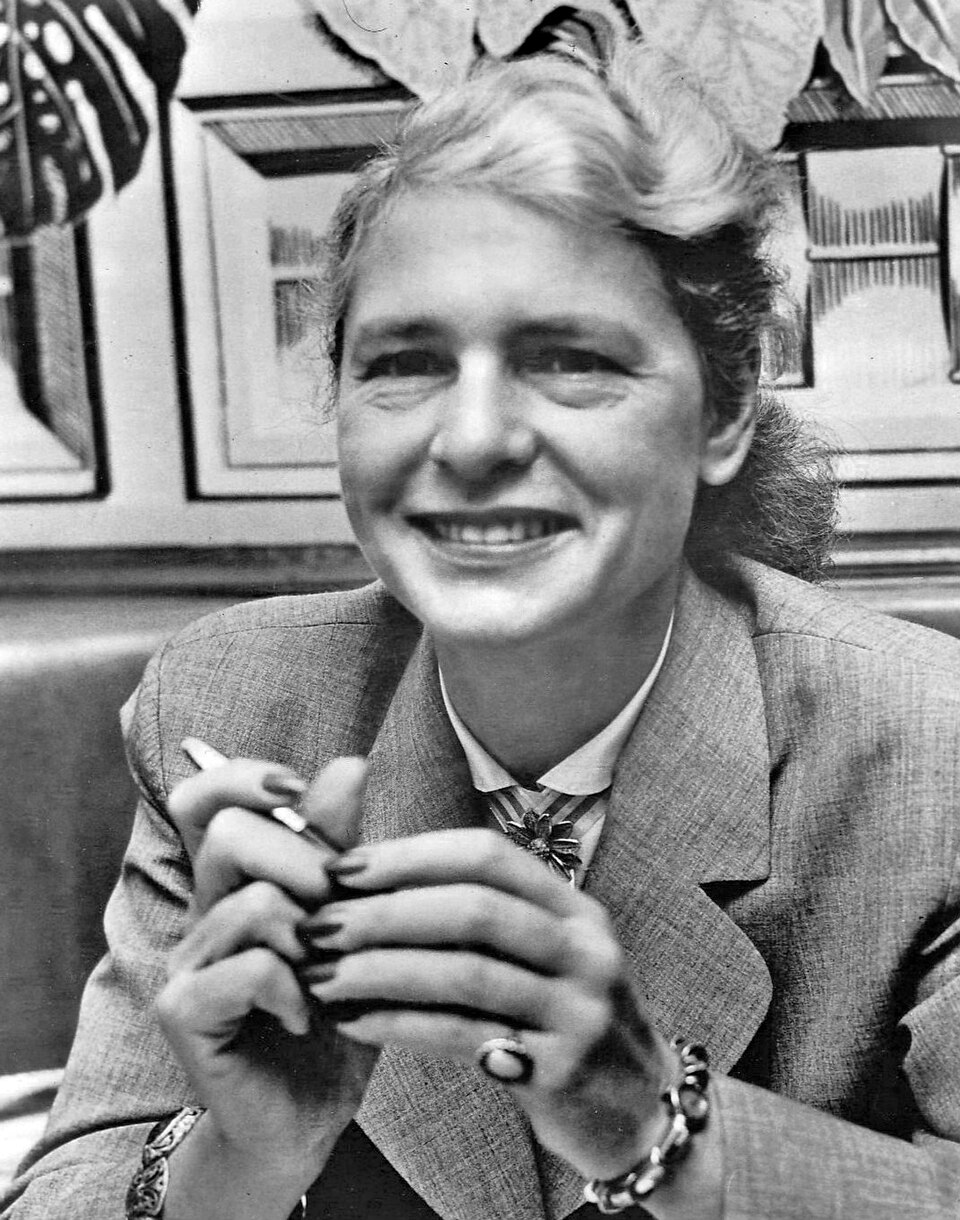
Garry Winogrand
The photographer who walked every American street as if the world might end before he reached the corner.
Garry Winogrand photographed America at street level with a speed and volume that no contemporary matched. He did not compose quietly; he worked in motion, tilting his frame, pressing close, trusting the 28mm lens to pull more world into the picture than the eye expected. John Szarkowski, photography's most influential curator of the postwar era, called him the central photographer of his generation.
Formation
Winogrand was born in the Bronx in 1928. He studied briefly at Columbia University before enrolling at the Art Students League, where he trained under Alexey Brodovitch — the legendary art director who had already shaped a generation of editorial photographers. Commercial work followed: Winogrand shot for magazines throughout the 1950s, but the medium he was really studying was the street.
The decisive influence was Robert Frank's The Americans (1958), which demonstrated that a photographer could move through public space with a subjective, tilted, unresolved eye and produce something truer than any composed document. Winogrand absorbed the lesson and pushed further: more tilt, more speed, more bodies, more light.
The New Documents generation
In 1967 MoMA curator John Szarkowski organised New Documents, an exhibition that introduced Winogrand alongside Diane Arbus and Lee Friedlander. Szarkowski's wall text named a shift: a new generation of photographers had turned the documentary tradition inward, using its tools not to reform society but to investigate their own experience of it. The show made Winogrand's reputation.
His method was physical as much as optical. He shot with a 28mm wide-angle lens on a Leica, moving through crowds, airports, zoos, and protest marches without pausing to frame. The slight wide-angle distortion — figures leaning, horizons tilting — became his signature grammar. Three Guggenheim Fellowships (1964, 1969, 1979) funded extended road trips across the United States, and the work accumulated faster than he could process it.
Winogrand was the central photographer of his generation.
Books and reception
Three major books defined Winogrand's public output. The Animals (1969) applied his restless eye to the Bronx Zoo, catching the triangular tension between tourists, cages, and animals with deadpan wit. Women Are Beautiful (1975) was more contentious — a collection of women photographed on New York streets that drew accusations of objectification alongside praise for its formal energy. Public Relations (1977) documented the theatre of American media events: press conferences, demonstrations, celebrity appearances — the self-consciousness of a nation performing for cameras.
Each book drew on work shot across years. The editing was agonising to Winogrand, who found the act of selection far harder than the act of shooting.
The unprocessed archive
Winogrand died of gallbladder cancer in Tijuana, Mexico on 29 March 1984, aged 56. He left behind approximately 2,500 rolls of unprocessed film and over 300,000 unedited frames — an archive so vast that Szarkowski spent four years working through it to produce the posthumous retrospective Winogrand: Figments from the Real World (1988) at MoMA. A second major retrospective, organised by SFMOMA, toured in 2013.
The unprocessed rolls are not evidence of failure but of the logic of his practice: Winogrand photographed compulsively because he believed something worth keeping was always about to happen. He often put months between the shooting and the contact-sheet edit so that he could no longer remember what he had intended and could see only what was there.