George Eliot
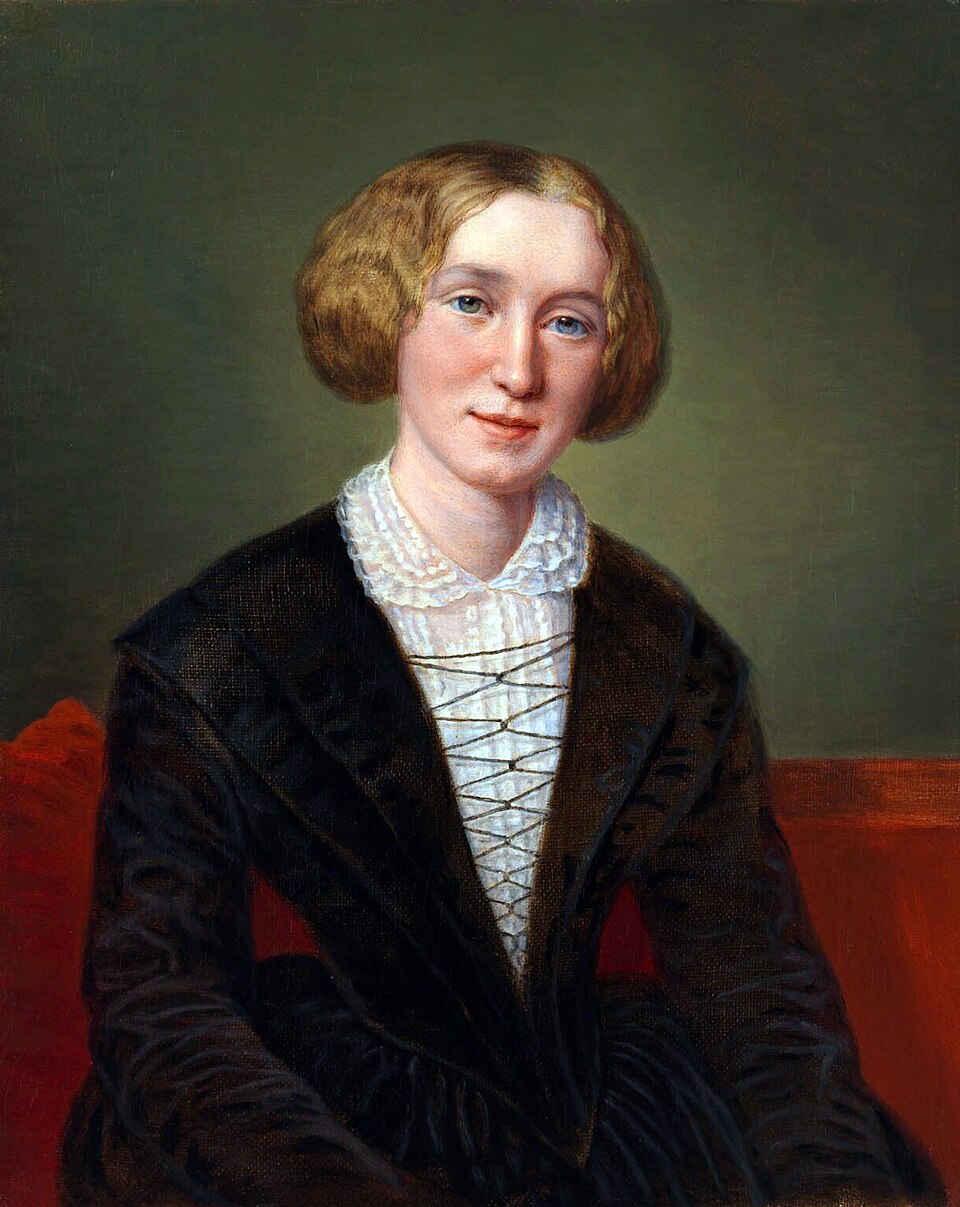
The Victorian novelist who wrote as a man, lived outside convention, and produced Middlemarch — which Virginia Woolf called one of the few English novels written for grown-up people.
Mary Ann Evans adopted the pen name George Eliot because she needed reviewers to read the work before they decided what a woman could and could not write. The strategy succeeded. Middlemarch is now taught as the summit of the English novel.
From Evans to Eliot
Born in Warwickshire in 1819, Evans was a provincial autodidact who taught herself Latin, Greek, German, and Italian and moved to London in 1851 to work as assistant editor of The Westminster Review — at the time the most intellectually serious periodical in England.1 Her translations of Strauss's Das Leben Jesu (1846) and Feuerbach's The Essence of Christianity (1854) were foundational acts of English intellectual life; neither carried her name.
The relationship with philosopher and critic George Henry Lewes began in 1854. He was separated from his wife but legally unable to divorce under English law. Evans and Lewes lived together as a married couple for twenty-four years, publicly and unapologetically, in arrangements that cost Evans the company of her brother Isaac until Lewes died. She referred to him as her husband. Society largely accepted it.
The novels
Eliot's fiction begins in pastoral realism — Adam Bede (1859), The Mill on the Floss (1860), Silas Marner (1861) — and expands into panoramic social analysis. The tool is psychological interiority: her characters' moral reasoning is as much subject as their external action. She is not interested in types; she is interested in the specific, contradicted individual.
Middlemarch (1871–1872), published in eight parts, is the novel at full extension. Its subject is a provincial English town in the years 1829–1832, observed across four interlocking plots. Its method is the slow accumulation of motive and error, with an irony that never tips into contempt.
The growing good of the world is partly dependent on unhistoric acts; and that things are not so ill with you and me as they might have been, is half owing to the number who lived faithfully a hidden life, and rest in unvisited tombs.
Middlemarch and reputation
Virginia Woolf, in her 1919 essay on Eliot, called Middlemarch one of the few English novels written for grown-up people. The line survived as the most accurate single-sentence account of what distinguishes Eliot from her contemporaries: she does not resolve the difficulties she raises; she renders them with precision and moves on.
Daniel Deronda (1876) was her last novel. Lewes died in 1878. In 1880 she married the banker John Walter Cross, twenty years her junior; she died seven months later, in December 1880.
Footnotes
- At The Westminster Review, Evans effectively ran the journal under the nominal editorship of John Chapman. Her work selecting, commissioning, and editing copy went uncredited. ↩