Gerrit Rietveld
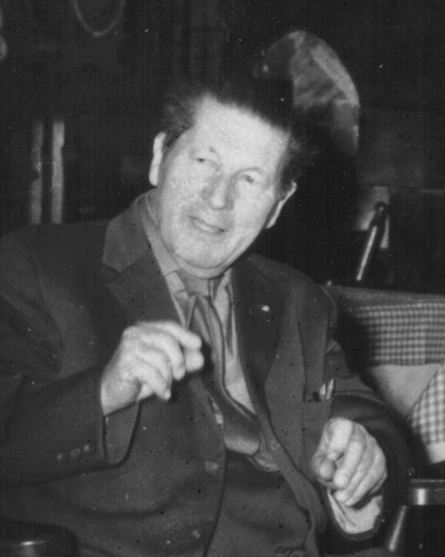
The Utrecht cabinetmaker who turned De Stijl into a liveable room — and built a house that became a UNESCO monument.
Gerrit Rietveld built the Schröder House with the grammar of a painting by Mondrian — primary colours, perpendicular planes, no hierarchy — then furnished it with chairs that look as though they were assembled by a geometer. That he arrived at this position from a cabinetmaker's bench, not an architecture school, made his thinking stranger and more physical than theory alone could have produced.
Formation
Rietveld was born in Utrecht in 1888 and spent his youth in his father's furniture workshop. He trained formally as a cabinetmaker and jewellery designer before turning to furniture design in the 1910s. The craft background never left him: he understood joinery at the level of the joint, and his furniture designs read as spatial arguments rather than comfort propositions.
Contact with the De Stijl group — the Dutch art and design movement whose founding figures included Theo van Doesburg and Piet Mondrian — brought his instinctive formal reductionism into contact with an explicit theory. De Stijl held that all art should reduce to primary colours (red, blue, yellow) and neutral tones (black, white, grey) arranged on perpendicular axes, eliminating individual expression in favour of universal harmony.
The Red and Blue Chair
The Red and Blue Chair was designed around 1917 and refined through the early 1920s. Its construction is transparent: thirteen timber battens intersect at right angles, capped with a flat red headrest and a reclined blue seat. No joint is concealed; every element is coloured to differentiate it from the next. The chair is as much a diagram as an object — a three-dimensional proof that De Stijl principles could survive the transition from canvas to furniture.
The purpose is not to make a comfortable chair but to show that the spirit of De Stijl can inhabit a domestic object.
It entered production and was eventually accepted into the MoMA collection, where it remains one of the defining objects of early modernist design.
The Schröder House
The Rietveld Schröder House in Utrecht (1924), designed for Truus Schröder-Schräder, is Rietveld's architectural masterpiece. The facade is a composition of overlapping planes, projecting balconies, and coloured elements that dismantles traditional wall-and-window logic in favour of De Stijl abstraction. From the street it reads as a three-dimensional Mondrian.
The interior was more radical still: the upper floor could be configured as a single open space or subdivided by sliding and folding panels, making the domestic plan genuinely variable. Schröder was a collaborator rather than simply a client; the functional programme emerged from her requirements as a widow with three children who wanted openness, light, and spatial flexibility.
The house was designated a UNESCO World Heritage Site in 2000, recognised as an outstanding example of the De Stijl movement.
Later work
Rietveld continued to practise architecture into his later decades, taking on housing projects, museums, and civic commissions. His work after De Stijl's dissolution in the 1930s was less doctrinaire but retained the spatial clarity and structural honesty of his early period. The Dutch Pavilion at the Venice Biennale (1953–1954) demonstrated that his ability to compose space from simple elements had not diminished.
He died in Utrecht on 25 June 1964 — one day after his 76th birthday.