Grace Hopper
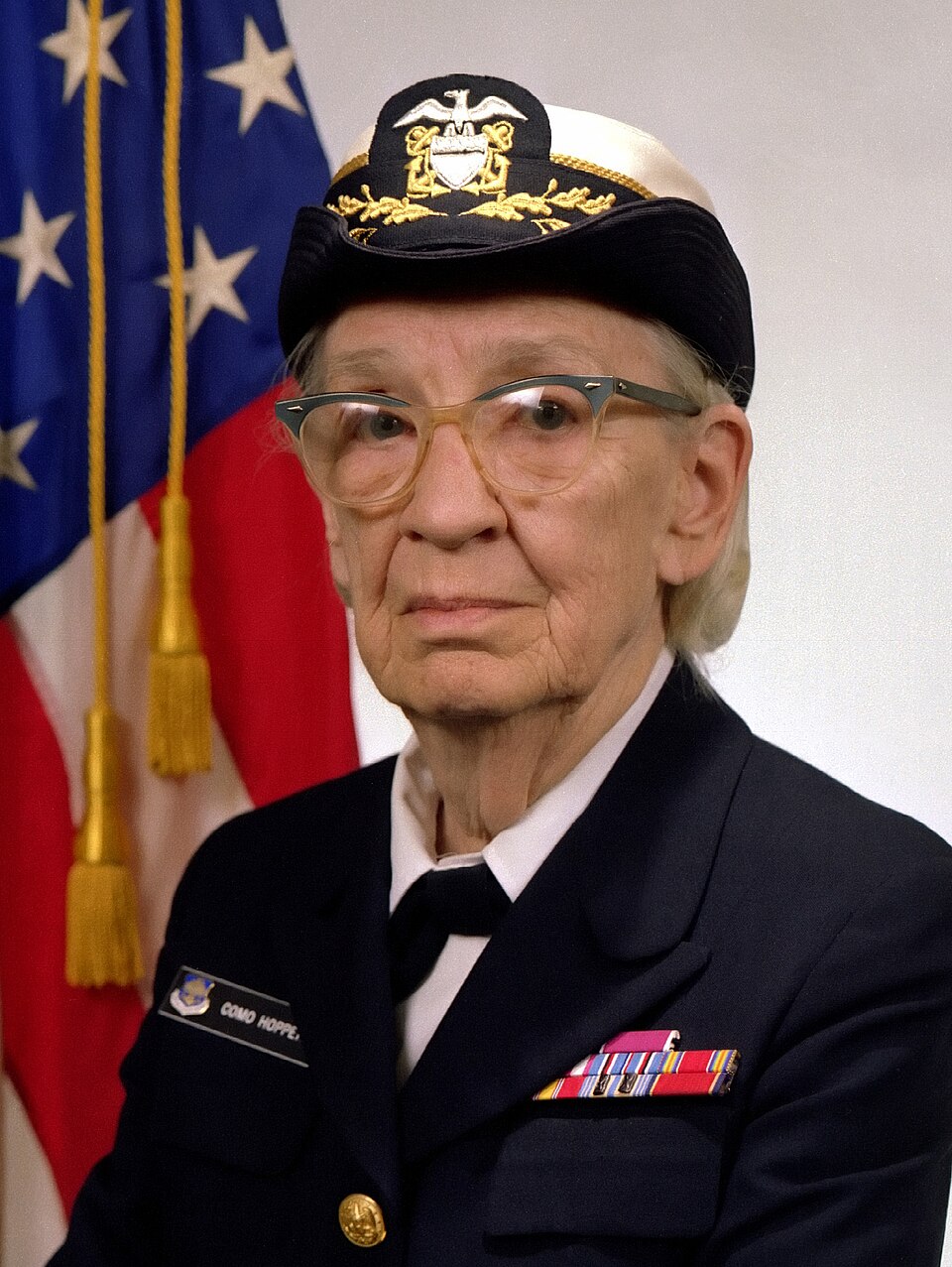
The Navy rear admiral who taught computers to speak plain language, pioneering the compiler and laying the conceptual ground for every high-level programming language that followed.
Grace Hopper joined the U.S. Navy during the Second World War and ended her career as one of its most decorated officers — but her lasting contribution was intellectual: the conviction that computers could be programmed in words rather than numbers, an idea her contemporaries thought impossible and that she proved workable by building it herself.
Education and wartime service
Grace Brewster Murray was born in New York City on 9 December 1906. She studied mathematics and physics at Vassar College, graduating in 1928, then completed a doctorate in mathematics at Yale in 1934 — one of very few women to do so in that era. She joined the faculty at Vassar but left in 1943 to enlist in the U.S. Navy WAVES (Women Accepted for Volunteer Emergency Service).
Assigned to the Bureau of Ordnance Computation Project at Harvard, she became one of the first programmers of the Harvard Mark I — the electromechanical computer designed by Howard Aiken. The Mark I had to be instructed in binary-coded sequences; Hopper wrote the operating manual for it, one of the first comprehensive documents of its kind.
The compiler and machine-independent programming
After the war Hopper remained with the Navy Reserve and joined the Eckert–Mauchly Computer Corporation, where she worked on the UNIVAC I. Her pivotal insight was that the tedious translation of mathematical notation into machine code was itself a computational task that a program could perform automatically. In 1952 she completed the A-0 system, widely considered the first compiler: a program that translated symbolic mathematical code into machine instructions.
Her supervisors were sceptical — the prevailing assumption was that computers could only do arithmetic, not interpret symbolic language. Hopper pressed the argument anyway, demonstrating that compilers reduced programming errors and made the work accessible to non-specialists.1
FLOW-MATIC and COBOL
Hopper developed FLOW-MATIC, the first programming language to use English-like commands, between 1955 and 1959. It was the direct predecessor of COBOL (Common Business-Oriented Language), which she helped design from 1959 onward through a consortium of computer manufacturers and the U.S. Department of Defence. COBOL became the dominant language for business data processing and remains in active use in banking and government systems today — one of the most widely deployed programming languages ever written.
Naval career and later life
Hopper retired from the Navy Reserve in 1966 but was recalled to active duty the following year and served until 1986, retiring at 79 as the oldest active-duty commissioned officer in the U.S. armed forces. She reached the rank of Rear Admiral. She continued lecturing and consulting into her eighties, popularising the concept of a "nanosecond" by distributing foot-long pieces of wire — the distance light travels in one billionth of a second — to illustrate why compact hardware matters.
She died on 1 January 1992 and was buried with full military honours at Arlington National Cemetery.
A ship in port is safe, but that's not what ships are for.
Footnotes
- Hopper reportedly said her supervisors told her the computer "could not do that" — meaning translate symbolic input. Her response was to build a working demonstration. The A-0 system ran on the UNIVAC I in 1952. ↩