Harry Callahan
A self-taught American photographer who turned his wife, his city, and the bare winter tree into an inexhaustible formal vocabulary.
Harry Callahan was largely self-taught and spent his career at two schools — the Institute of Design in Chicago and the Rhode Island School of Design — shaping generations of photographers while producing a body of work that moved between intimate minimalism and restless formal experiment.
Formation
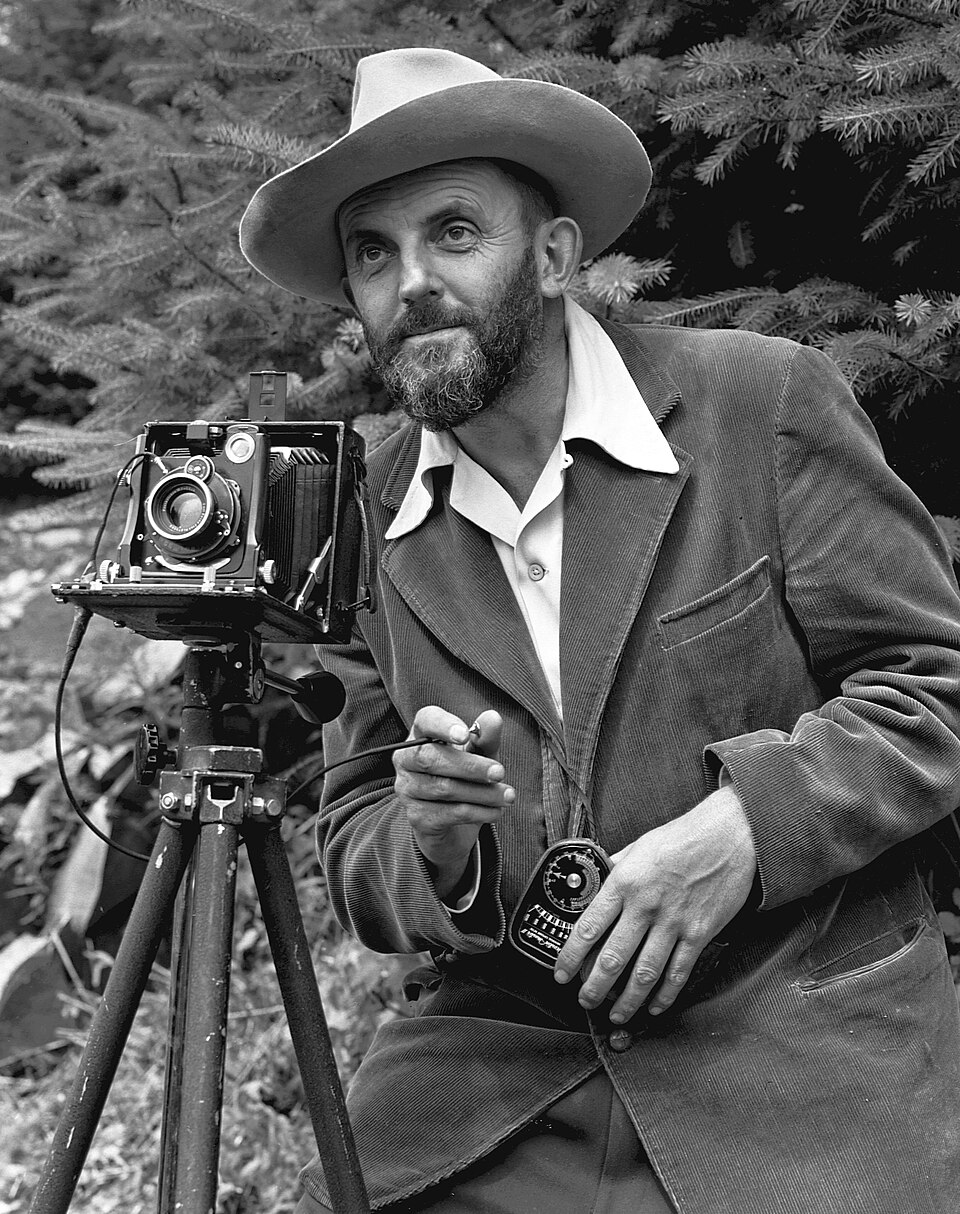
Callahan was born in Detroit in 1912 and worked for Chrysler before taking up photography in his mid-twenties. He was largely self-taught until 1941, when a lecture and workshop by Ansel Adams in Detroit opened a new frame of reference — not so much Adams's own aesthetic but the seriousness of approach, the idea that photography was a medium demanding full intellectual commitment.
He began photographing obsessively: his wife Eleanor, the streets of Detroit, weeds and grasses in snow. The subjects were ordinary; the treatment was not. He worked with multiple exposures, extreme contrast, and blank white skies, finding abstraction inside the everyday. There were no exotic locations and no dramatic events — only the domestic world pushed until it yielded something essential.
The Institute of Design
In 1946, Laszlo Moholy-Nagy invited Callahan to join the faculty of the Institute of Design in Chicago — the New Bauhaus, heir to the original Bauhaus's belief in design thinking across all media. Callahan taught there until 1961, and the environment suited him: the institute treated photography as an art form on equal footing with painting and sculpture, which was not yet the consensus.
His own work through the Chicago years ranged across multiple exposures (grass blades stacked until they become a texture, street figures layered into crowds), photographs of Eleanor alone in the city and at home, and the pure white negative spaces of snow. Eleanor appears in hundreds of his photographs over forty years — not as a portrait subject but as a formal constant, a recurring shape that the work returns to without ever exhausting.
I only photograph what I love.
RISD and the later work
In 1961 Callahan moved to Providence to chair the photography department at the Rhode Island School of Design, where he taught until 1977. The move shifted his environment without changing his method. He photographed in Cape Cod, in Europe, in Providence's streets — the same plainness of subject, the same formal rigour. Colour began to appear in his later work, adding warmth without sentimentality.
He represented the United States at the Venice Biennale in 1978, a late institutional recognition of a career that had been influential at ground level — through teaching — long before the museum world caught up.