Hayao Miyazaki
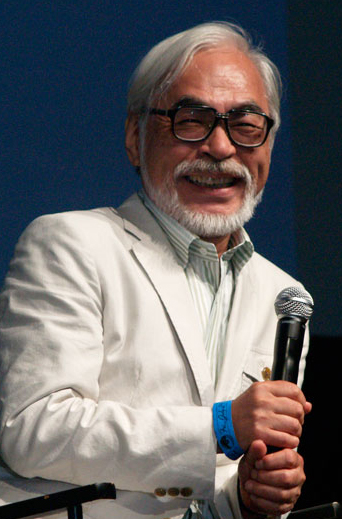
The Japanese animator who built Studio Ghibli into the pre-eminent force in hand-drawn animation, creating films of ecological longing and moral seriousness that have become foundational works of world cinema.
Hayao Miyazaki is the animator, director, and co-founder of Studio Ghibli whose work redefined what animated film could carry: not escapist fantasy but a rigorous encounter with the natural world, the cost of war, the contradictions of modernity, and the particular dignity of children navigating a world shaped by adults. His films have been seen by hundreds of millions and remain among the most discussed works in global cinema.
Formation and Early Career
Miyazaki was born in Tokyo in 1941, the second of four sons in a family with connections to the aircraft manufacturing industry — an early exposure to flight that would recur throughout his work as one of its defining preoccupations. He studied political science and economics at Gakushuin University while drawing, and joined Toei Animation in 1963 as an in-between animator.
His years at Toei brought him into contact with Isao Takahata, who became his lifelong collaborator and co-founder of Ghibli. Together they worked on television series and theatrical features through the 1970s, developing the meticulous attention to background painting and movement that would characterise their studio's output. Miyazaki's breakthrough came with the television series Future Boy Conan (1978) and the theatrical feature The Castle of Cagliostro (1979).
Studio Ghibli and the Defining Work
Studio Ghibli was founded in 1985 by Miyazaki, Takahata, and producer Toshio Suzuki, with Miyazaki's Nausicaä of the Valley of the Wind (1984) having effectively established the studio's aesthetic before it officially existed. The studio operated on the principle that every frame would be hand-drawn with absolute commitment to detail.
My Neighbor Totoro (1988) and Grave of the Fireflies (1988) — released as a double feature — announced Ghibli as a force capable of extraordinary range. Princess Mononoke (1997) became Japan's highest-grossing film at the time of its release. Spirited Away (2001) surpassed it, winning the Academy Award for Best Animated Feature and the Golden Bear at Berlin, making Miyazaki the only anime director to win both awards.1
Method and Philosophy
Miyazaki is famously resistant to digital production methods, insisting on hand-drawn animation even as the industry moved wholesale toward computer generation. Each Ghibli film involved thousands of individually painted cels and months of background illustration work. He has published extensively on animation theory and has expressed consistent skepticism about the cultural implications of digital spectacle.
His films are structured around a coherent set of moral concerns: ecological destruction, the loss of enchanted relationship with the natural world, the violence of industrialisation, and the capacity of the young — especially girls — to act with clarity and courage in situations of genuine danger. The absence of clear villains is a recurring structural choice; damage comes from systems and misunderstandings rather than evil individuals.
| Recurrent theme | Example |
|---|---|
| Flight and freedom | Nausicaä, Kiki, Howl |
| Nature vs. industry | Princess Mononoke, Nausicaä |
| Female protagonists | Nausicaä, Kiki, Chihiro, Sophie |
| Moral ambiguity | Princess Mononoke, Howl's Moving Castle |
Retirements and Continuations
Miyazaki announced his retirement multiple times — most definitively in 2013 — before returning to complete The Boy and the Heron (2023), which won the Academy Award for Best Animated Feature, giving him a second competitive Oscar four decades into his career.
The concept of portraying evil and then destroying it — I know this is considered mainstream, but I think it is rotten. This idea that whenever something evil happens someone particular can be blamed and punished for it, in life and in politics, is hopeless.
Footnotes
- Spirited Away was the first non-English-language film to win Best Animated Feature at the Academy Awards when the category was introduced in 2002. ↩