Henri Poincaré
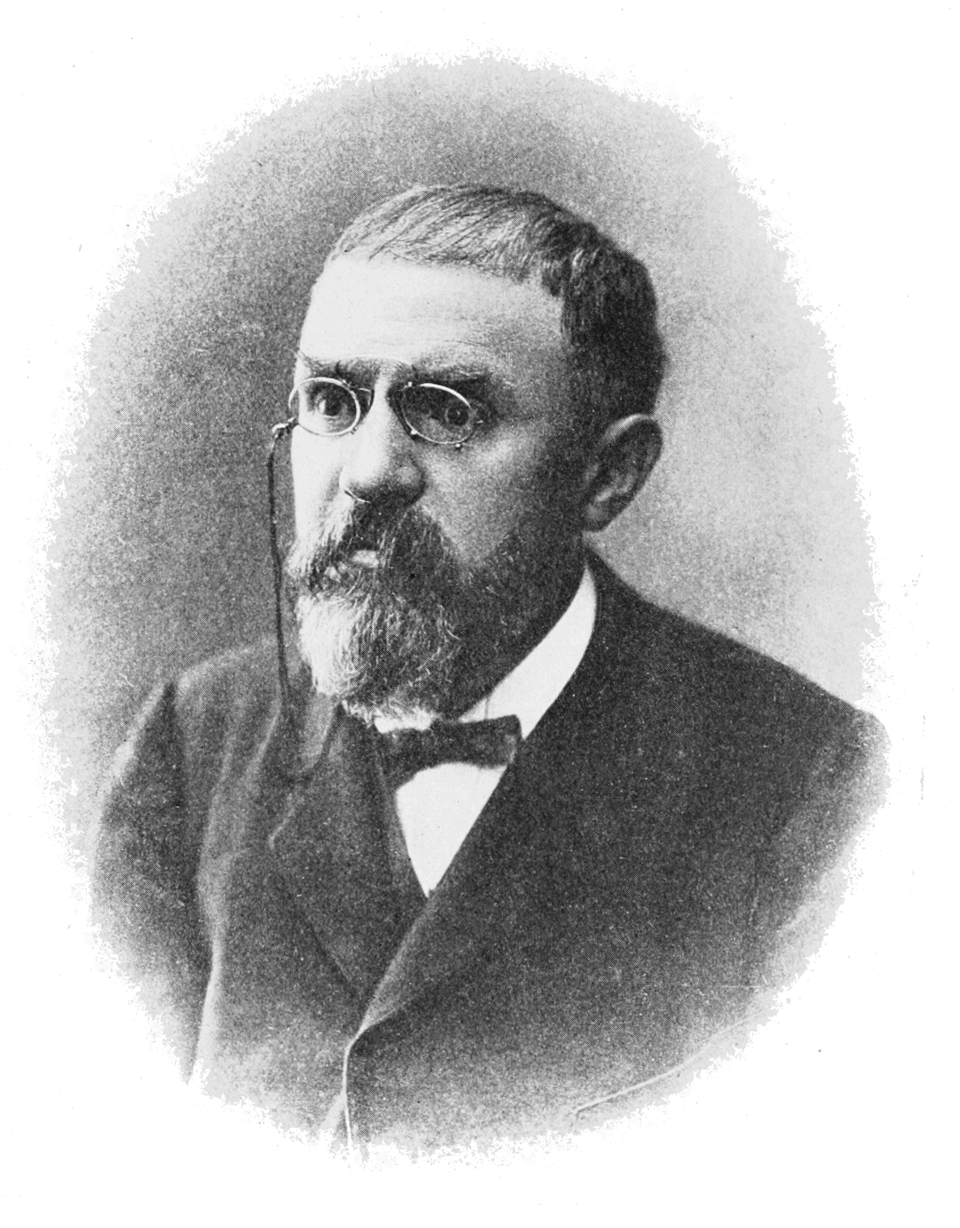
The French polymath who touched every branch of mathematics and came within a step of relativity — the last mathematician to master his discipline entire.
Henri Poincaré was the last mathematician of whom it could be said that he worked productively across the whole of mathematics as it then existed. He founded algebraic topology, transformed celestial mechanics, discovered the mathematical possibility of chaos, and — in papers published in 1905 — arrived at many of the same equations as Einstein while interpreting them differently. His 1904 Poincaré conjecture was proved only in 2003, nearly a century after his death.
Formation
Poincaré was born on 29 April 1854 in Nancy, France. His cousin Raymond Poincaré later became President of the French Republic. Henri showed exceptional aptitude from childhood; accounts describe him doing advanced mathematics in his head, writing very fast, and revising little. He graduated from the École Polytechnique and then the École des Mines, trained as a mining engineer before his mathematical ability was impossible to ignore. He defended his doctoral thesis in 1879 and was appointed to the Sorbonne in 1881, where he remained until his death.
Celestial mechanics and chaos
In the 1880s the King of Sweden offered a prize for a proof of the stability of the solar system — could it be shown that the planets would continue in their present orbits indefinitely? Poincaré submitted a lengthy memoir on the three-body problem and won the prize. During the review process he discovered an error; in correcting it he found something more significant: the three-body problem exhibits what we now call chaos — trajectories so sensitive to initial conditions that long-term prediction is impossible in principle. The corrected memoir, published in 1890, is the founding document of chaos theory.
His three-volume Les Méthodes nouvelles de la mécanique céleste (1892–1899) restated celestial mechanics in terms of the qualitative, topological study of differential equations — a shift from the 18th-century programme of finding explicit solutions to the 19th-century programme of understanding the structure of solutions.
Topology
Poincaré founded algebraic topology — the study of topological spaces using algebraic invariants. His 1895 Analysis Situs introduced the fundamental group and homology groups as invariants that distinguish topological spaces. At the end of his life he posed the Poincaré conjecture: every simply connected, closed three-dimensional manifold is homeomorphic to a three-sphere. The conjecture was the central unsolved problem in topology for a century. Grigori Perelman proved it in 2003, for which he was awarded (and declined) the Fields Medal and the Millennium Prize.
Physics and relativity
Poincaré worked extensively on electromagnetism and the electrodynamics of moving bodies. His 1905 papers "Sur la dynamique de l'électron" introduced the Lorentz group, noted the covariance of Maxwell's equations, and stated the principle of relativity. He derived many of the mathematical structures of what became special relativity — including the formula for the addition of velocities — but interpreted them within the existing framework of the luminiferous ether rather than abandoning it. Einstein, working simultaneously and independently, took the cleaner conceptual step: there is no ether, and space and time transform together.
Mathematics is the art of giving the same name to different things.
Legacy
Poincaré wrote prolifically for general audiences — Science and Hypothesis (1902), The Value of Science (1905), and Science and Method (1908) — and remained engaged with the philosophy and methodology of mathematics throughout his career. His description of mathematical intuition and the role of the unconscious in discovery remains cited in discussions of mathematical cognition. He died on 17 July 1912 after a brief illness, aged fifty-eight.