Henry David Thoreau
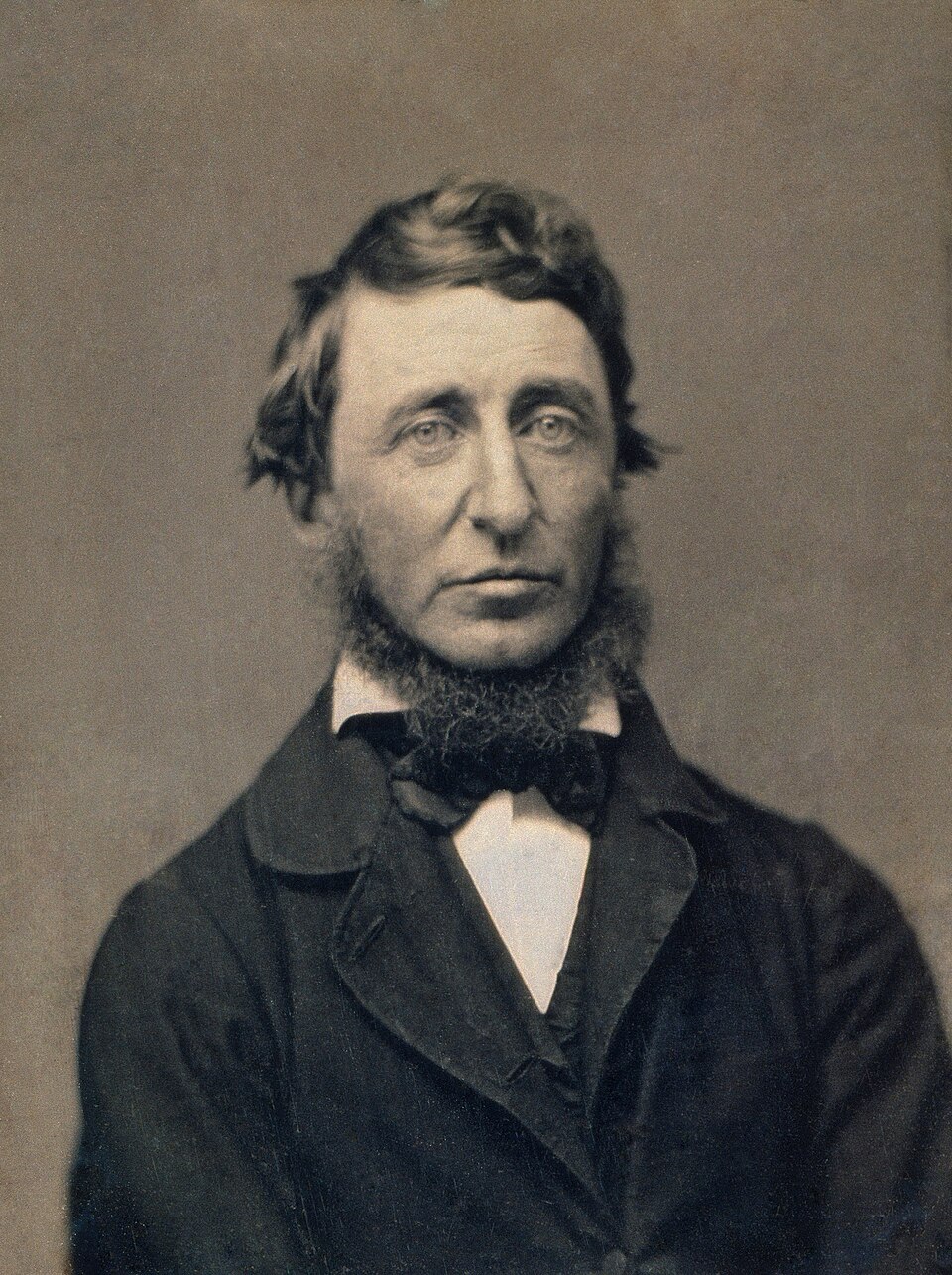
The naturalist who spent two years in a self-built cabin and wrote the argument for civil disobedience that Gandhi and King made history with.
Henry David Thoreau was an American naturalist, essayist, and philosopher who spent two years, two months, and two days living in a small cabin he built himself on the shore of Walden Pond in Concord, Massachusetts. The book he wrote about the experiment — Walden (1854) — is one of the foundational texts of American literature and of the environmental tradition. His essay "Resistance to Civil Government" (1849), later called "Civil Disobedience," articulated a principle that Mahatma Gandhi and Martin Luther King Jr. both acknowledged as central to their methods.
Concord and formation
Thoreau was born on 12 July 1817 in Concord, Massachusetts, the third of four children. He attended Harvard College, graduating in 1837 with enough literary preparation to begin his journals — which he maintained for the rest of his life and which eventually ran to some two million words. In Concord he came under the influence of Ralph Waldo Emerson, who became a mentor, employer, and philosophical touchstone. Emerson's concept of self-reliance and the individual's direct relationship with nature were the intellectual ground from which Thoreau's own thinking grew.
He worked variously as a schoolteacher (briefly), a pencil-maker in his family's business, a surveyor, and a handyman. He never married and lived most of his life in or near Concord.
Walden
On 4 July 1845, Thoreau moved into a one-room cabin on land owned by Emerson at Walden Pond, about a mile and a half from Concord. He was not, as is sometimes imagined, isolating himself from society — he walked into town regularly, his mother brought him food, and he had visitors. The experiment was philosophical: he wanted to test what was genuinely necessary in a life and what was merely customary accumulation.
Walden (1854) is the account of his two years there, though heavily revised from his journals and shaped as a single symbolic year moving from summer through winter to spring. It combines natural observation of extraordinary precision — he measured the ice thickness of the pond, tracked the first flowering dates of local plants — with social critique of industrial capitalism and the Protestant work ethic. He argued that most people lead lives of "quiet desperation," working to acquire what they do not need, and proposed simplicity and attentiveness as the alternative.
Civil Disobedience
In July 1846, during his time at Walden, Thoreau was arrested for refusing to pay a poll tax, on the grounds that the tax supported a government that sanctioned slavery and was waging an unjust war against Mexico. He spent one night in jail before someone — likely his aunt — paid the tax against his wishes. The episode prompted the essay "Resistance to Civil Government" (1849), republished as "Civil Disobedience."
The essay argues that when a government requires citizens to participate in injustice, the morally correct response is to refuse compliance and accept the legal consequences — that individual conscience must take precedence over law. The argument's influence was direct: Gandhi cited it in developing Satyagraha; King cited it in "Letter from Birmingham Jail."
Natural observation
Thoreau's journals record the phenology of Concord — the dates of ice-out on the pond, the first appearances of specific wildflowers, the migration of birds — with scientific precision. This record has been used by biologists studying climate change, as a baseline against which current observations can be compared. He was among the first to develop the concept of ecological succession in forests.
I went to the woods because I wished to live deliberately, to front only the essential facts of life, and see if I could not learn what it had to teach, and not, when I came to die, discover that I had not lived.
Legacy
Thoreau died of tuberculosis on 6 May 1862, aged forty-four. His influence spans the environmental movement, the tradition of civil disobedience, and American literary nonfiction. Walden remains in print in dozens of editions and translations; "Civil Disobedience" has been reprinted countless times and translated into most major languages.