Henry James
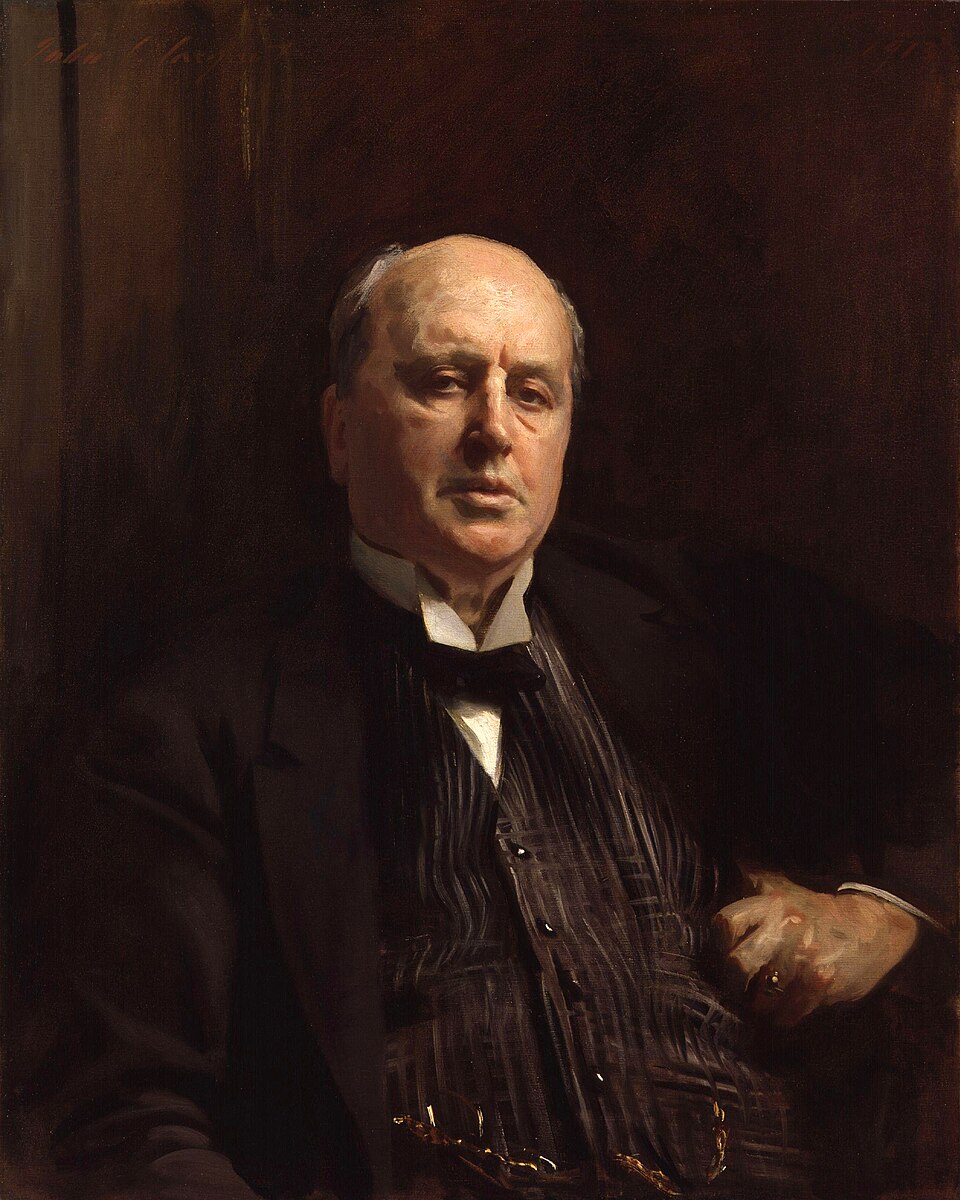
The American expatriate who bent the novel inward — making consciousness itself the primary terrain of narrative.
Henry James wrote novels in which almost nothing happens externally and everything happens within. His great subject was the American confronting European society — its codes, its corruptions, its density of historical implication — and the cost paid in misunderstanding. He is regarded as a key transitional figure between literary realism and literary modernism, and his technical innovations in point of view and indirect narration have influenced practically every serious novelist who followed him.
Formation
James was born in New York City on 15 April 1843, the second of five children of Henry James Sr., a theologian and lecturer, and Mary Robertson Walsh. His elder brother William became one of the most important American philosophers and psychologists. The family was affluent and cosmopolitan: Henry's childhood moved between New York, London, Paris, Geneva, and Boulogne. He read voraciously in French and English, and absorbed European culture before he had reached maturity.
He studied briefly at Harvard Law School, then abandoned it for literature. His early criticism appeared in The Nation and The Atlantic Monthly; he published his first novel, Watch and Ward, in 1871. In 1875 he moved to Europe permanently, settling first in Paris — where he met Turgenev, Flaubert, Zola, and Maupassant — then in London.
The international theme
James's early and middle periods are dominated by what he called "the international theme": the encounter between American innocence and European experience. Daisy Miller (1878) made his name with the story of an American girl in Rome undone by her failure to read European social codes. The Portrait of a Lady (1881) is his most celebrated work of this period — the story of Isabel Archer, an American woman whose pursuit of autonomy leads her into a disastrous marriage engineered by sophisticated Europeans. The Bostonians (1886) and The Princess Casamassima (1886) address American politics and London radicalism respectively.
The late style
After a disastrous attempt at writing for the theatre in the 1890s, James returned to fiction with a revised set of technical ambitions. The Wings of the Dove (1902), The Ambassadors (1903), and The Golden Bowl (1904) — the so-called "Major Phase" — are among the most formally demanding novels in English. The prose becomes almost entirely constituted of consciousness: characters perceive, infer, and misread, but rarely act. Everything is qualified, suspended, hedged by the observer's understanding of their own limited knowledge.
He dictated his later work to a typist, and contemporaries noted that the spoken quality entered the sentence — its sinuous self-corrections and parenthetical asides.
Try to be one of the people on whom nothing is lost.
Legacy
James became a British citizen in 1915, a year before his death — a gesture of solidarity with Britain during the First World War. He was appointed to the Order of Merit shortly before he died. His twenty novels, more than a hundred short stories, and extensive critical writing form one of the most sustained bodies of literary thought in English. His prefaces to the New York Edition of his collected works (1907–1909) are themselves a substantial contribution to the theory of fiction.