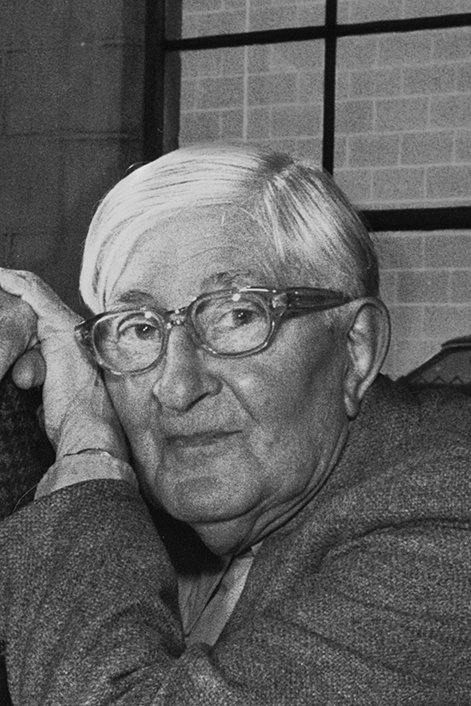
Herbert Matter
The Swiss-born designer who married photography and typography in bold, unexpected scales — creating Swiss travel posters that remain landmarks of photomontage and a career that bridged two continents.
Herbert Matter invented a photographic poster language in Switzerland and brought it to America — using radically scaled photographs, diagonal compositions, and overprinted typography to produce images that stopped viewers dead. His Swiss travel posters of the 1930s remain among the most celebrated works in the graphic design canon, and his later career at Knoll and Yale extended his influence across two continents.
Formation in Europe
Matter was born in Engelberg, in the Swiss Alps, in 1907. He studied at the École des Beaux-Arts in Geneva and then at the Académie Fernand Léger in Paris, where he also worked with A. M. Cassandre — the French poster master whose dramatic typographic compositions were already influencing European commercial art. He learned printing and photography alongside design, giving him command of both the lens and the press.
The Swiss posters
Returning to Switzerland, Matter worked for the Swiss National Tourist Office from 1934 to 1936, producing a series of travel posters that became immediately celebrated. The technique was photomontage: photographs of Alpine landscapes and sporting activity cropped and scaled to extreme proportions — a tiny skier above a vast snow field, a face filling the full height of the sheet — with minimal sans-serif type. The colour was often restricted to one or two tones applied to a black-and-white photographic base, creating a visual impact that conventional illustration could not match.
The compositions were oblique, kinetic, and spatially surprising. They demonstrated that photography, handled as a design material rather than mere documentation, could achieve a poster authority equal to the finest painted lithography.
When you look through the camera and compose, you are already designing.
America and the design community
Matter emigrated to the United States in 1936, settling in New York. He worked initially for Harper's Bazaar and Vogue under Alexey Brodovitch, then established freelance relationships with major American clients. His most sustained commercial collaboration was with Knoll, the modernist furniture company, for which he produced graphic materials from 1946 onward — catalogue design, advertising, and the visual identity systems that presented Knoll's designer furniture to a broad audience. His photography of Knoll furniture, with its spare backgrounds and attention to form and shadow, helped establish the aesthetic standard for furniture photography in the American modernist idiom.
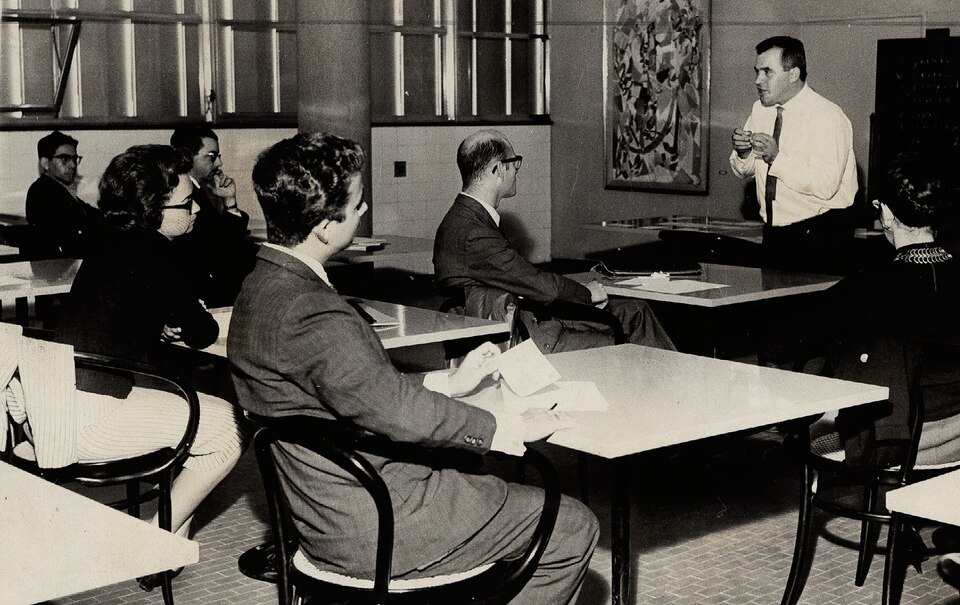
He taught at Yale University School of Art for many years, influencing a generation of American designers.
Legacy
Matter died in Southampton, New York, in 1984. His Swiss posters of the 1930s are in major collections and appear in virtually every historical survey of twentieth-century graphic design. His later work — less visible in design history until scholars began recovering it in the late twentieth century — shows an equally rigorous intelligence applied to the problems of corporate visual identity and editorial photography. The photomontage techniques he pioneered moved into advertising, editorial design, and eventually digital image-making, making his vocabulary one of the most pervasively adopted in twentieth-century visual communication.