Herman Melville
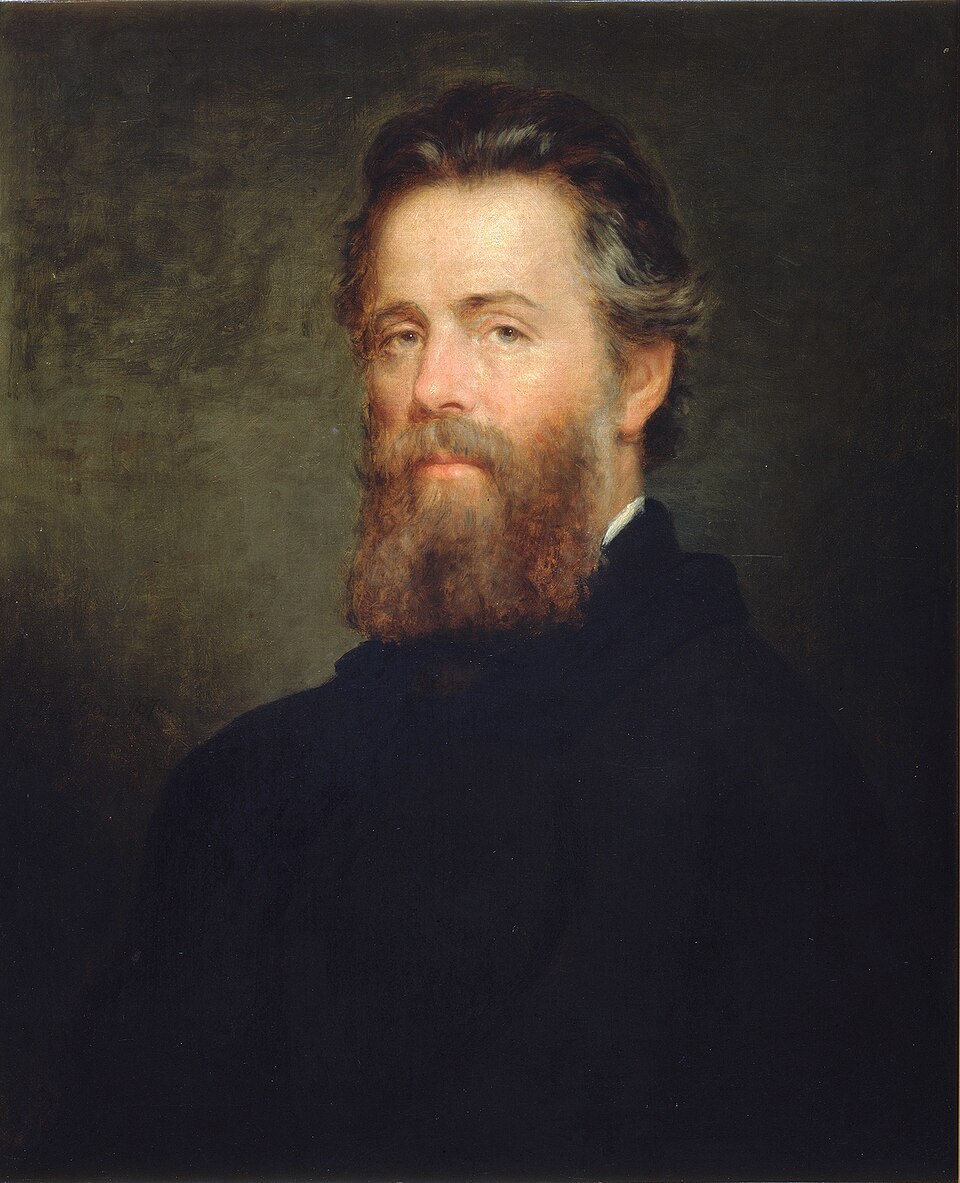
The merchant sailor who turned a whaling voyage into the American epic — ignored in his lifetime and indispensable ever since.
Herman Melville served on whaling ships and naval vessels for four years in his early twenties and spent the remaining forty years of his life writing about what he had seen, experienced, and thought. His reputation collapsed after the commercial failure of Moby-Dick in 1851, and he died in 1891 almost entirely forgotten. The centenary of his birth in 1919 triggered a reappraisal that placed Moby-Dick among the greatest American novels — perhaps the greatest — a judgment that has not since been seriously challenged.
Early life and years at sea
Melville was born in New York City on 1 August 1819, the third of eight children of Allan Melville, a merchant, and Maria Gansevoort. His father died bankrupt when Herman was twelve, leaving the family in poverty. After working as a clerk, farm labourer, and schoolteacher, Melville went to sea in 1839 as a cabin boy on a merchant ship to Liverpool.
In 1841 he shipped aboard the whaling vessel Acushnet out of New Bedford, Massachusetts. He jumped ship in the Marquesas Islands in 1842, living among the Typee people — an experience that became the basis for his first novel. He served briefly on another whaler, participated in a mutiny, was jailed briefly in Tahiti, enlisted in the US Navy in Honolulu, and arrived home in Boston in 1844.
The early novels
Typee (1846) and Omoo (1847), based on his Pacific adventures, were immediate successes — readable, adventurous, and critical of missionary activity in the Pacific. Mardi (1849), an ambitious allegorical novel, was a commercial failure, and Melville reverted to more accessible sea narratives with Redburn (1849) and White-Jacket (1850).
Moby-Dick
Moby-Dick; or, The Whale (1851) is a novel about the obsessive quest of Captain Ahab for the white sperm whale that destroyed his leg. It is also a treatise on whaling, a philosophical meditation on evil and fate, a study in narration — the narrator Ishmael is among American literature's most distinctive first-person voices — and a technical experiment in mixing genres: it includes chapters of pure cetology, Shakespearean dramatic soliloquy, and lyric prose poetry.
Contemporary readers found it baffling. It sold poorly, and Melville's reputation declined sharply. Pierre (1852), an even more experimental novel, was a critical disaster.
Later work and obscurity
Melville worked as a customs inspector in New York from 1866 to 1885 — nineteen years of obscure employment while continuing to write. Billy Budd, Sailor, a novella about a young sailor falsely accused and executed, was found in his papers after his death and published posthumously in 1924. It is now considered one of his finest works — a spare, morally precise examination of justice and institutional power.
It is not down in any map; true places never are.
Legacy
The Melville revival of the 1920s was led by critics including Carl Van Doren and Raymond Weaver, who produced the first biography. The revival established Moby-Dick as an American epic on the scale of Leaves of Grass — a claim that has since hardened into consensus. The novel has generated more critical writing than almost any other work in American literature.