Homer
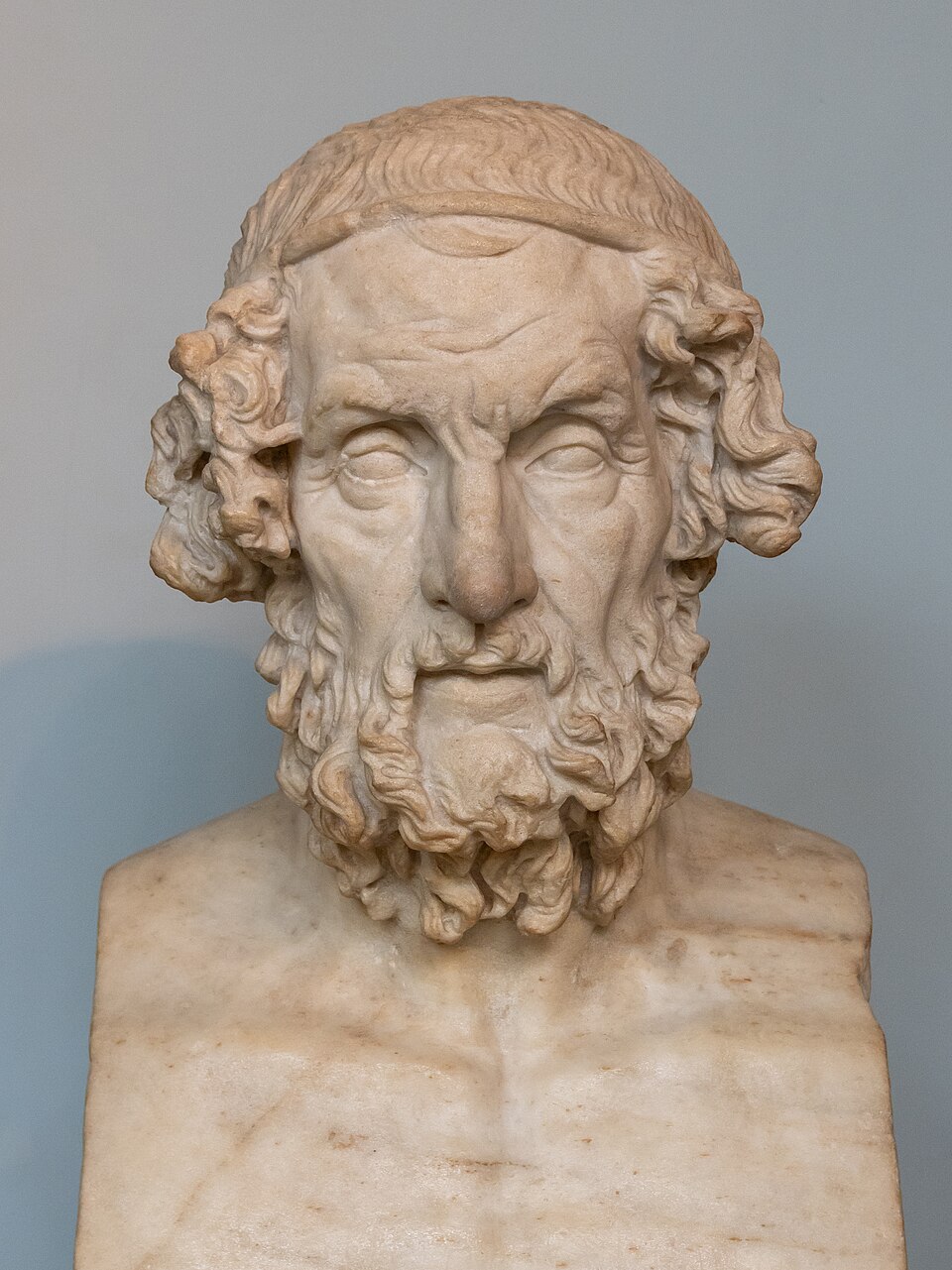
The poet — or tradition of poets — to whom Western literature traces its oldest surviving epics, two works that have shaped storytelling for nearly three thousand years.
Homer is the name attached to the two foundational texts of Western literature — the Iliad and the Odyssey — though whether a single individual composed them, and when and where he lived, has been argued since antiquity. What is certain is that the poems themselves are real, vast, and formative: the source of the warrior code, the idea of the hero, the epic as a form, and much of what Western literature has been doing since.
The Homeric Question
Ancient Greeks revered Homer as the poet above all others, cited him as an authority on almost everything, and disputed his birthplace — seven cities claimed the honour. Modern scholars have complicated the picture further: the Iliad and Odyssey are now generally regarded as products of a long oral tradition, composed and recomposed by bards who worked with stock phrases, repeated epithets, and formulaic type-scenes before reaching the written forms that survive.
The question of whether "Homer" was a single genius who fixed the tradition in something like its current form, or a conventional name for the tradition itself, remains open. Scholars generally treat the two poems as the work of different composers. The dates assigned — somewhere in the 8th century BC for the texts' written crystallisation, though the traditions behind them are older — are themselves debated.
Chios is one of the traditional claimants to Homer's birthplace; Smyrna is another. No biographical fact is verifiable.
The Iliad
The Iliad covers a few weeks near the end of the ten-year Trojan War, focusing on the wrath of Achilles — the Greek hero who withdraws from battle after being dishonoured by Agamemnon, returns only when his companion Patroclus is killed, and then kills the Trojan prince Hector. It is a poem about rage, grief, honour, and mortality, composed in dactylic hexameter with an architecture of extraordinary sophistication. The gods intervene, take sides, and argue; the human characters face choices that determine fate; and the poem refuses easy moral resolution, giving Hector as much dignity as Achilles.
Sing, goddess, the anger of Achilles son of Peleus, that brought countless ills upon the Achaeans.
The Odyssey
The Odyssey follows Odysseus across ten years of wandering on his way home from Troy, encountering monsters, enchantresses, and the dead while his wife Penelope holds off suitors in Ithaca and his son Telemachus searches for him. Where the Iliad is martial and tragic, the Odyssey is a poem of cunning, endurance, and return — the hero who survives by wit rather than strength. It established the template for the journey narrative and the idea of homecoming as meaning.
Both poems were central to Greek education, memorised extensively, and served as the implicit shared culture that the literature of the classical period assumed.
Influence and legacy
Homer's position at the root of Western literary culture is structural rather than merely canonical. Virgil wrote the Aeneid as an explicit sequel to the Trojan War tradition. Dante makes Virgil his guide in the Commedia, tracing a lineage back to Homer. Joyce's Ulysses maps a single Dublin day onto the Odyssey. The epithets, type-scenes, and compositional methods of the Homeric tradition provided the technical vocabulary within which European narrative art operated for centuries.
The discovery that the poems emerged from oral tradition — associated with Milman Parry's fieldwork in Yugoslavia in the 1930s — transformed understanding of how they were made, but not their standing. They remain the starting point.