Honoré de Balzac
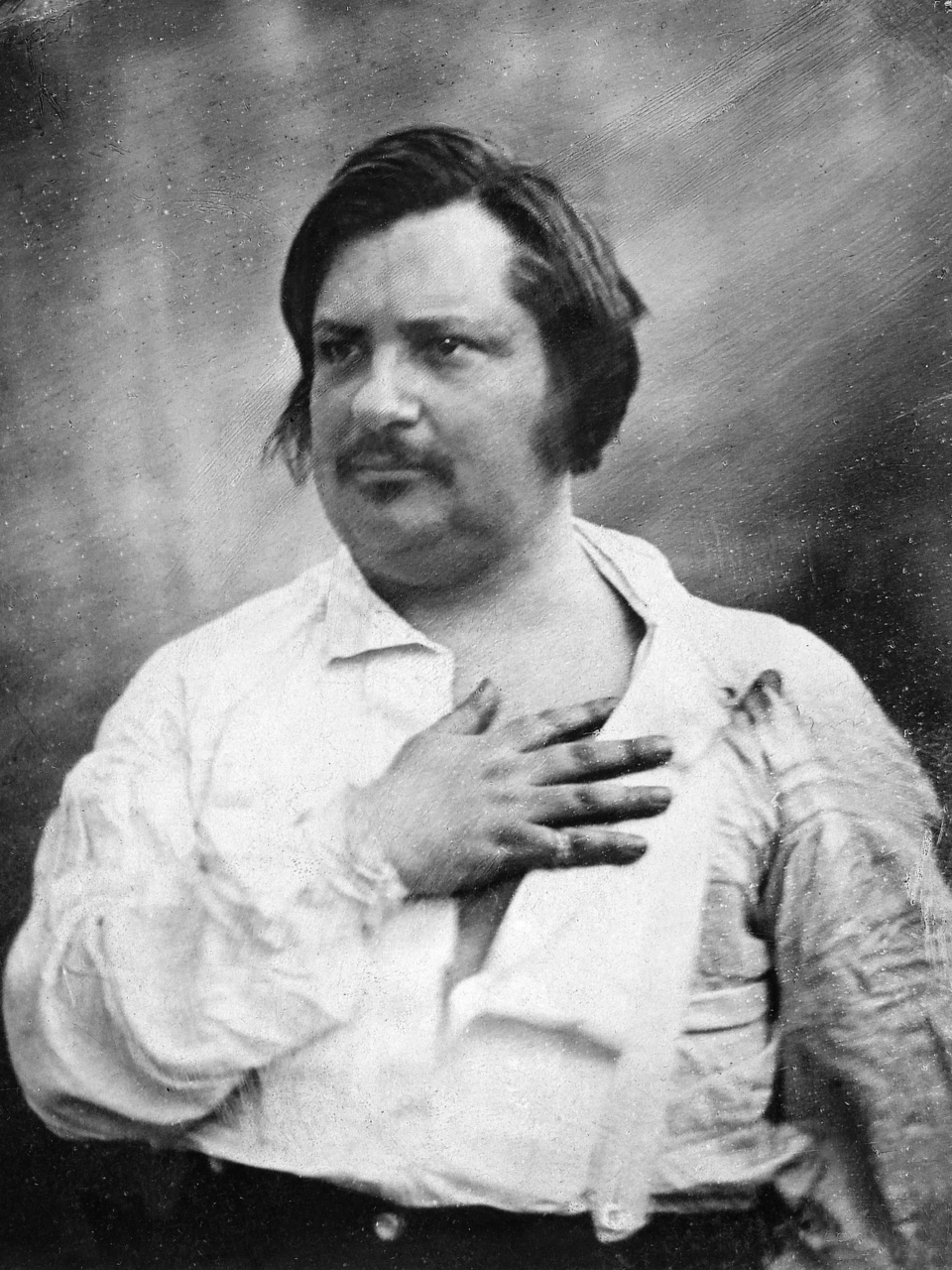
The insomniac novelist who mapped an entire society in ninety novels and gave literary realism its working method.
Honoré de Balzac conceived one of the most ambitious projects in the history of literature: a sequence of novels and stories, linked by recurring characters and unified by a comprehensive sociological design, that would depict all of French society in the aftermath of the Revolution and under the Restoration and July Monarchy. He called it La Comédie humaine. He produced approximately ninety works for it, working through the night on black coffee, before dying at fifty-one from overwork and the accumulated damage of the task.
Origins and the failed businessman
Balzac was born in Tours on 20 May 1799, the son of a civil servant. He studied law in Paris and worked briefly in a solicitor's office, but turned to writing against his family's wishes. His early novels, published under pseudonyms, were largely unsuccessful. He then spent the years 1826 to 1828 as a printer and publisher — a disastrous venture that left him in enormous debt. Debt was to pursue him for the rest of his life and become one of the animating subjects of his fiction.
The experience of the commercial world, of credit and failure and social ambition, gave him the material he needed. His first major novel, Les Chouans (1829), was the first he published under his own name.
La Comédie humaine
The organising idea came to Balzac around 1834: rather than writing separate, unconnected novels, he would unify his existing work and future work into a single structure, in which characters from one novel would reappear in others — sometimes as major figures, sometimes glimpsed in passing. The device of recurring characters was his technical innovation; it gave the sequence the quality of a world rather than a collection.
La Comédie humaine was divided into three sections: Études de moeurs (Studies of Manners), Études philosophiques (Philosophical Studies), and Études analytiques (Analytical Studies). The Studies of Manners — the largest section — depicted Parisian life in all its registers: aristocratic, bourgeois, commercial, criminal, provincial.
Among the most celebrated individual works are Eugénie Grandet (1833), a study of provincial avarice; Le Père Goriot (1835), which introduces the recurring figure of the criminal mastermind Vautrin and the ambitious young Rastignac; Illusions perdues (1837–1843), a three-part novel about the collision between literary ambition and commercial reality; and La Cousine Bette (1846) and Le Cousin Pons (1847), paired studies of destructive obsession.
Method and working habits
Balzac worked at night, rising at midnight and writing until dawn, sustained by black coffee that he consumed in industrial quantities. He revised obsessively and expensively, correcting proofs so extensively that his publishers were driven to despair — and further debt. He dressed in a monk's habit while working. He was also a gregarious social animal, dining widely and maintaining an extensive correspondence, including a long love affair conducted largely through letters with the Polish countess Ewelina Hańska, whom he married five months before his death.
His descriptive method was systematic and quasi-scientific: he documented the material environment of his characters — their apartments, their clothes, their possessions — with the attention of a naturalist. Zola, who invented the term naturalisme, acknowledged Balzac as his predecessor.
There is no such thing as a great talent without great will-power.
Legacy
Balzac died in Paris on 18 August 1850. Victor Hugo, who visited him on his deathbed, delivered the eulogy at his burial. Marx and Engels cited La Comédie humaine as a more truthful account of bourgeois society than any theoretical treatise. Henry James called him "the master of us all." Zola, Flaubert, and the entire tradition of French literary realism descend from him; he is a foundational figure for the modern novel as a form of social analysis.