Ibn Khaldun
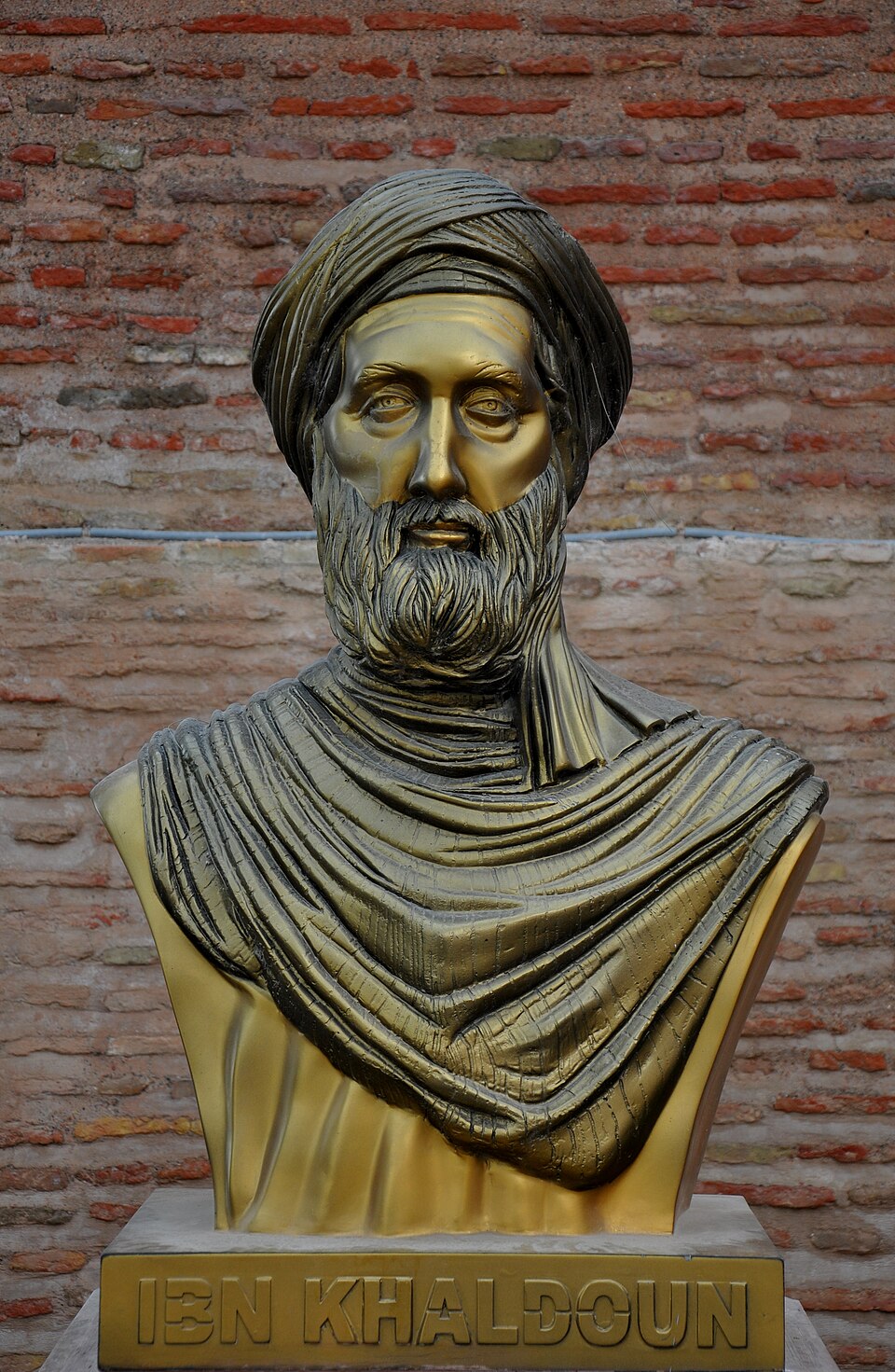
The medieval Arab thinker who turned history into a science: charting the rise and fall of civilisations through the logic of social solidarity.
Ibn Khaldun wrote a universal history of the world and prefaced it with a theory of civilisation so rigorous that scholars of sociology, economics, and demography have claimed him as a forerunner of their disciplines. Working in the fourteenth century, without the institutional scaffolding of a modern university, he formulated laws of social change that would not be paralleled in European thought for another four centuries.
Early life and formation
Ibn Khaldun was born in Tunis on 27 May 1332 into a family of Andalusian Arab origin that had fled the Iberian Peninsula as Christian kingdoms expanded southward. His family had a long tradition of scholarly and administrative service, and the young Ibn Khaldun received a thorough education in Islamic theology, law, mathematics, and the classical Arabic literary canon.
The political landscape of the Maghreb and al-Andalus was fractured and turbulent. Ibn Khaldun served a succession of courts — in Tunis, Fez, Granada, and Tlemcen — as secretary, diplomat, and adviser. He was repeatedly caught in factional reversals, imprisoned at least once, and forced into repeated exile. These years of direct experience at the levers of power gave his later theorising an unusually empirical foundation. He had watched dynasties consolidate and collapse at close quarters.
The Muqaddimah and the theory of asabiyyah
In 1375 Ibn Khaldun withdrew to a fortress in the Algerian highlands under the protection of a local tribe. There, in relative seclusion over roughly four years, he composed the Muqaddimah — the prolegomenon to his vast universal history, the Kitab al-Ibar. The Muqaddimah (completed 1377) was conceived as an introduction, but it stands alone as the most original work of social theory produced in the medieval world.
Its central argument rests on the concept of asabiyyah — group solidarity, or social cohesion. Ibn Khaldun observed that nomadic peoples of the desert possessed a fierce internal solidarity born of shared hardship and mutual dependence. This cohesion allowed them to overwhelm sedentary urban civilisations, which had grown soft through prosperity. Once the nomadic conquerors settled and established a dynasty, however, they too began to acquire urban habits; asabiyyah weakened across generations, and the cycle repeated. History, for Ibn Khaldun, was not a chronicle of individual deeds but a rhythm driven by social forces.
From this framework he drew observations that anticipate later disciplines. He argued that the division of labour and the accumulation of surplus value were preconditions of urban life — a claim economists would rediscover. He theorised that excessive taxation undermined the productive base of a state, reducing revenues in the long run. He described how epidemic disease, demographic contraction, and agricultural decline could accelerate dynastic collapse.
Cairo and later years
After completing the Muqaddimah, Ibn Khaldun moved to Cairo, the greatest metropolis of the medieval Islamic world, where he served as a judge and lecturer. In 1401 he accompanied the Mamluk sultan on a military campaign to Syria and, in a remarkable episode, was lowered by rope from the walls of besieged Damascus to negotiate directly with Timur (Tamerlane), the Central Asian conqueror. The encounter produced no agreement that saved the city, but Ibn Khaldun's account of their conversations — preserved in his autobiography — is one of the more vivid documents of the period.
He continued revising the Kitab al-Ibar until his death in Cairo on 17 March 1406, at the age of seventy-three.
Legacy
The Muqaddimah was largely unknown in Europe until the nineteenth century, when orientalist scholars began translating Arabic manuscripts. It has since been recognised as a founding document in the philosophy of history, sociology, and historical economics. The cyclical theory of asabiyyah remains a reference point in comparative historical sociology.
The past resembles the future more than water resembles water.