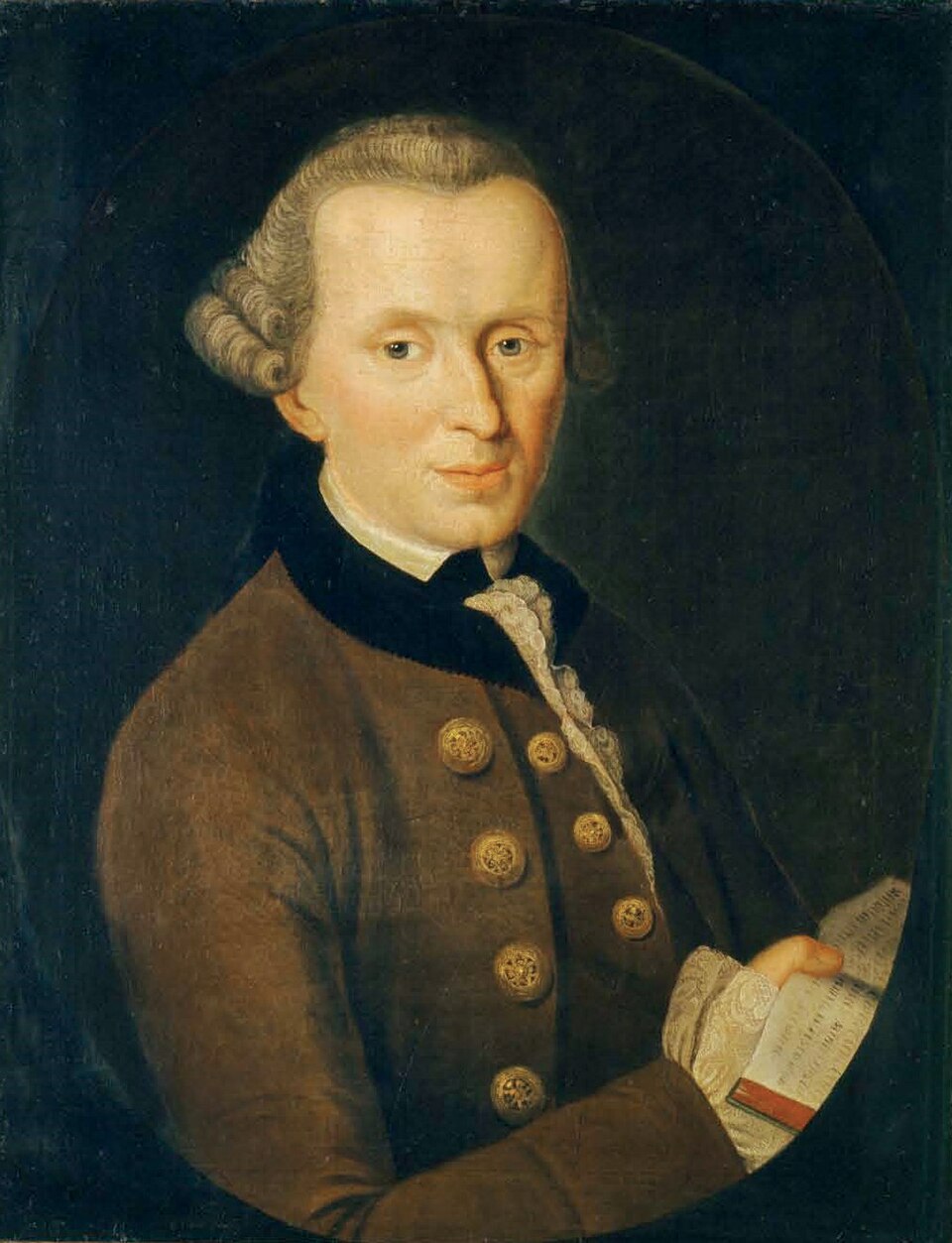
Immanuel Kant
The philosopher who asked what the mind brings to experience — and answered with a system that still sets the terms for every subsequent debate in epistemology, ethics, and aesthetics.
Immanuel Kant spent most of his life in Königsberg without travelling farther than forty miles, then reorganised the entire framework of Western philosophy in three dense volumes over nine years, establishing the critical method that philosophy has been responding to — for and against — ever since.
Königsberg and formation
Kant was born in Königsberg, then in the Kingdom of Prussia, in 1724. His family was devout Pietist; the moral seriousness of that tradition stayed with him long after his theological commitments loosened. He studied at the Albertina University and spent several years as a private tutor before joining its faculty, where he lectured for four decades — on physics, mathematics, anthropology, and logic, as well as philosophy.
His early career was empiricist in orientation, shaped by Newton's physics and Leibniz's metaphysics. The turning point, which he described as his "Copernican revolution," came from reading David Hume, who, Kant wrote, "interrupted my dogmatic slumber" by demonstrating that necessary causal connection could not be derived from experience alone.
The critical philosophy
Kant's answer was that the mind is not a passive receiver of experience but an active organiser of it. Space, time, and causality are not features of things as they are in themselves but forms that the human mind imposes on raw sensation. We can never know the Ding an sich — the thing-in-itself — only the world as structured by our cognitive apparatus.
The Critique of Pure Reason (1781, revised 1787) set out this epistemological framework in exhaustive and often baffling detail. It established what could and could not be known through reason, effectively closing off traditional metaphysical claims about God, the soul, and free will as objects of theoretical knowledge while preserving space for practical reason.
The Critique of Practical Reason (1788) then grounded ethics in reason rather than theology or consequence. The categorical imperative — act only according to the maxim you could will to become a universal law — offered a formal, non-theological basis for moral obligation that did not depend on outcomes or divine command.
Act only according to that maxim by which you can at the same time will that it should become a universal law.
Aesthetics and the Third Critique
The Critique of Judgment (1790) addressed aesthetics and teleology. Kant argued that aesthetic judgment — the claim that something is beautiful — is neither purely subjective nor objectively provable, but occupies a distinctive middle ground: a subjective judgment made with a claim to universal assent. "This is beautiful" is not the same as "I like this." The analysis of the sublime — the experience of nature's overwhelming scale as a reminder of reason's superiority — became a major resource for Romantic aesthetics.
Legacy
Kant's influence is difficult to overstate. German Idealism (Fichte, Schelling, Hegel) developed directly from his framework. Analytic philosophy's preoccupation with the conditions of knowledge, meaning, and judgment is Kantian in structure. Rawlsian political philosophy, with its emphasis on principles that rational agents could choose behind a veil of ignorance, is explicitly neo-Kantian. Even critics — Schopenhauer, Nietzsche, Heidegger — defined themselves against him.