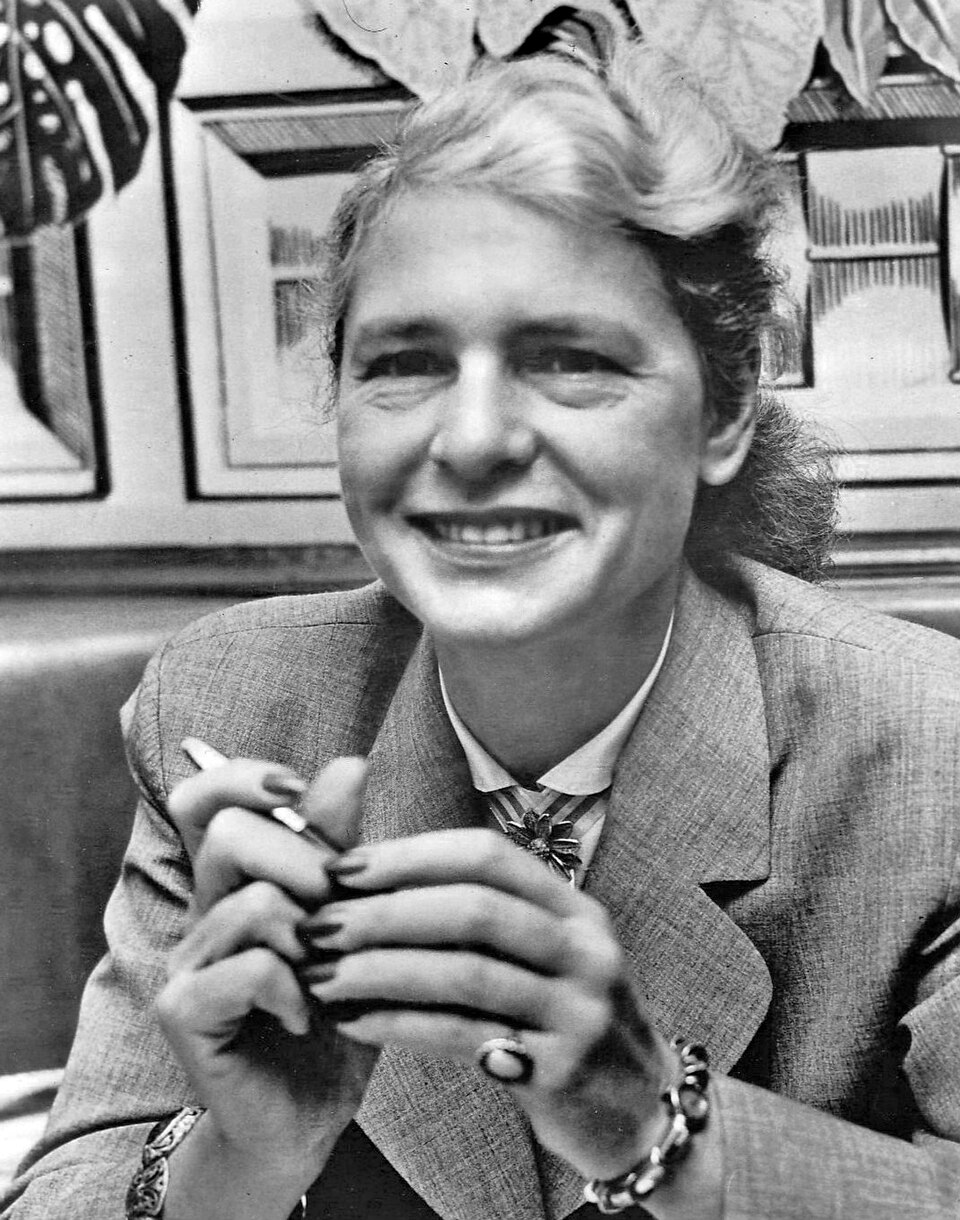
Imogen Cunningham
The botanist's eye — Cunningham trained as a chemist, photographed flowers with surgical precision, and kept working until she was ninety-three.
Imogen Cunningham studied chemistry before she studied photography, and the combination showed. Her botanical prints isolate pistils and petals with a clarity that feels scientific and sensuous at once — a tension she sustained across a career of more than seventy years.
Formation
Cunningham was born in Portland, Oregon in 1883 and grew up in Seattle. She enrolled at the University of Washington, where she studied chemistry, a subject whose discipline in observation and process she would carry directly into the darkroom. In 1906 she purchased her first camera; by 1907 she had graduated and taken a job in the studio of Edward S. Curtis, printing and platinum-coating his large-format plates of Native American subjects. The work gave her technical command she could not have acquired otherwise.
In 1909 she travelled to Dresden on a scholarship to study photochemistry under Robert Luther at the Technische Hochschule. She returned to Seattle in 1910, opened her own portrait studio, and began exhibiting the soft-focus pictorialist work then in fashion. She married printmaker Roi Partridge in 1915 and moved to the San Francisco Bay Area, where she raised three children while continuing to photograph.
Botanical studies and Group f/64
In the 1920s Cunningham shifted her attention to plants — magnolia blossoms, calla lilies, agave, aloe — and began producing the work for which she is best remembered. The photographs are made at close range, with large-format equipment, and printed to emphasise texture and tonal gradation. They are neither documentary nor decorative: the plant becomes a formal subject, and Cunningham applies the same exacting focus to an unfurling magnolia that a chemist applies to a specimen under glass.
Around 1932 she joined Group f/64, a loose association of West Coast photographers — Ansel Adams, Edward Weston, Willard Van Dyke, and others — named for the smallest aperture setting on a large-format lens, which yielded maximum depth of field. The group stood collectively for sharp focus, precise tonal range, and the rejection of pictorialist manipulation. Cunningham's botanical work aligned naturally with these commitments, though her portrait practice — fluid, immediate, attentive to personality — showed a different range.
Which of my photographs is my favourite? The one I'm going to take tomorrow.
Portraiture and late career
Cunningham's portraits span six decades and an extraordinary range of subjects: artists, writers, dancers, and ordinary people encountered on the street. She worked for Vanity Fair in the 1930s and continued commercial work throughout the Depression. What marks the best of these portraits is the absence of flattery — a directness that her subjects appear to have accepted rather than submitted to.
In her eighties and nineties she carried a small camera in public and photographed elderly strangers, a project she titled After Ninety. She was awarded a Guggenheim Fellowship in 1970, at the age of eighty-seven — one of the oldest recipients of that award. She founded the Imogen Cunningham Trust in 1974 to preserve and print her negatives. She died in San Francisco in June 1976, two months after her ninety-third birthday, with the After Ninety book still in preparation.