Isaac Newton
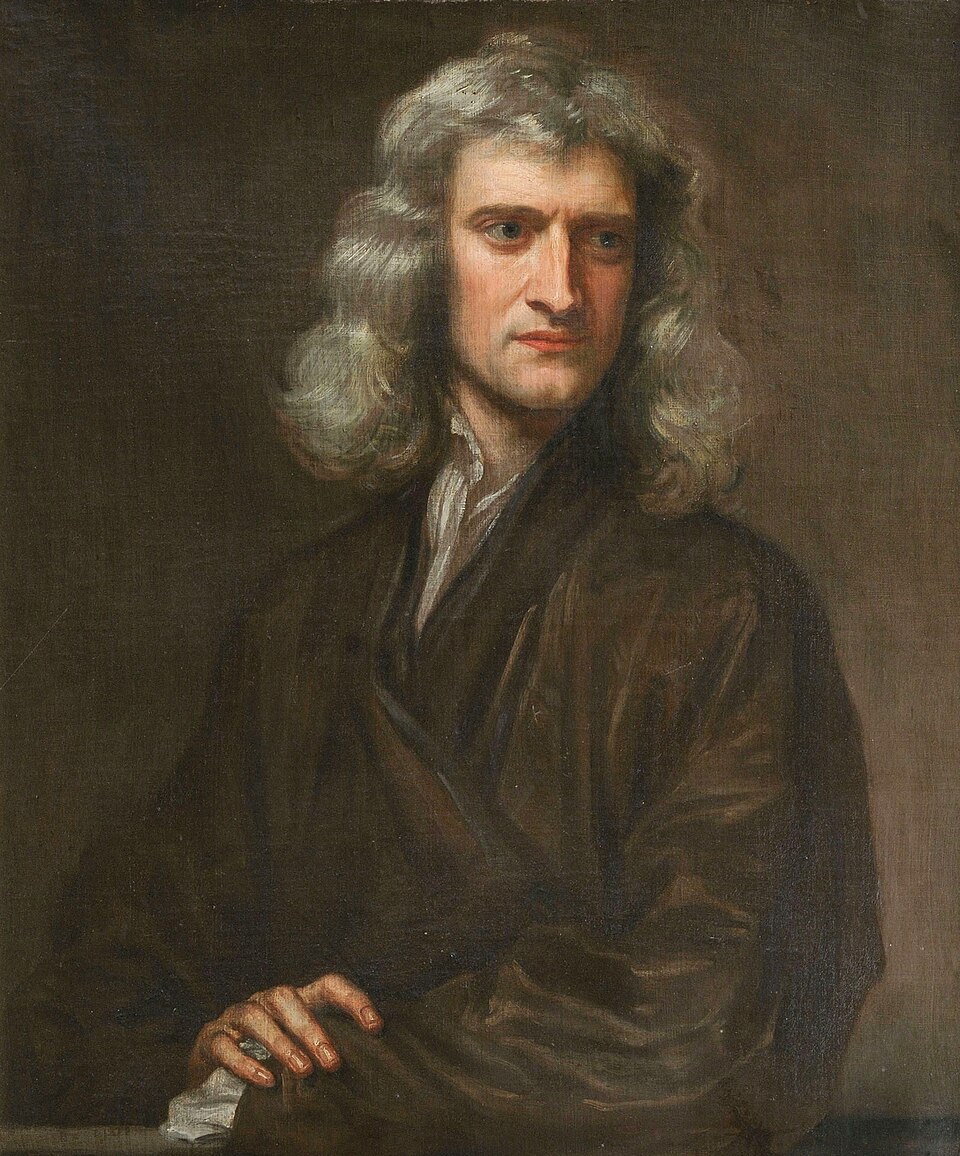
The English mathematician and physicist who unified terrestrial and celestial mechanics, invented calculus, and gave science the method it still uses — all largely before his thirtieth birthday.
Isaac Newton's Principia Mathematica of 1687 achieved the first great unification in physics — bringing falling apples and orbiting moons under a single mathematical law — while his concurrent invention of the calculus provided the tool that physics would use to describe change for the next three centuries.
The plague years and their productivity
Newton was born on Christmas Day 1642 at Woolsthorpe Manor in Lincolnshire, to a family of modest farmers. His father died before he was born; his mother remarried when he was three, leaving him in the care of his grandmother. He entered Trinity College, Cambridge in 1661. In 1665 and 1666, Cambridge was closed because of an outbreak of plague and Newton returned to Woolsthorpe.
Those two years are among the most productive in the history of science. Working largely alone, Newton developed the foundations of differential and integral calculus (which he called the method of fluxions), conducted experiments with prisms that led to the decomposition of white light into its spectral components, and formulated the early version of the law of universal gravitation. The story of the falling apple is a simplification, but Newton himself confirmed in later life that observing a falling apple prompted thoughts about gravitational attraction.
The Principia
Newton's Philosophiæ Naturalis Principia Mathematica, first published in 1687, set out the three laws of motion and the law of universal gravitation in the rigorous mathematical form of geometric proof. Its central achievement was demonstrating that the same force — gravity — governs both the fall of objects near Earth's surface and the orbital motion of the Moon and planets. Kepler's empirical laws of planetary motion, previously disconnected from terrestrial physics, followed as mathematical consequences.
The Principia established classical mechanics as a coherent system and gave science the paradigm of a mathematically formulated physical law tested against observation. Its influence was not merely technical: it established that the universe operated by discernible, rational principles accessible to human reason — the defining intellectual proposition of the Enlightenment.
If I have seen further, it is by standing on the shoulders of giants.
Optics and later career
His optical work, published as Opticks in 1704, demonstrated that white light is a mixture of all visible colours that a prism separates but does not produce — colours are properties of light, not of the prism. He also invented the reflecting telescope, using a mirror rather than a lens to focus light, which avoided the chromatic aberration that afflicted refracting instruments.
Newton was appointed Lucasian Professor of Mathematics at Cambridge in 1669 and served as Master of the Royal Mint from 1699, overseeing the recoinage of English currency and prosecuting counterfeiters. He was knighted in 1705, the first scientist to receive that honour for scientific work.
His later decades were marked by bitter priority disputes — most notably with Leibniz over the invention of calculus — and by private theological and alchemical investigations that he kept largely separate from his published scientific work.