J. Robert Oppenheimer
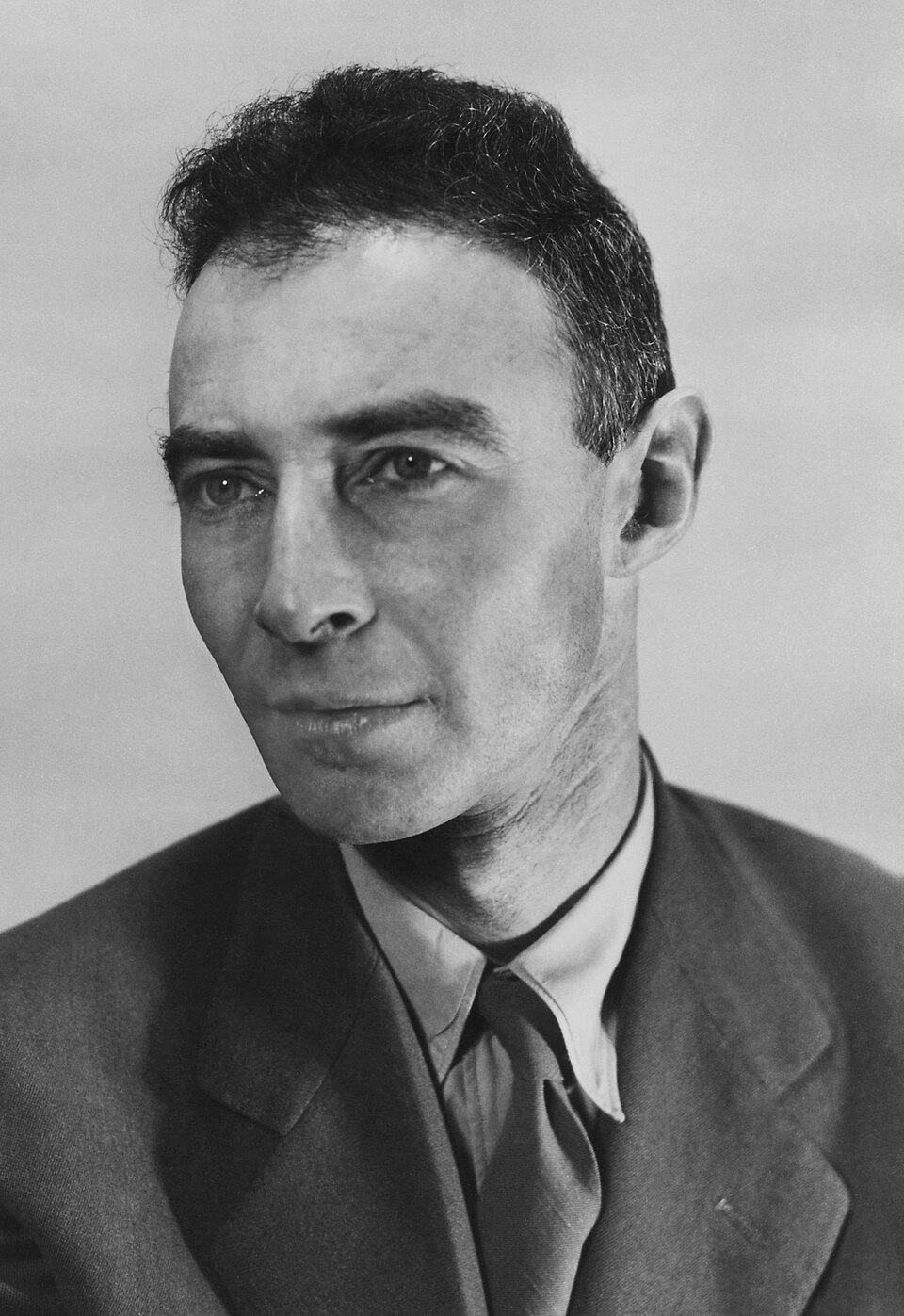
The physicist who led the team that built the first nuclear weapon, and spent the rest of his life grappling with what that meant — his country eventually answering him with a security hearing that stripped his clearance.
J. Robert Oppenheimer was among the most brilliant theoretical physicists of his generation, a man whose capacity for synthesising other people's ideas and holding an enormous scientific enterprise together made him the irreplaceable director of Los Alamos — a role that defined and eventually destroyed his public life.
Formation and theoretical physics
Oppenheimer was born in New York City in 1904 to a wealthy German Jewish family. He was a prodigious student: graduating from Harvard in three years, studying at Cambridge under J. J. Thomson, and completing his doctorate at Göttingen under Max Born in 1927. Göttingen was then the centre of the new quantum mechanics, and Oppenheimer absorbed the framework that would shape his research.
He joined the faculties of the University of California, Berkeley and Caltech in 1929, building the first significant school of theoretical physics in the United States. His research ranged across quantum electrodynamics, cosmic ray physics, and, in 1939, with Hartland Snyder, an early theoretical paper on what would later be called black holes — predicting the gravitational collapse of massive stars into objects from which nothing escapes. The term "black hole" was not coined until decades later, but the physics was Oppenheimer's.
Los Alamos
In 1942, Oppenheimer was appointed scientific director of the Manhattan Project's weapons laboratory at Los Alamos, New Mexico. The project had access to the United States' full wartime resources and the most concentrated collection of theoretical and experimental physicists ever assembled. Oppenheimer's achievement was administrative as much as scientific: managing competing egos, maintaining secrecy, and synthesising work from dozens of disciplines into a functioning weapon under extreme time pressure.
The first nuclear device was tested at Trinity in the New Mexico desert on 16 July 1945. Oppenheimer later recalled quoting from the Bhagavad Gita: "Now I am become Death, the destroyer of worlds." Within weeks, atomic bombs destroyed Hiroshima and Nagasaki.
Now I am become Death, the destroyer of worlds.
The security hearing
After the war Oppenheimer chaired the General Advisory Committee of the Atomic Energy Commission and argued against accelerated development of the hydrogen bomb, citing both technical and moral grounds. This position, combined with earlier associations with left-wing figures and Communist Party members (including his wife and brother), made him a target during the McCarthy era.
In 1954, the AEC held a security hearing. Oppenheimer was not charged with disloyalty or espionage; he was found to be a security risk on grounds of character and associations. His clearance was revoked. The hearing was widely seen as a political verdict rather than a security determination. He continued as director of the Institute for Advanced Study at Princeton until 1966, working in relative scientific isolation.
In 2022, the US Department of Energy formally vacated the 1954 finding, concluding that the original process had been flawed.