James Clerk Maxwell
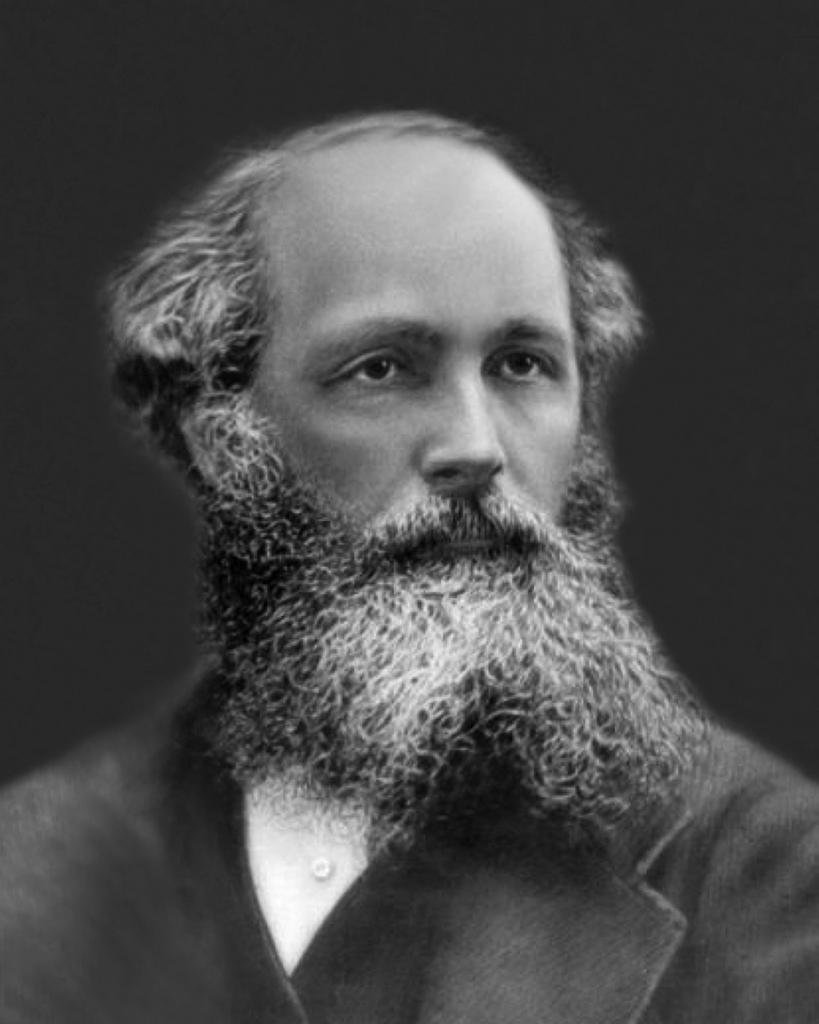
The Scottish physicist who unified electricity, magnetism, and light into four equations — the second great unification in physics, which quietly predicted the existence of radio waves before anyone had detected them.
James Clerk Maxwell completed, at forty-two, the work that unified electricity, magnetism, and light into a single mathematical framework — a synthesis from which Einstein derived special relativity, Hertz produced radio waves, and Marconi built a wireless telegraph, none of which Maxwell lived to see.
Edinburgh and Cambridge formation
Maxwell was born in Edinburgh in 1831. His family had estates in Galloway; he grew up moving between Edinburgh and the countryside, developing an unusually broad intellectual formation. He was recognised as a prodigy early — at fourteen he submitted a paper on the construction of oval curves to the Royal Society of Edinburgh — and entered Edinburgh University at fifteen before moving to Cambridge, where he studied at Peterhouse and then Trinity College, graduating as Second Wrangler in the Mathematical Tripos in 1854.
The Cambridge mathematics of the period was the most rigorous in the world. Maxwell's training there gave him the formal tools to do what he did: translate Michael Faraday's intuitive, experimental, and geometrically conceived field theory of electromagnetism into precise mathematical form.
The equations
Faraday had demonstrated through experiment that electricity and magnetism were related, and had introduced the concept of electromagnetic fields — invisible structures through which electrical and magnetic forces propagated. Maxwell spent the 1860s turning these insights into mathematics. In his 1865 paper "A Dynamical Theory of the Electromagnetic Field" he consolidated four differential equations describing the behaviour of electric and magnetic fields.
One immediate consequence was extraordinary: the equations predicted that electromagnetic disturbances propagate as waves at a speed that Maxwell calculated to be approximately 3 × 10⁸ metres per second — which matched the known speed of light. The inference was direct: light is an electromagnetic wave. Invisible forms of electromagnetic radiation at other frequencies necessarily existed. Heinrich Hertz experimentally demonstrated radio waves in 1887, eight years after Maxwell's death.
We can scarcely avoid the inference that light consists in the transverse undulations of the same medium which is the cause of electric and magnetic phenomena.
Statistical mechanics and Saturn's rings
Maxwell's other major contribution was to the kinetic theory of gases. Working alongside Ludwig Boltzmann, he developed the Maxwell-Boltzmann distribution, which describes the statistical distribution of speeds among molecules in a gas — a foundation of statistical mechanics and thermodynamics.
Earlier in his career, in 1859, he had published a mathematical analysis demonstrating that Saturn's rings could not be solid or liquid but must consist of independently orbiting particles. The result was confirmed by the Voyager space missions more than a century later.
He was appointed the first Cavendish Professor of Experimental Physics at Cambridge in 1871, overseeing the construction of the Cavendish Laboratory before his death from abdominal cancer in 1879 at forty-eight.