Jean-Luc Godard
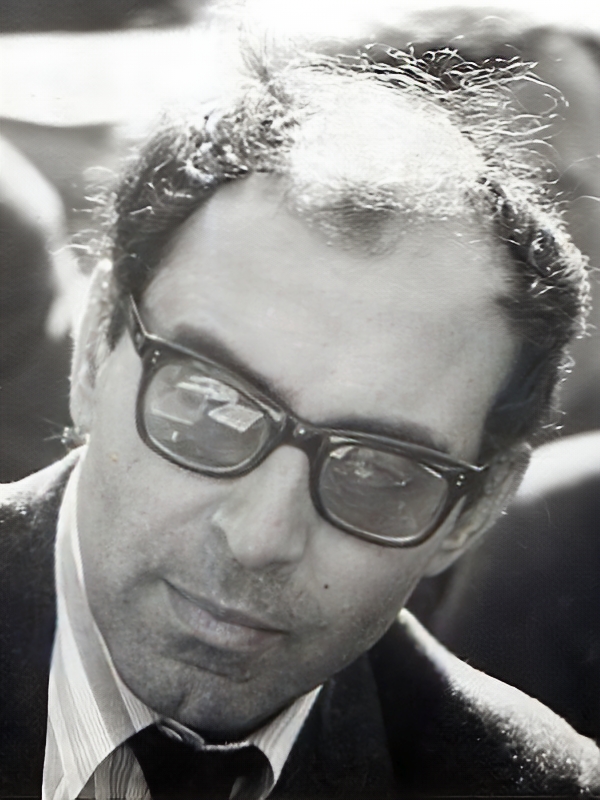
The French–Swiss filmmaker who dismantled cinematic convention with as much rigour as he applied to rebuilding it, making the act of watching a film a form of critical thought.
Jean-Luc Godard made cinema question itself. In films that jump-cut mid-sentence, address the audience directly, and refuse the consolations of narrative resolution, he demonstrated that film's most powerful tool is not illusion but interruption — the break that forces the viewer to think about what they are seeing.
Formation and criticism
Godard was born in Paris to a French-Swiss Protestant family of means; he grew up partly in Switzerland and later moved between the two countries, eventually holding only Swiss citizenship. In Paris in the early 1950s he was part of the circle around Henri Langlois's Cinémathèque Française, watching several films a day alongside François Truffaut, Jacques Rivette, Éric Rohmer, and Claude Chabrol. He wrote criticism for Cahiers du Cinéma, the journal that would become the house organ of the New Wave, publishing under the name Hans Lucas.
The Cahiers critics' central argument — that the film director is the author of the work, as the novelist is of the book; that genre films by directors like Howard Hawks and Alfred Hitchcock constitute art — became the theoretical foundation of the movement they would create.
À bout de souffle and the New Wave
À bout de souffle (Breathless, 1960) arrived as a rupture. Shot on location in Paris with a handheld camera and natural light, edited with jump cuts that violated every rule of continuity, and structured around a thriller plot it refused to take seriously, the film gave cinema new tools and made most existing tools look exhausted. It was also a commercial success, which amplified its influence rapidly.
Godard's films of the 1960s — Vivre sa vie (1962), Le Mépris (1963), Bande à part (1964), Alphaville (1965), Pierrot le fou (1965), Week End (1967) — form one of the most productive decades in film history. Each works a different formal problem: how to integrate direct-to-camera address, how to use music against image, how to make political content that does not simply illustrate political argument.
A story should have a beginning, a middle, and an end, but not necessarily in that order.
Political cinema and the Dziga Vertov Group
After the upheaval of May 1968, Godard broke from conventional filmmaking entirely, forming the Dziga Vertov Group with Jean-Pierre Gorin and producing a series of overtly Maoist films designed to be shown to political activists rather than cinema audiences. Tout va bien (1972), with Jane Fonda and Yves Montand, was the most accessible of these works. The period is often characterised as a refusal of cinema's complicity with spectacle.
His return to more widely distributed work in the 1980s — Sauve qui peut (la vie) (1980), Passion (1982), Prénom Carmen (1983) — maintained his formal radicalism within a more legible framework. Histoire(s) du cinéma (1988–1998), a video essay project in eight parts, stands as his most sustained theoretical work: a meditation on cinema, history, and the twentieth century that draws on thousands of film clips, texts, and musical fragments.
Legacy
Godard used aide au suicide — assisted dying, legal in Switzerland — to end his life on 13 September 2022, aged 91. His influence on world cinema is pervasive: the directors of the Taiwanese New Wave, Iranian cinema, American independent film of the 1980s–90s, and beyond acknowledge his formal precedents. The jump cut, the direct address, the refusal of narrative comfort — these are now the common vocabulary of any cinema that wishes to think.