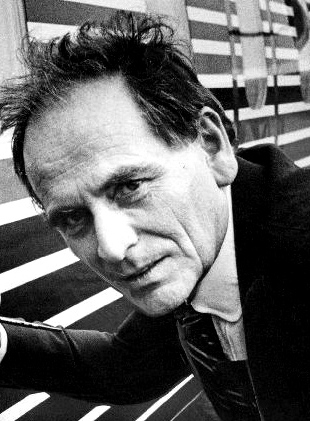
Jean-Paul Gaultier

The French couturier who turned fashion's outsiders — punks, drag queens, the street — into the vocabulary of haute couture, and did so with a wit that kept it from becoming mere provocation.
Jean-Paul Gaultier built a house of fashion out of what fashion had previously refused: the corset worn as outerwear, the skirt on a man, the sailor stripe beside the bondage harness. His subversion was not shock for its own sake but a genuine recoding of what clothes mean and who they belong to.
Formation
Gaultier was born in Bagneux, a suburb south of Paris, and raised largely by his maternal grandmother. He has described spending his childhood drawing fashion sketches and styling his teddy bear as a corset-wearing model. Without formal training at any fashion school, he sent sketches to Pierre Cardin at seventeen; Cardin hired him. He subsequently worked for Jacques Esterel and Jean Patou before founding his own label in 1976.
The autodidact's path shaped his sensibility: he arrived in fashion without absorbing its prohibitions, and his work would spend decades testing each of them.
The label and its language
Gaultier's collections of the late 1970s and 1980s drew from sources that French haute couture had ignored — London punk, Hasidic dress, workwear, fetish culture, street fashion from multiple continents. The cone bra bodice, which he first showed in the 1980s and which Madonna wore on her 1990 Blond Ambition World Tour, became one of the most photographed garments of the decade. It did not provoke simply; it argued that the undergarment-as-outerwear had a sartorial logic and a power that conventional fashion suppressed.
His introduction of skirts for men in 1984 was received as a stunt; it has proved to be a more durable challenge to the binary organisation of fashion. He maintained it across subsequent decades without treating it as a novelty.
Fashion is a mirror of society. My job is to show all of society, not just the comfortable parts of it.
Perfume and popular culture
In 1993 Gaultier launched Le Mâle, a men's fragrance housed in a torso-shaped bottle modelled on a sailor's body. The bottle has itself become a design object. He designed the costumes for several of Luc Besson's films, including The Fifth Element (1997), extending his visual language into cinema.
His television programme Eurotrash (1993–2004), co-presented on Channel 4 in the United Kingdom, brought his persona — irreverent, camp, boundary-testing — to a mass audience that had little access to his clothes.
Haute couture and the final chapter
Gaultier ended his ready-to-wear line in 2014 to concentrate on haute couture. In 2020, following the death of his long-time partner Francis Menuge in 1990 and his colleague Michel Goma, he staged a final haute couture show and indicated that the house would continue through guest designers — an unusual model that has allowed the label to persist without a permanent successor. The brand maintains its couture calendar in Paris.