Jean-Paul Sartre
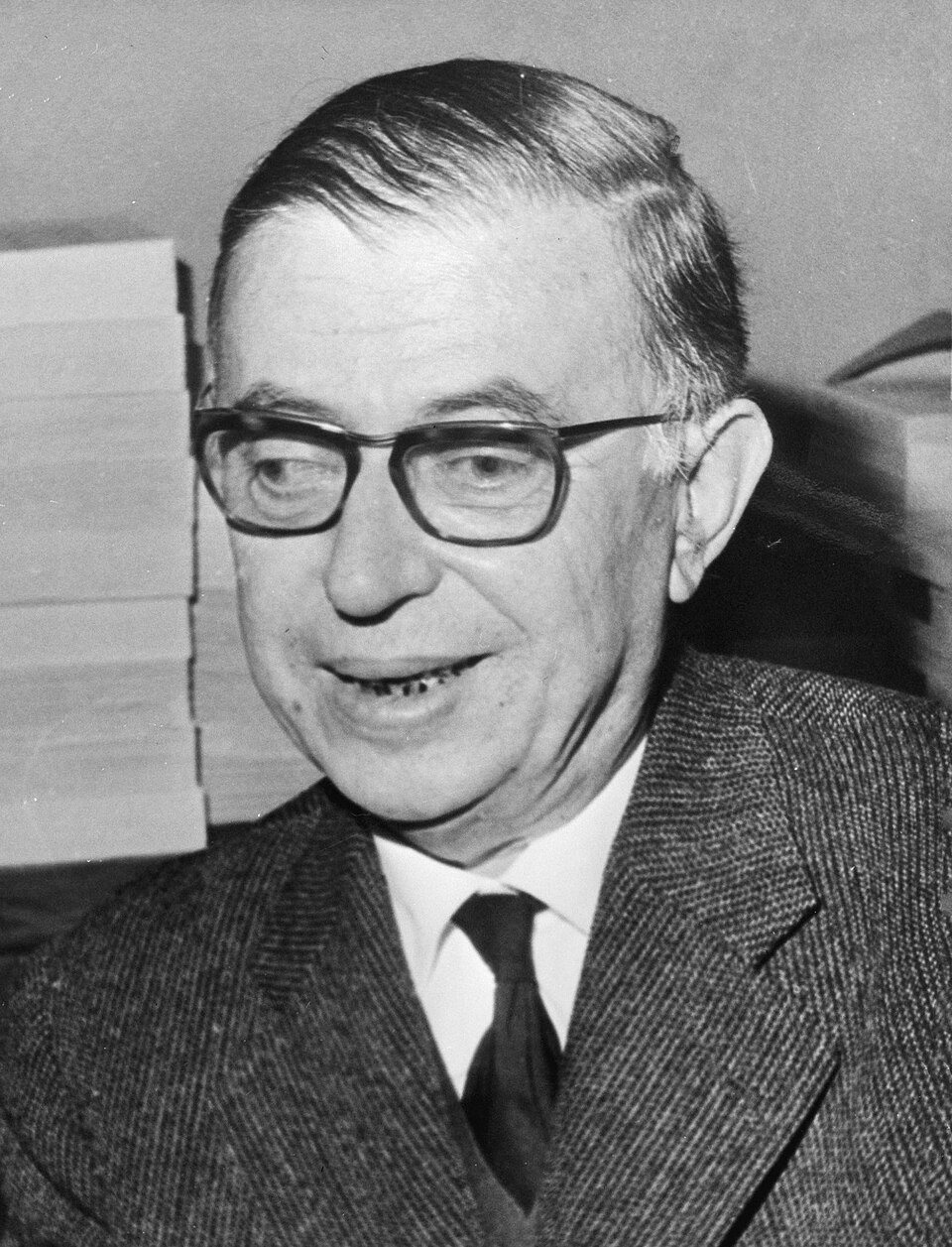
The French philosopher who placed freedom and its attendant anguish at the centre of human existence, and lived out those contradictions with an insistence that made him the defining public intellectual of postwar Europe.
Jean-Paul Sartre argued that existence precedes essence — that there is no given human nature, no predetermined purpose, and therefore no excuse: we are entirely responsible for what we become. The weight of that position drove his philosophy, his plays, his novels, and his political engagements for five decades, making him the figure in whom the twentieth century's hope and bad faith are most legibly recorded.
Formation
Sartre was born in Paris in 1905, the son of a naval officer who died before his second birthday. He was raised by his mother and maternal grandfather, Charles Schweitzer, a teacher of German whose library gave Sartre an early and encyclopaedic literary education. At the École Normale Supérieure in Paris, where he studied philosophy, he met Simone de Beauvoir in 1929; the relationship — conducted as a pact of intellectual equals and transparent non-exclusivity — would define both their lives and their public positions.
He completed his agrégation in philosophy in 1929, began teaching in Le Havre, and spent the year 1933–34 in Berlin on a scholarship studying Husserl's phenomenology, which became the technical foundation of his own thought.
Being and Nothingness and existentialism
Being and Nothingness (1943), written partly while Sartre was a German prisoner of war, is the central text of French existentialism. Drawing on Heidegger and Husserl, it argues that human consciousness — pour-soi, being-for-itself — is characterised by its freedom: unlike a stone or a table, a human being has no fixed nature. This freedom is inescapable and therefore terrifying; bad faith is the strategy of pretending it is otherwise, of acting as though one's choices are determined.
The argument entered popular culture immediately. No Exit (1944) — the play that contains the line frequently paraphrased as "hell is other people" — staged the existentialist situation as a three-person prison. Nausea (1938), the novel Sartre had published before the war, gave the same themes a visceral literary form.
Existence precedes essence.
Political engagement and the Nobel
After 1945 Sartre became France's most visible public intellectual. He co-founded and edited Les Temps Modernes, engaging with Marxism, anti-colonialism, and the Algerian war. His positions were often wrong, sometimes defensively so — his prolonged sympathy for Soviet positions in the early Cold War period and his complex relationship to Stalinism have been extensively criticised. His break with Albert Camus in 1952 over the question of Soviet labour camps remains one of the defining intellectual ruptures of the century.
In 1964 he was awarded the Nobel Prize in Literature, which he declined — citing his consistent refusal of official honours and his view that a writer should not become an institution. The refusal was itself a public act continuous with his philosophical commitments.
Later work and legacy
His late work included the Critique of Dialectical Reason (1960), an attempt to reconcile existentialism and Marxism; the autobiography Words (1964); and an unfinished biography of Flaubert, The Family Idiot, of which three volumes appeared before his death in 1980. He died nearly blind, attended by de Beauvoir, in Paris.
Sartre's influence is simultaneously philosophical, literary, and political — and more complex than either his reputation as a Cold War moralist or his caricature as a café philosopher suggests. His insistence that philosophy is always also a form of political practice shaped the French intellectual tradition that followed him, from Foucault to Derrida.