Jean Prouvé
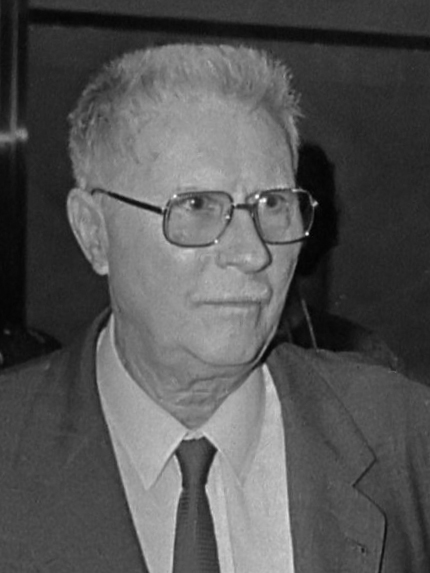
The French metal-worker and self-taught architect who proved that industrial manufacturing and genuine beauty were not opposites but the same ambition pursued honestly.
Jean Prouvé never held an architecture licence, yet Le Corbusier called him a constructeur — a builder in the fullest sense — because his work achieved what most architects cannot: structures and objects whose formal elegance is inseparable from their industrial logic. Every fold in his steel was both structural and beautiful.
Formation in metal
Prouvé was born in Paris in 1901 into an artistic family — his father Victor Prouvé was a leading figure of the École de Nancy, the Art Nouveau movement centred on Nancy, in eastern France. Jean trained as a metalsmith and blacksmith under Émile Robert in Paris, absorbing a craft ethic that held materials and their treatment to be the primary source of form. He established his own atelier in Nancy in 1923.
His early work was decorative ironwork — grilles, railings, stair balustrades — executed with a precision that attracted architectural commissions. But from the early 1930s he shifted systematically toward a different problem: how to use the techniques of metal fabrication — bending, pressing, welding, riveting — to build structures at scale.
Prefabrication and the constructeur
The decade of the 1930s established Prouvé's central argument. Working with architects including Robert Mallet-Stevens and later with Le Corbusier, he developed curtain-wall systems, prefabricated façade panels, and furniture ranges — notably the Standard Chair (1934) and the Antony Chair (1950) — in which the distribution of structural forces is made visually legible by the asymmetry of the legs. The heavier rear leg carries the greater load; the form tells the truth about the structure.
During and after the Second World War, Prouvé applied prefabrication to urgent need: demountable schools, emergency housing for bombed-out families in Lorraine, and the Maison des Jours Meilleurs — prefabricated housing designed to be built quickly and moved if necessary. He ran the Ateliers Jean Prouvé in Maxéville from 1947, producing building components in industrial quantities.
Never design anything that cannot be made.
Furniture and architecture as the same problem
Prouvé's furniture is inseparable from his structural thinking. The Standard Chair, the Compass Table, the Cité Chair — all designed for mass production, all resolved through the logic of material and load rather than stylistic choice. The visual character that results — angular, direct, technically evident — looks designed precisely because it was worked out from the inside rather than applied from the outside.
His Maison Tropicale (1949–51), designed as a demountable prefabricated house for use in French West Africa, was shipped in pieces to Niamey and Brazzaville; surviving examples have since achieved extraordinary auction prices as icons of the postwar industrial aesthetic.
Dismissal and recognition
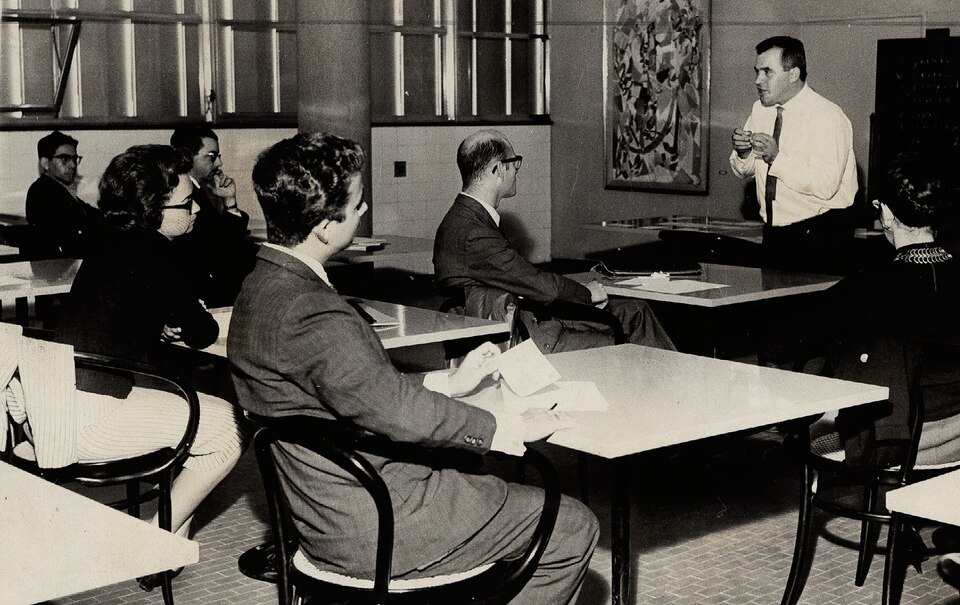
In 1953, following a disagreement with the financial backers of Ateliers Jean Prouvé, Prouvé was forced out of the company he had built. He subsequently ran a small consultancy and taught — at the Conservatoire National des Arts et Métiers, and at the École Polytechnique — but never rebuilt the industrial capacity that had made his large-scale work possible. He was appointed to the jury that selected the design for the Centre Pompidou in 1971, lending his authority to Renzo Piano and Richard Rogers's radical structural proposal.
His posthumous reputation has grown considerably since the 1990s, with major retrospectives and a secondary market for his furniture that has made original pieces extremely valuable.