Jean Renoir
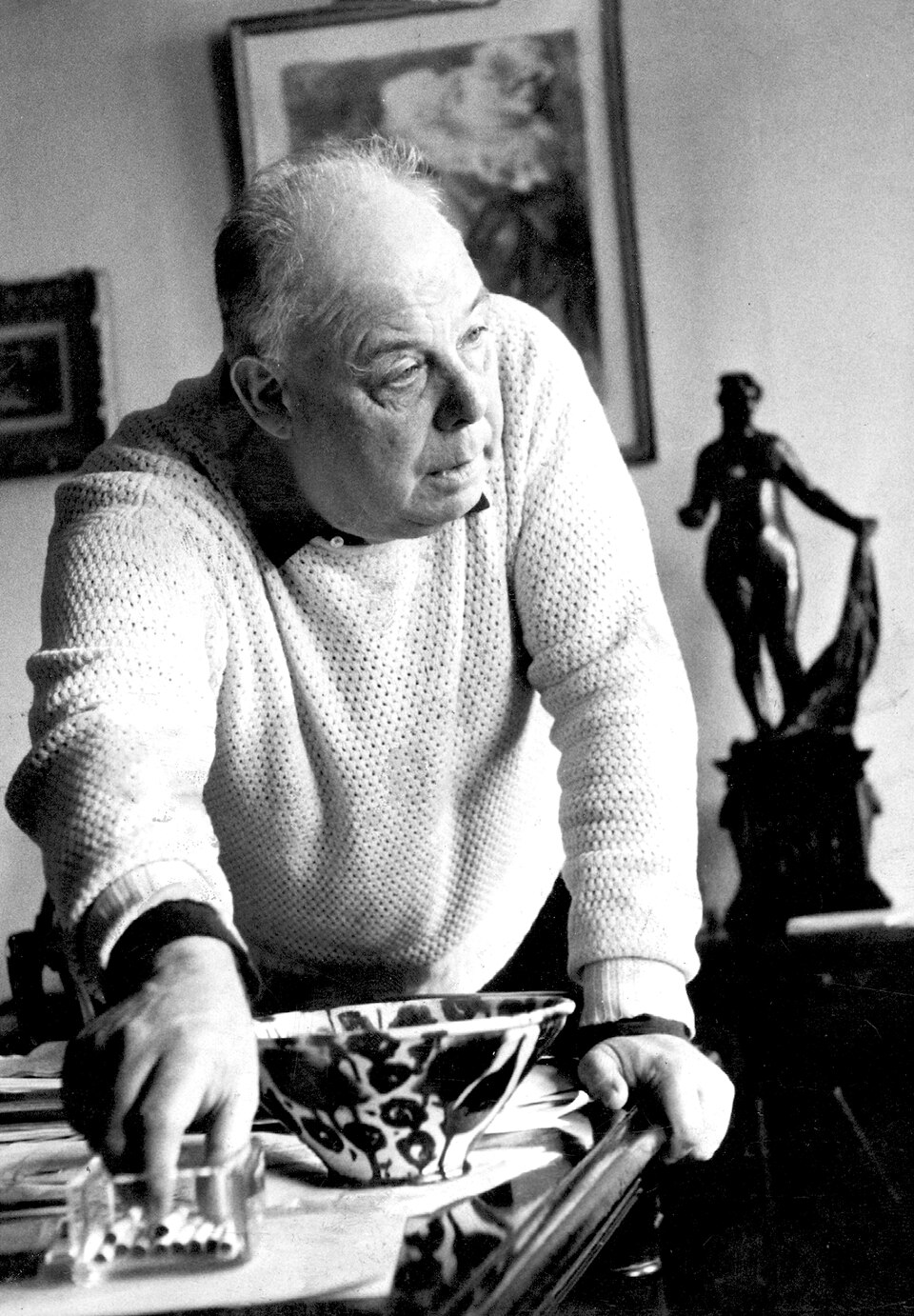
Son of an Impressionist painter, he became the cinema's great humanist — a director who found grace, contradiction, and class in the same frame.
Jean Renoir made films the way his father painted — by looking at people until their contradictions became coherent. Over five decades, working in France, Hollywood, India, and Italy, he built a body of work whose two masterpieces, La Grande Illusion and The Rules of the Game, remain among the most closely studied films ever made.
Origins and inheritance
Born in Paris in 1894 as the second son of Pierre-Auguste Renoir, Jean grew up surrounded by artists, models, and the physical world of paint and light. The household shaped his eye: an attention to texture, gesture, and the surfaces through which inner life leaks out. He was wounded in the First World War, an experience that fed directly into the pacifist current running through his mature work.
He made his first films in the 1920s, financing early silents partly from the sale of his father's canvases. The decade taught him camera mechanics; it also introduced him to the social world — workers, performers, petty criminals — that would populate his best work.
The prewar masterpieces
The late 1930s produced the films on which Renoir's reputation rests. La Grande Illusion (1937) placed French prisoners of war alongside a German commandant and dissolved the logic of national enmity in favour of class solidarity and individual dignity. The film was banned in Germany and Italy on release. Two years later, The Rules of the Game (1939) turned an aristocratic country-house weekend into a dissection of a society too polite to acknowledge its own collapse. Audiences rioted at the Paris premiere; the film was cut, shelved, and later reconstructed into what critics now recognise as one of cinema's supreme achievements.
Both films share a formal signature: deep-focus photography that keeps background and foreground equally sharp, allowing multiple actions and meanings to coexist within a single shot. The critic Penelope Gilliatt wrote that a Renoir shot could be identified "in a thousand miles of film."
Hollywood exile and return
After the fall of France, Renoir moved to the United States, where he made a series of films — including Swamp Water (1941) and The Southerner (1945) — that engaged with American landscape and social texture without quite finding the same register as his French work. He gained American citizenship but remained a visitor in sensibility.
The return to international co-production brought The River (1951), the first colour film shot in India, made with his nephew, cinematographer Claude Renoir. The film's slow, lyrical attention to life on the banks of the Ganges signalled a late style: less plot, more contemplation.
Legacy
Renoir was one of the first filmmakers to whom the word auteur was seriously applied. The critics at Cahiers du cinéma — Truffaut, Godard, Rivette — held him as a founding argument for the idea that a director's personal vision gives a film its coherence. He received an Honorary Academy Award in 1975 and was ranked fourth in the BFI's 2002 poll of the greatest directors. His influence runs from the French New Wave through American naturalist cinema and beyond: the belief that a camera placed among real people, in real light, in real places, yields something no studio set can manufacture.
A director makes only one movie in his life. Then he breaks it into pieces and makes it again.