Johann Wolfgang von Goethe
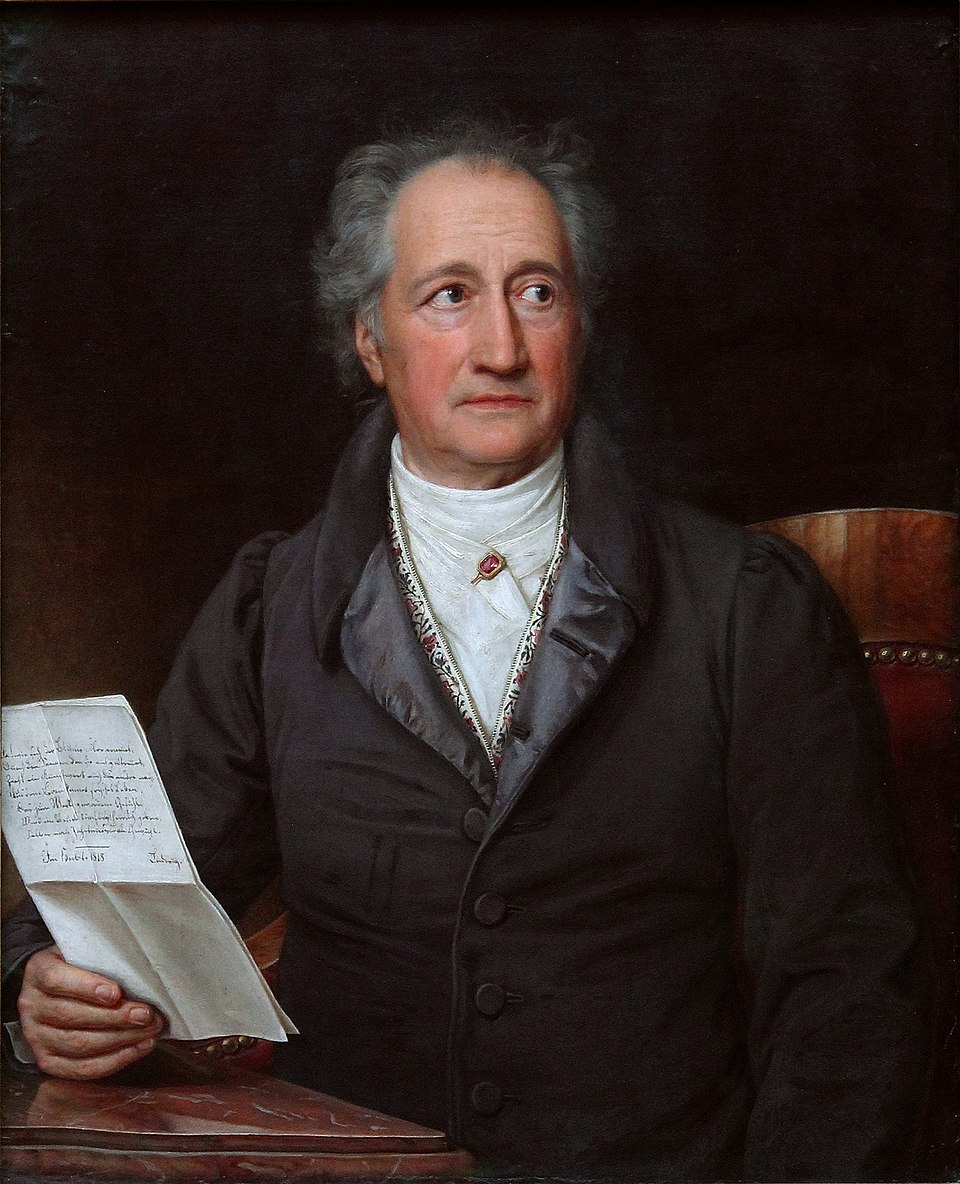
The German polymath whose restless ambition stretched from lyric poetry to colour theory and became the measure of an age.
Johann Wolfgang von Goethe spent eighty-two years producing — poems, novels, plays, scientific treatises, autobiography. He is the writer by whom the German language is most often measured, and Faust is the work European literature most readily offers as its secular scripture.
The sensation of Werther
Born in Frankfurt in 1749 into a wealthy bourgeois family, Goethe studied law at Leipzig and Strasbourg while writing poetry. In 1774 he published The Sorrows of Young Werther — an epistolary novel whose lovesick, suicidal hero caused a sensation across Europe. The book launched Goethe's international reputation before he was twenty-five and gave Romantic literature one of its founding templates.
Weimar and the classical turn
In 1775 Duke Karl August of Saxe-Weimar invited Goethe to his court. He accepted, and Weimar became his home for the rest of his life. A decade later, an extended journey to Italy (1786–1788) redirected his sensibility: the excesses of Sturm und Drang gave way to the ordered, formal ideals of Weimar Classicism. His friendship and correspondence with Friedrich Schiller, from 1794 until Schiller's death in 1805, produced one of the great intellectual partnerships in German letters.
More light!
Faust and the late work
Faust Part One appeared in 1808 — the product of decades of drafting that began in the 1770s. Part Two, vastly more complex and allegorical, was sealed and published only after his death in 1832, as Goethe had requested. The two parts together constitute the most ambitious single literary project in the German language.
His Theory of Colours (Zur Farbenlehre, 1810) was his own preferred achievement — a sustained polemic against Newton's optics that proved scientifically wrong but influenced painters, including Turner, and later Wittgenstein.