Johannes Kepler
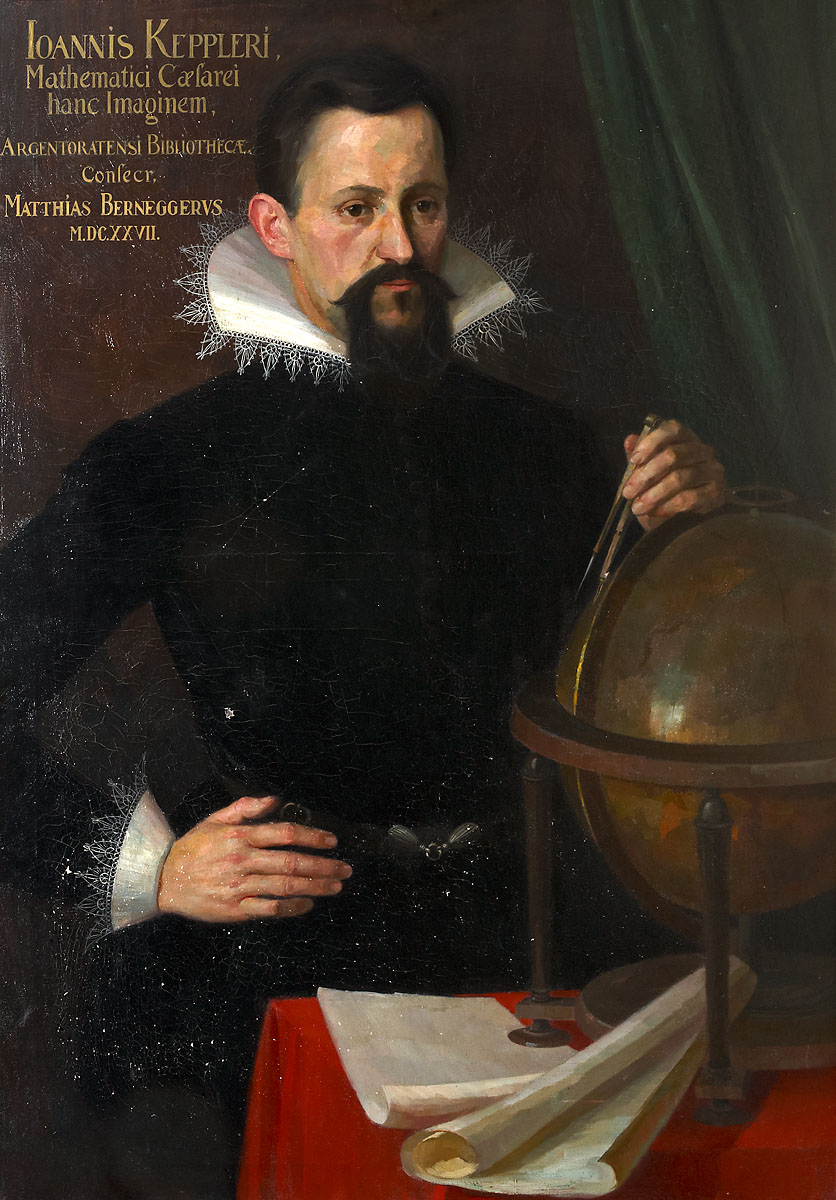
The German astronomer who replaced circular orbits with ellipses and gave the planets their true paths through the solar system.
Johannes Kepler dismantled the perfect sphere as the shape of the cosmos. Using Tycho Brahe's meticulous observations of Mars, he showed that planets travel in ellipses with the Sun at one focus, sweeping equal areas in equal times — three laws that Newton would later explain by gravity and that remain the foundation of orbital mechanics.
Early life and formation
Kepler was born on 27 December 1571 in Weil der Stadt, in the Duchy of Württemberg. His family was poor and his health precarious — he suffered smallpox as an infant, leaving him with weak eyesight and permanently damaged hands, which made detailed astronomical observation difficult. He attended the University of Tübingen on a scholarship, where he studied theology and encountered the Copernican heliocentric hypothesis, which he became convinced was correct.
He moved to Graz to teach mathematics and astronomy. There he began speculating about the geometry of the solar system and published his first major work, the Mysterium Cosmographicum (1596), which attempted to explain the spacing of the planets using the five Platonic solids nested inside one another. The physical model was wrong, but the mathematical ambition was genuine and brought him to the attention of Tycho Brahe.
The laws of planetary motion
In 1600 Kepler joined Tycho Brahe in Prague. When Brahe died in 1601, Kepler inherited his archive of planetary observations — the most precise data yet compiled, made without a telescope. He spent the next decade analysing Mars, whose orbit most obviously deviated from a circle.
His Astronomia nova (1609) announced the first two laws: planets move in ellipses with the Sun at one focus, and a line from the Sun to a planet sweeps equal areas in equal times. The second law implies that planets move faster when closer to the Sun. These results demolished the assumption of circular, uniform motion that had governed astronomy since antiquity.
A decade later, Harmonice Mundi (1619) stated the third law: the square of a planet's orbital period is proportional to the cube of the semi-major axis of its ellipse. This gave the ratio of orbits a precise mathematical form.
The heavenly motions are nothing but a continuous song for several voices, perceived not by the ear but by the intellect.
Other contributions
Kepler founded the field of mathematical optics. His Astronomiae Pars Optica (1604) explained how the eye works and described the refraction of light through lenses. He designed an improved refracting telescope — the Keplerian telescope — using two convex lenses. He also developed approximation techniques in mathematics that anticipated integral calculus, and he studied the geometry of snowflakes and packing problems.
Legacy
Kepler's three laws gave Isaac Newton the empirical constraints he needed to derive the inverse-square law of gravity and generalise it into the Principia. Every satellite orbit, every interplanetary trajectory, is calculated using Kepler's laws with Newtonian corrections. He is also credited with writing one of the earliest works of science fiction, Somnium (published posthumously 1634), imagining a voyage to the Moon.