John Keats
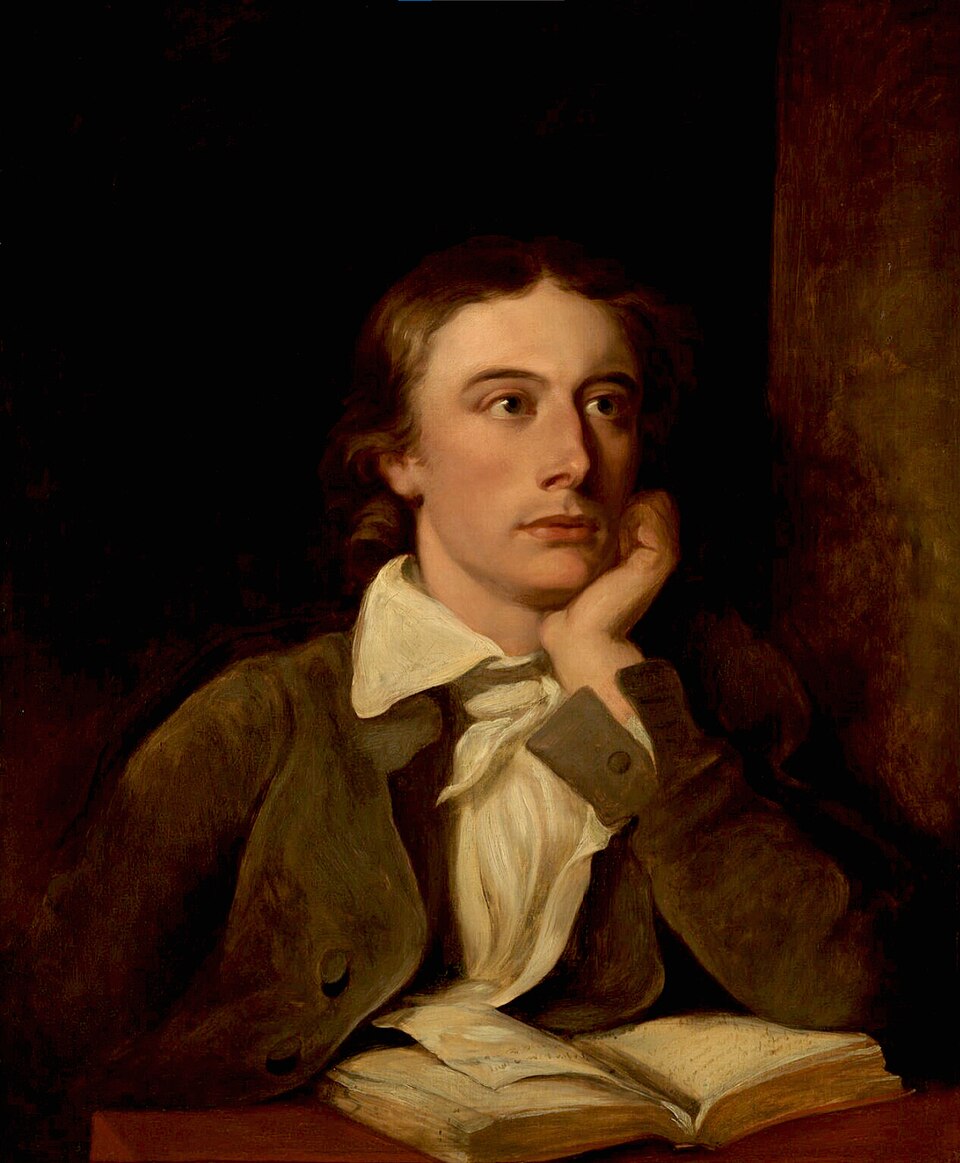
The poet who produced some of the finest odes in English in a single year and died of tuberculosis at twenty-five, before his fame had even begun.
John Keats had fewer than four years of active publication, yet produced in the spring of 1819 a sequence of odes — among them "Nightingale," "Grecian Urn," and "To Autumn" — that stand as the finest concentration of lyric achievement in the English Romantic period.
Origins and training
Born in London (Moorgate) in 1795, Keats lost both parents young — his father in a riding accident, his mother to tuberculosis — and was raised by guardians. He trained as a surgeon and apothecary, qualifying in 1816, but abandoned medicine for poetry after meeting Leigh Hunt and encountering the circle of London literary radicals. His first significant poem, the sonnet "On First Looking into Chapman's Homer" (1816), announced an imagination of unusual sensory richness and mythological confidence.
His debut collection Poems (1817) was largely ignored. Endymion (1818) — a four-thousand-line narrative poem — drew savage reviews, most notoriously from the Quarterly Review (though Keats remained contemptuous rather than crushed). He cared less for his contemporary reception than for what he called "negative capability" — the capacity to remain in uncertainty without irritably reaching after fact and reason.
The odes of 1819
In the spring and summer of 1819, from a house in Hampstead, Keats wrote in rapid succession "Ode to a Nightingale," "Ode on a Grecian Urn," "Ode on Melancholy," "Ode to Psyche," and "To Autumn." These poems develop a sustained and complex engagement with transience, beauty, and the impossibility of holding experience still. The final line of "Ode on a Grecian Urn" — "Beauty is truth, truth beauty" — is among the most discussed lines in English poetry. "To Autumn," written in September 1819, is regarded by many critics as the most formally perfect poem in the language.
Beauty is truth, truth beauty, — that is all Ye know on earth, and all ye need to know.
Final years and death
Keats's health had been declining; in 1820 he diagnosed himself with tuberculosis from the arterial blood in his cough. He sailed for Rome that autumn, hoping the climate would help. He died in Rome in February 1821, at twenty-five. His gravestone, at the Protestant Cemetery in Rome, bears the epitaph he dictated himself: "Here lies One Whose Name was writ in Water."
Legacy
Keats was placed in the canon of English literature by the end of the nineteenth century. The Encyclopædia Britannica of 1888 described "Ode to a Nightingale" as "one of the final masterpieces." The Pre-Raphaelites, the Aesthetic movement, and Tennyson all drew on his sensory density and his theme of beauty imperilled by time. His letters — published posthumously — are among the most searching accounts of the creative process in English.