John von Neumann
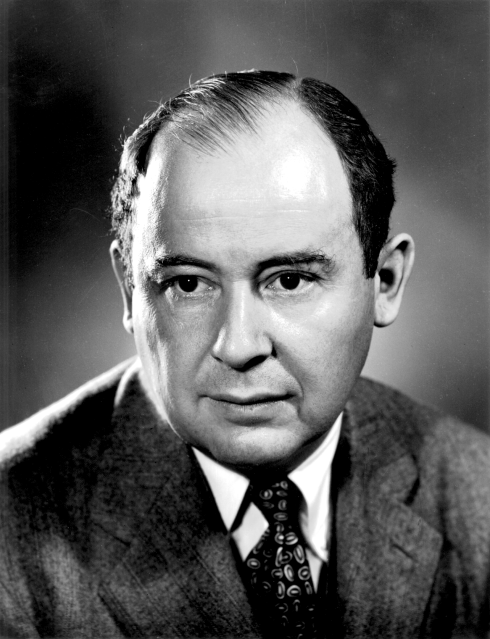
The Hungarian-American polymath who built the mathematical foundations of quantum mechanics, game theory, and the modern stored-program computer.
John von Neumann may have had the widest intellectual range of any twentieth-century scientist. He made foundational contributions to pure mathematics, quantum physics, economics, and computer science — often in the same decade — and the architecture of nearly every digital computer built since his death bears the structural imprint of his 1945 report on the EDVAC.
Budapest and early prodigy
Von Neumann was born Neumann János Lajos in Budapest on 28 December 1903 into a wealthy Jewish banking family. His memory and computational facility were noticed early: reportedly he memorised the Budapest telephone directory as a child. He studied chemistry at the University of Berlin and the ETH Zurich while simultaneously pursuing mathematics at the University of Budapest, where he received his doctorate in 1926.
At twenty-three he published his axiomatisation of set theory, which resolved issues left open by earlier formulations. By his mid-twenties he had made major contributions to quantum mechanics, operator algebras, and the theory of games.
Quantum mechanics and functional analysis
His 1932 book Mathematische Grundlagen der Quantenmechanik (Mathematical Foundations of Quantum Mechanics) gave quantum theory the rigorous functional-analytic framework it needed. Von Neumann introduced Hilbert space formalism as the proper setting for quantum states and operators, and proved that matrix mechanics and wave mechanics — two apparently different theories — were mathematically equivalent. The book remained the standard mathematical reference for quantum physics for decades.
He also developed the theory of operator algebras (later called von Neumann algebras), which became central to modern functional analysis and, eventually, to quantum field theory.
Game theory and economics
Von Neumann's 1928 minimax theorem established the mathematical foundations of game theory: in any finite two-person zero-sum game, there exists a pair of mixed strategies such that each player minimises their maximum loss. The 1944 book Theory of Games and Economic Behavior, co-authored with Oskar Morgenstern, applied this framework to economics and launched game theory as a discipline.
In mathematics you don't understand things. You just get used to them.
The computer and the Manhattan Project
In 1933 von Neumann joined the newly founded Institute for Advanced Study in Princeton, where he remained for the rest of his life. During World War II he consulted on the Manhattan Project, contributing to the hydrodynamics of implosion for the Fat Man bomb design.
His most enduring technological legacy is the von Neumann architecture described in the 1945 First Draft of a Report on the EDVAC: a computer in which program instructions and data share the same memory, processed sequentially by a central unit. This design — rather than machines with fixed programs — is the structural principle of virtually every general-purpose computer built since.