Jorge Luis Borges
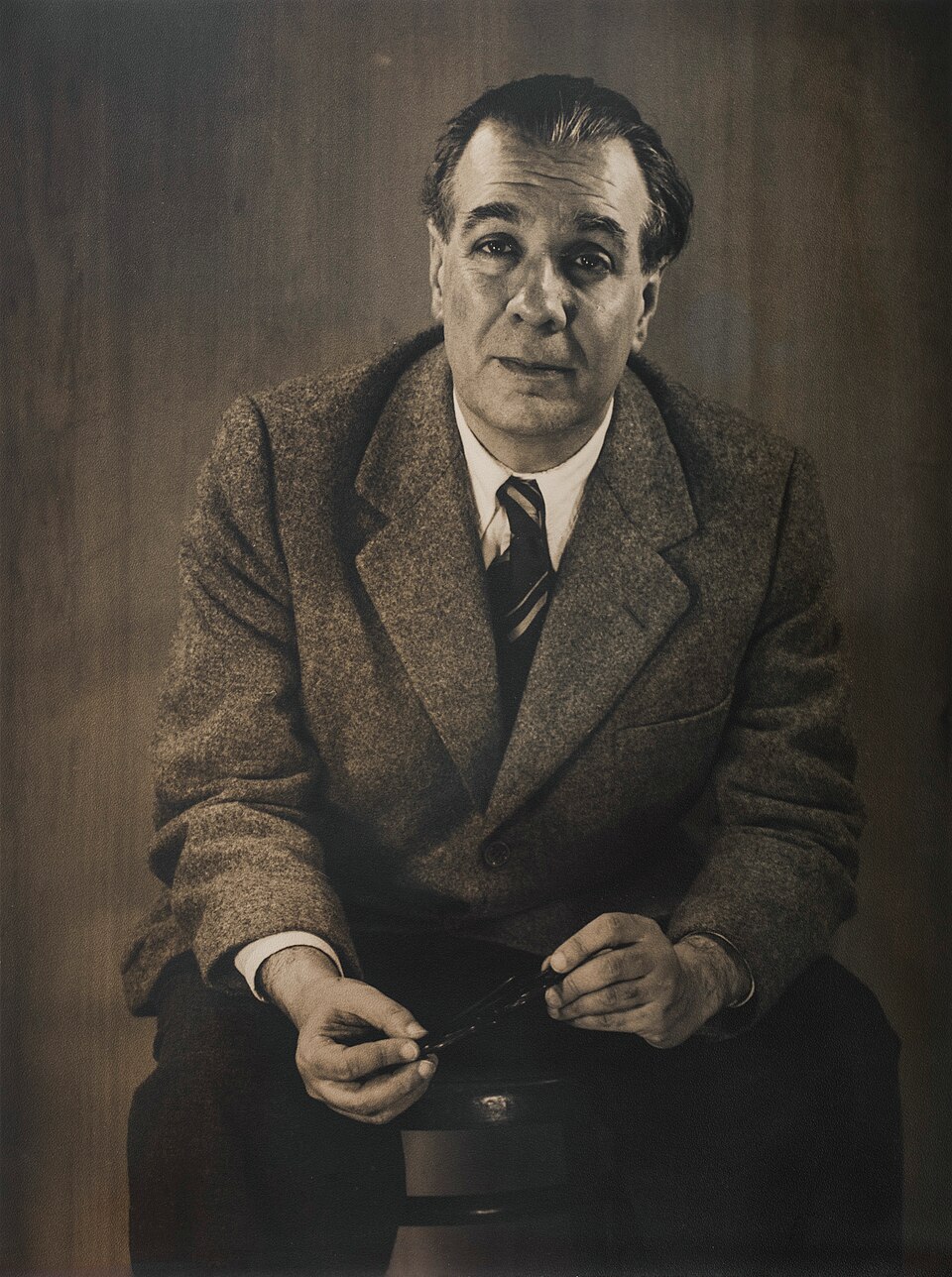
An Argentine writer who turned the short story into a philosophical instrument, mapping infinite libraries, forking gardens, and cyclical time with the precision of a mathematician and the wonder of a dreamer.
Jorge Luis Borges published no novels, yet no writer of the twentieth century did more to reshape what fiction could think. Working in the compressed space of the short story and the essay, he constructed a body of work in which labyrinths, mirrors, encyclopaedias, and infinite libraries function as both metaphor and argument — a literature of ideas that remains formally irresistible.
Buenos Aires and Geneva
Borges was born in Buenos Aires in 1899 into a bilingual household: his father's library included English-language books, and Borges later recalled reading Cervantes first in English translation. When he was fifteen the family moved to Geneva, where he completed his secondary schooling during the First World War, learning French and German and encountering the German Expressionists and Schopenhauer. The family returned to Spain briefly before settling back in Buenos Aires in 1921. There Borges joined the ultraísta poetry movement and began publishing in literary magazines, though he later repudiated his early verse as overwrought.
The invention of the Borges story
The decisive decade was the 1940s. Working as a cataloguer at a municipal library — a position he held for nine years — Borges produced the two collections that would secure his reputation internationally. Ficciones (1944) gathered stories that had appeared in the literary journal Sur, including "The Garden of Forking Paths," "The Lottery in Babylon," and "Pierre Menard, Author of the Quixote" — fictions that dissolved the boundary between essay and narrative and that proposed time, identity, and authorship as their true subjects. El Aleph (1949) continued the project, adding "The Aleph" itself, in which a single point in a Buenos Aires basement contains all points in space simultaneously.1
The stories share recurrent machinery — the labyrinth, the mirror, the library, the double — but no two deploy it identically. What unites them is a quality of rigorous whimsy: each begins from a single speculative premise and follows it with complete logical consistency.
Blindness and late recognition
Borges had poor eyesight from childhood, inherited from his father. By the mid-1950s he was effectively blind. He was appointed Director of the National Library of Argentina in 1955 — the same year he lost his sight entirely — a coincidence he memorialised in a celebrated poem, noting the irony that God had granted him "books and blindness at one touch." He turned increasingly to poetry and oral lecture as modes of composition. International recognition came via the Prix Formentor, which he shared with Samuel Beckett in 1961, and a wave of translations — notably into French and English — transformed him from a celebrated Argentine into a world figure.
Legacy
Borges died in Geneva in 1986. His influence on subsequent literature is pervasive and sometimes invisible: Umberto Eco, Don DeLillo, Paul Auster, and Salman Rushdie all bear his marks, and the entire apparatus of postmodern metafiction can be traced partly to his innovations. He never won the Nobel Prize in Literature — a canonical oversight — but his absence from that list has not diminished his standing.
Time forks perpetually toward innumerable futures.
Footnotes
- Borges noted that the name Aleph, the first letter of the Hebrew alphabet, was used by Cantor to denote the first transfinite cardinal — a mathematical infinite that appealed to the story's cosmological ambitions. ↩