Josef Koudelka
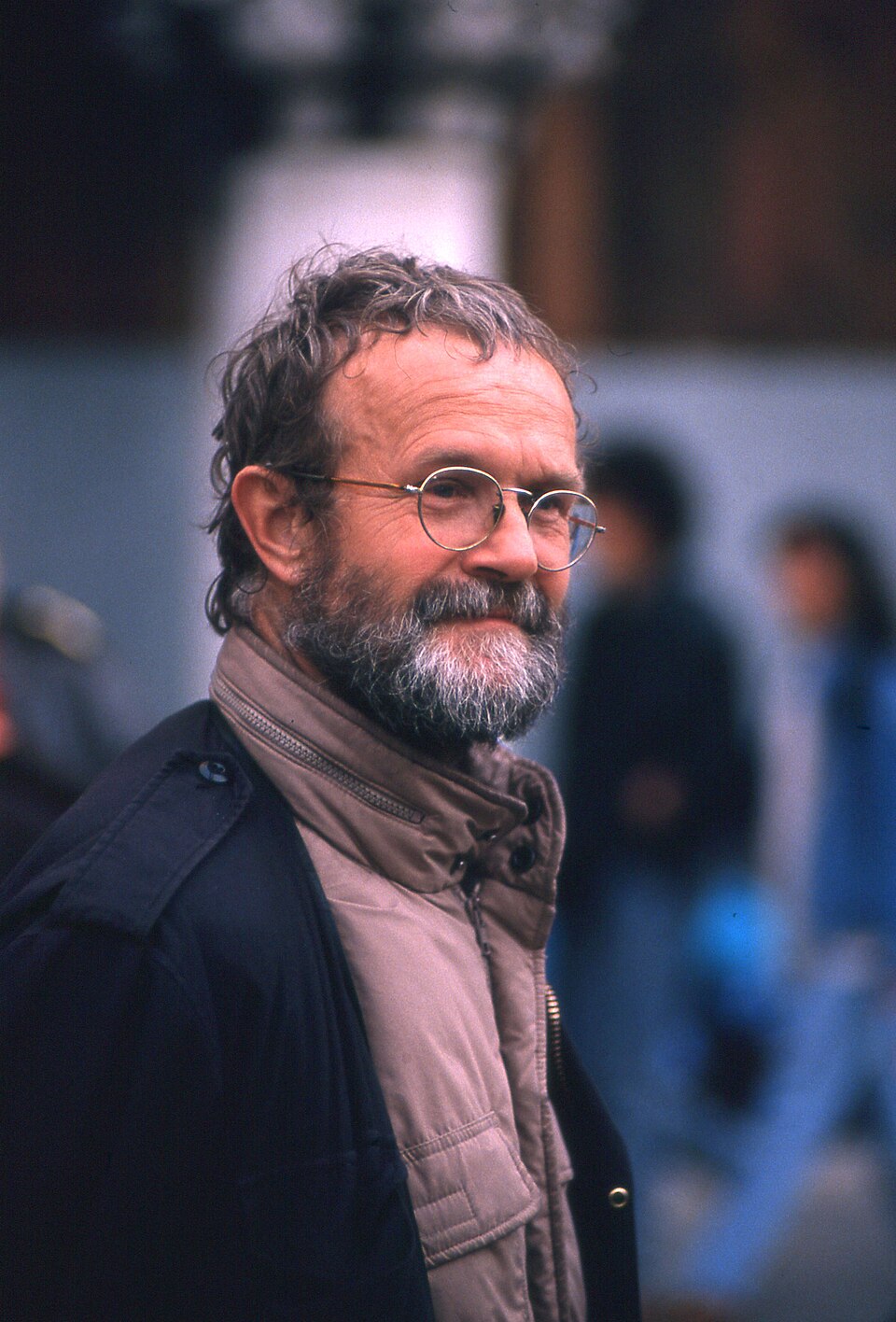
The Czech photographer who documented the Soviet invasion of Prague in 1968, went into exile, and spent the next fifty years recording dispossession and landscape with uncommon intensity.
Josef Koudelka trained as an aeronautical engineer before becoming one of the defining photographers of exile, displacement, and the drama of the margins — defined first by his clandestine documentation of the Soviet invasion of Czechoslovakia in 1968, and sustained across five decades of work with Roma communities, European landscapes, and the archaeological record of the ancient world.
Formation and early work
Koudelka was born in 1938 in Boskovice, Moravia. He trained as an aeronautical engineer at the Czech Technical University in Prague, a background that gave him the disciplined visual thinking of technical drawing without the romantic assumptions of an art education. He had been photographing since his teens and began his serious photographic career in the early 1960s, working primarily in theatre — documenting Czech theatre productions — while simultaneously documenting the Roma communities of Slovakia and Moravia.
The Roma work, carried out over several years of sustained access and trust, became the foundation of his first major book. The photographs are close, dark, and physically immediate — shot at the edges of communities, at celebrations and funerals and markets, without the distancing ethnographic eye.
Prague 1968
In August 1968 Soviet-led Warsaw Pact forces invaded Czechoslovakia, ending the Prague Spring. Koudelka was in Prague and photographed the invasion and the resistance that followed — tanks in the streets, citizens confronting soldiers, the particular atmosphere of a city that has just been occupied. He worked for days in the city, filling rolls of film.
The photographs were smuggled out of the country through Magnum Photos and published anonymously in the West under the credit "P.P." — Prague Photographer — to protect Koudelka and his family. The images circulated widely, appearing in The Sunday Times Magazine and other publications. In 1969, the photographs received the Robert Capa Gold Medal from the Overseas Press Club of America, awarded anonymously.
I am a nomad. I have no home. I carry everything I need with me.
Exile and Magnum
In 1970, Koudelka left Czechoslovakia on a short-term permit and did not return. He was stateless for more than a decade, travelling through Europe on an International Travel Document (a Nansen passport). He joined Magnum Photos in 1971 as a nominee and became a full member in 1974.
During his years of statelessness he made his most concentrated work: Gypsies (1975, published by Delpire and then Aperture) collected his Roma photographs in a landmark photobook. Exiles (1988) gathered images from his years of European wandering — figures in empty landscapes, landscapes without figures, the feeling of displacement made visual. French citizenship was granted in 1987.
He received the Prix Nadar in 1978, the Grand Prix National de la Photographie in 1989, the Grand Prix Henri Cartier-Bresson in 1991, and the Hasselblad Foundation International Award in 1992. Exhibitions of his work have been held at MoMA New York, the Hayward Gallery London, and the Palais de Tokyo Paris.