Karl Marx
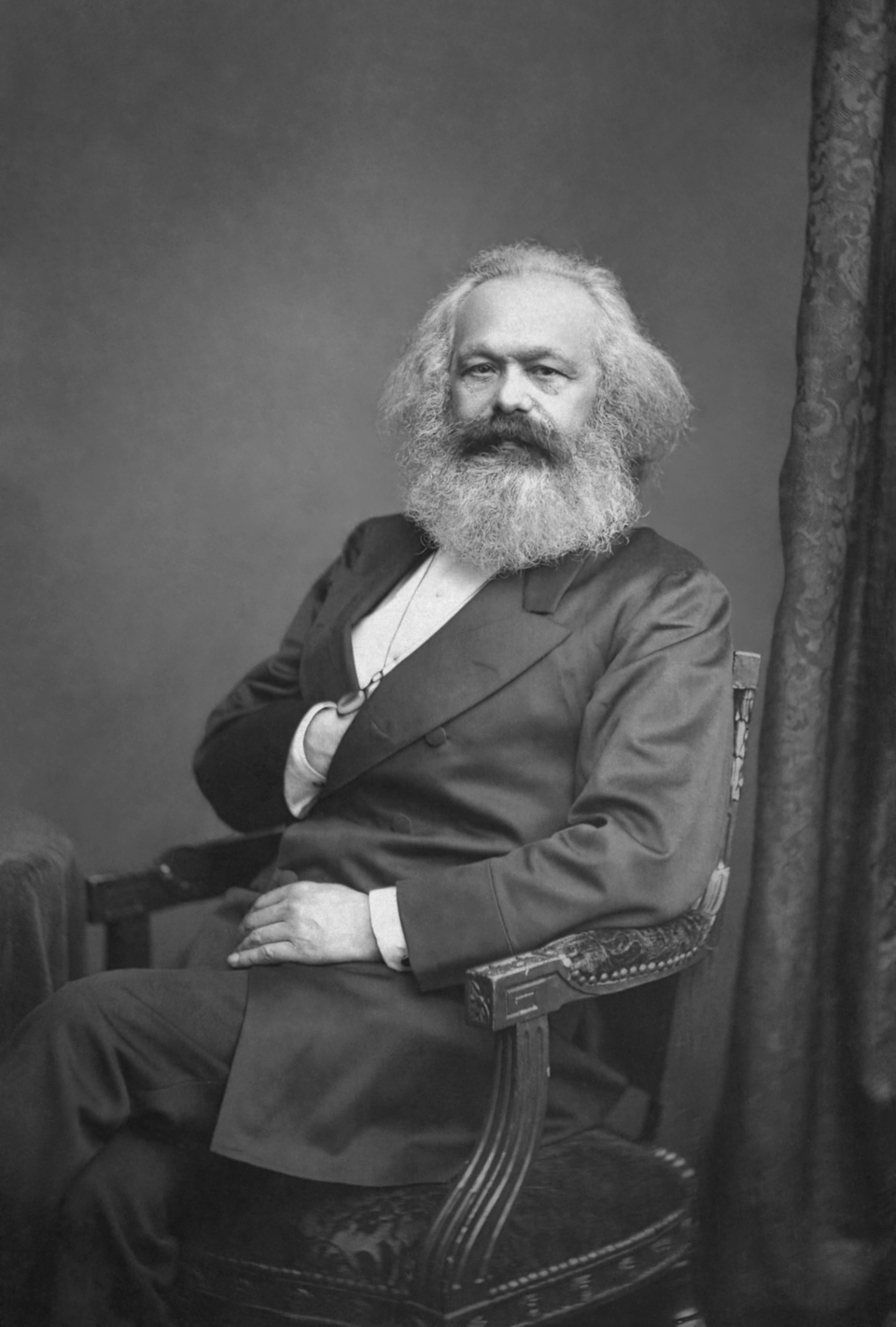
The German philosopher who diagnosed capitalism through the lens of history and class struggle, producing texts that shaped the political landscape of the next two centuries.
Karl Marx built an analysis of capitalism from the ground up — from the labour theory of value and the mechanics of commodity production to a sweeping theory of historical change driven by class conflict. His conclusions were not merely academic: they became the intellectual foundation for revolutionary movements across four continents.
Formation
Marx was born in Trier, in the Rhineland of the Kingdom of Prussia, in 1818. He studied law and then philosophy at Bonn and Berlin, immersing himself in the left-wing followers of Hegel who tried to apply Hegel's dialectical method to social rather than purely metaphysical questions. His doctoral dissertation examined Greek atomism, but his attention quickly turned toward journalism, censorship, and the economic conditions of the Rhineland peasantry. Expelled from Prussia and then France, he eventually settled in London in 1849, where he would spend the rest of his life working in the British Museum Reading Room and corresponding with revolutionaries across Europe.
The Communist Manifesto and political economy
In 1848 Marx and Friedrich Engels published The Communist Manifesto, a pamphlet commissioned by the Communist League. Its opening declaration — that the history of all hitherto existing society is the history of class struggles — announced the core of Marx's method: the materialist conception of history, in which the economic base of a society (who owns the means of production, how labour is organised) determines its political and cultural superstructure.
The Manifesto called for the proletariat to seize political power from the bourgeoisie. It was a brief, polemical text. The decade-spanning project of Das Kapital was Marx's attempt to ground that call in rigorous economic analysis. Volume I, published in 1867, examined the commodity form, the extraction of surplus value from wage labour, and the tendency of capital to accumulate and concentrate. Marx completed only volume I in his lifetime; Engels edited volumes II and III from notes after Marx's death.
The history of all hitherto existing society is the history of class struggles.
Method and intellectual legacy
Marx's method — historical materialism — insists that ideas, laws, and political institutions are shaped by the material conditions of production rather than the other way around. He criticised the classical economists (Smith, Ricardo) for naturalising capitalism's categories, presenting historically specific relations as eternal facts. His critique of ideology — the claim that dominant ideas in any era tend to be the ideas of the ruling class — has remained productive far beyond Marxist circles.
The political legacy is enormous and contested. Marxism informed the Russian, Chinese, Cuban, and Vietnamese revolutions among others; it also inspired social-democratic labour movements, trade unionism, and the welfare state in liberal democracies. The divergence between revolutionary and reformist uses of his work was present from the start — Marx himself reportedly said late in life that he was not a Marxist.