Katherine Johnson
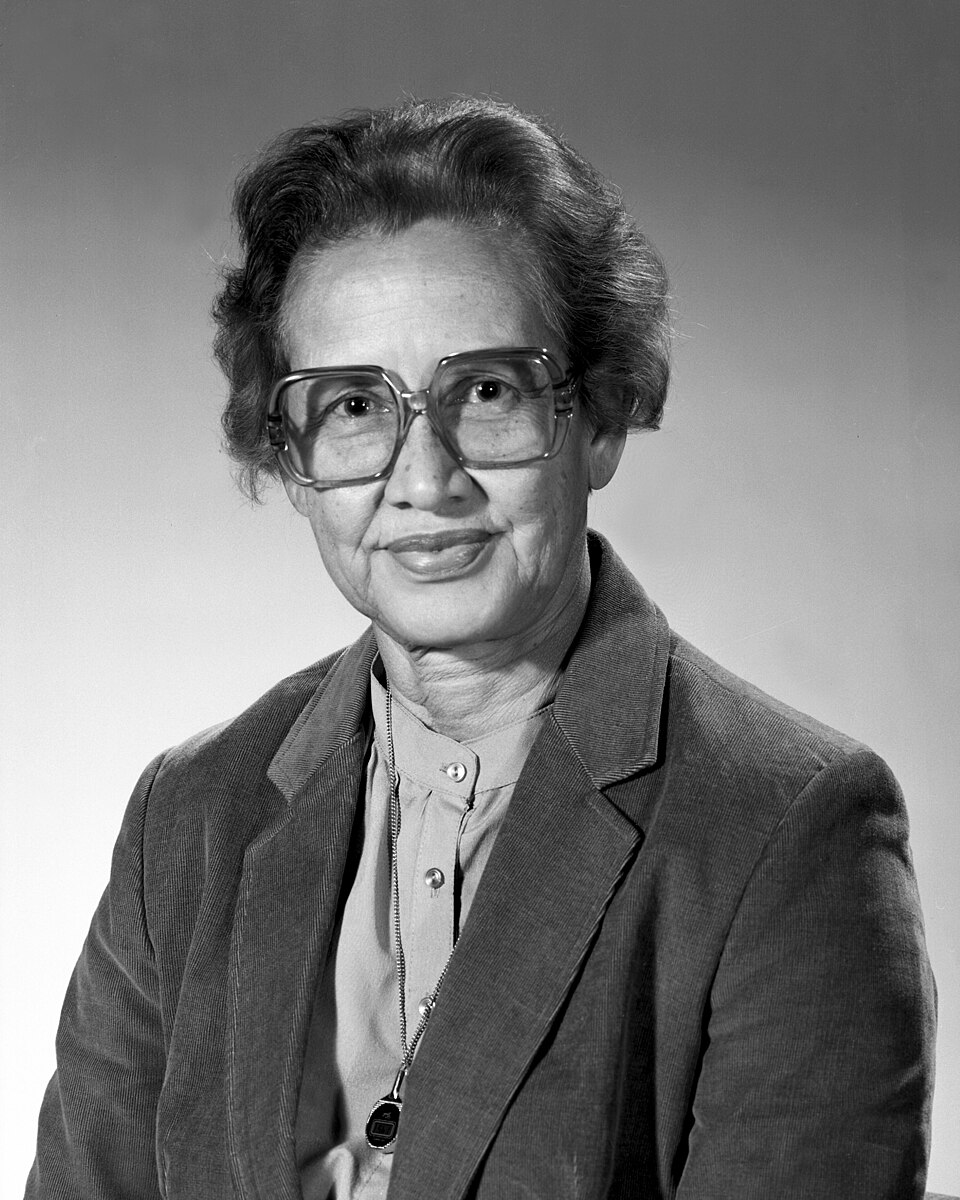
The West Virginia mathematician whose hand-calculated orbital trajectories were so trusted by astronauts that they refused to fly until she personally verified the computer's numbers.
Katherine Johnson worked for thirty-three years at NASA and its predecessor as a "human computer" — a title that in her hands was not a limitation but a standard of accuracy that electronic machines were measured against. Her calculations shaped the trajectories of the first American in space, the first lunar landing, and the rescue of Apollo 13.
Early life and education
Katherine Coleman was born in White Sulphur Springs, West Virginia, on 26 August 1918, the youngest of four children. Her mathematical aptitude was evident early; her father drove the family 125 miles each school year to Institute, West Virginia, because Greenbrier County provided no public schooling for Black children beyond grade eight. She enrolled at West Virginia State College at thirteen and graduated summa cum laude in 1937 with degrees in mathematics and French. She was one of three Black students — and the only woman — selected to integrate West Virginia University's graduate programme in 1940, though she left after one semester to start a family.
NACA and the "human computers"
In 1953 Johnson joined the National Advisory Committee for Aeronautics (NACA, NASA's predecessor) at Langley Memorial Aeronautical Laboratory in Hampton, Virginia. She was assigned to a pool of Black women mathematicians — collectively called "human computers" — who performed calculations by hand that engineers then used in research reports.1
Johnson's ability to locate herself precisely within the mathematical frame of any problem she was given quickly distinguished her. She moved into the Space Task Group, where she was among the first women to be credited as an author on a NASA research report — a breach of informal convention that she achieved through straightforward persistence.
Orbital mechanics and the space programme
Johnson's most consequential work began with Alan Shepard's 1961 suborbital flight, for which she calculated the trajectory. When John Glenn prepared for the first American orbital flight in 1962, NASA had by then acquired IBM electronic computers to handle the calculations. Glenn refused to fly unless Johnson personally verified the machine's output — a stipulation that speaks to the trust she had earned. Her numbers matched; Glenn flew.
She contributed calculations to the Apollo programme throughout the 1960s, including the lunar landing trajectories for Apollo 11 in 1969. After the Apollo 13 oxygen tank explosion in 1970, her backup procedures helped plot the trajectory that brought the crew safely home. She continued working at NASA until her retirement in 1986.
Recognition
For most of her career Johnson's contributions were not publicly known. Recognition came late and dramatically: in 2015 President Obama awarded her the Presidential Medal of Freedom. NASA named a research facility after her — the Katherine G. Johnson Computational Research Facility, dedicated in 2017. The same year, the film Hidden Figures brought her story — and those of her colleagues Dorothy Vaughan and Mary Jackson — to wide public attention. Johnson died on 24 February 2020, aged 101.
I counted everything. I counted the steps to the road, the steps up to church, the number of dishes and silverware I washed. Anything that could be counted, I did.
Footnotes
- The West Area Computing unit at Langley operated under racial segregation imposed by Virginia law until the early 1960s. The women worked in a separate building and used separate dining and bathroom facilities. Johnson moved to the Flight Research Division in 1958, effectively integrating that unit's working space. ↩