László Moholy-Nagy
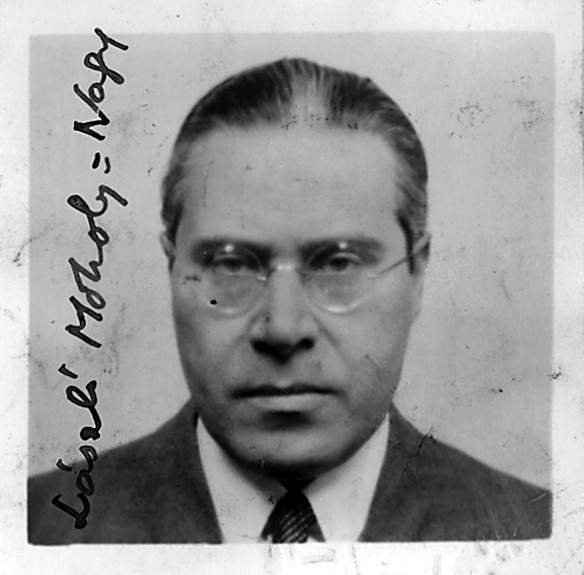
The Hungarian-American artist who treated light itself as a medium — pioneering photography without a camera, kinetic sculpture, and a pedagogy that redefined design education in America.
László Moholy-Nagy brought constructivism's faith in technology and abstraction into the Bauhaus and then carried Bauhaus pedagogy to Chicago, where he founded the New Bauhaus in 1937 — transferring European modernist design education to American soil with a new urgency and scope.
Origins and constructivist formation
Moholy-Nagy was born in 1895 in Bácsborsód, Hungary. He studied law before turning to art, and his early work was shaped by his encounter with constructivism — the Russian avant-garde movement that held that art must engage with technology, industry, and the material conditions of modern life. Constructivism's vocabulary of geometric abstraction, photomontage, and typographic experiment is visible throughout his subsequent practice.
Bauhaus master
In 1923 Moholy-Nagy joined the Bauhaus in Weimar as a master, appointed by Walter Gropius. He took over the preliminary course — the Bauhaus's foundational design programme — and the metalworking workshop, replacing Johannes Itten and bringing a decisively more technology-oriented approach to the preliminary curriculum. Where Itten had emphasised spiritual and personal expression, Moholy-Nagy foregrounded material investigation, industrial process, and visual analysis.
His years at the Bauhaus, which ran until 1928, were among the most productive of his career. He experimented with typography, photomontage, stage design, film, and what he called Fotogramme — photograms, cameraless photographs made by placing objects directly on light-sensitive paper and exposing them to light. The technique was not new, but Moholy-Nagy systematised it, theorised it, and published it as a method for investigating light, shadow, and form.
The enemy of photography is the convention, the fixed rules of the 'how-to.' The salvation of photography comes from the experiment.
Light-Space Modulator
The Light-Space Modulator (1930) is his most discussed object. A motorised kinetic sculpture of perforated metal, glass, and chrome, it was built to project patterns of moving light onto surrounding walls — the sculpture was inseparable from the light it cast. Moholy-Nagy used the Modulator as the basis for a short film, Light Play: Black and White and Grey (1930), extending the investigation into cinema. The object connects his concern for light as a plastic medium to his longstanding interest in the relationship between static object and temporal experience.
After the Bauhaus
After the Bauhaus closed in 1933 Moholy-Nagy moved to London, where he worked in advertising and exhibition design, then to Amsterdam and finally to Chicago. In 1937 he founded the New Bauhaus in Chicago, later renamed the School of Design and eventually incorporated into the Illinois Institute of Technology as the Institute of Design. The school transplanted the Bauhaus's preliminary course and workshop structure into an American context, training a generation of American designers in the same empirical, material-focused method that Moholy-Nagy had developed in Weimar and Dessau.
He died of leukemia in Chicago on 24 November 1946, aged 51, less than a decade after arriving in the United States.
Legacy
Moholy-Nagy's influence runs through American design education, photography, and kinetic art. His theoretical writings — particularly Vision in Motion (1947, published posthumously) and The New Vision (1928) — articulated a pedagogy that treated the visual as trainable and the modern environment as both subject and medium. The critic Peter Schjeldahl described him as "relentlessly experimental" — a characterisation that captures the range and restlessness of a career that encompassed painting, photography, film, sculpture, typography, and education.