Le Corbusier
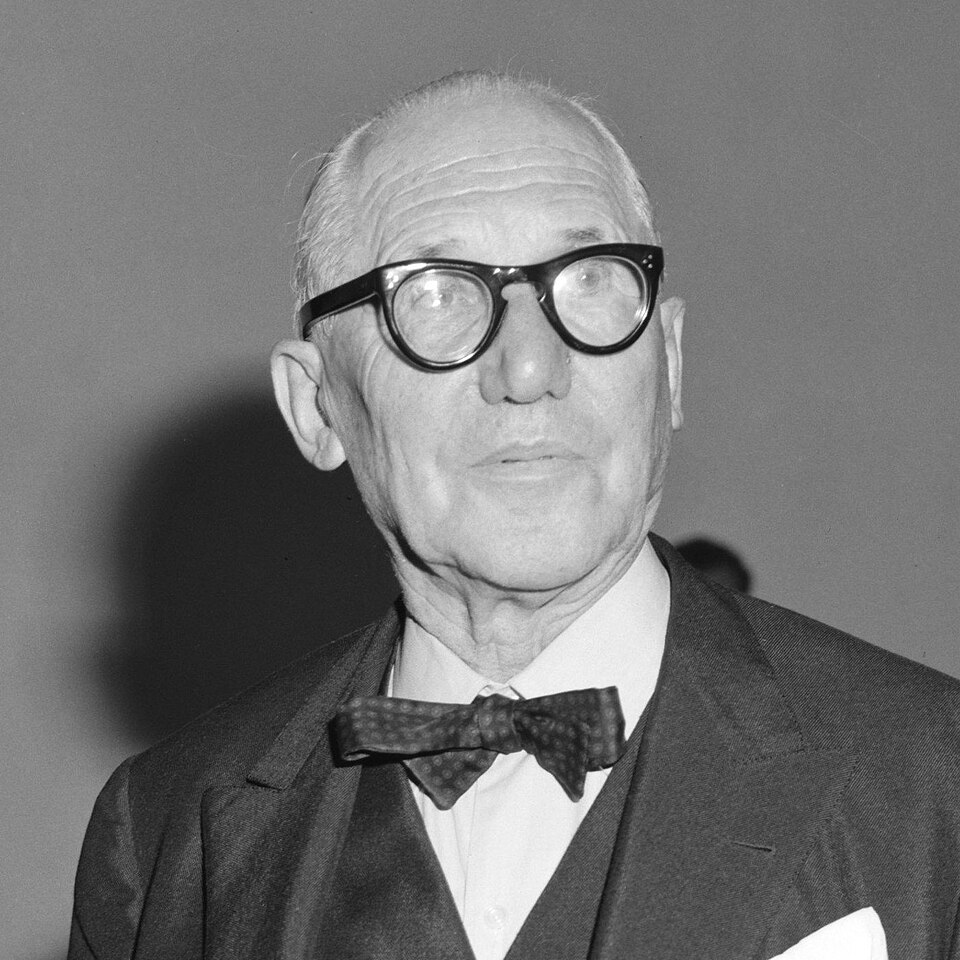
The Swiss-French architect, polemicist, and painter who more than any other individual shaped the vocabulary of 20th-century architecture — and whose ideas about cities carry a legacy that remains deeply contested.
Charles-Édouard Jeanneret, who took the pseudonym Le Corbusier in 1920, was simultaneously the most creative and the most destructive force in 20th-century architecture. His buildings — from the shimmering Villa Savoye to the rough-cast concrete of Chandigarh — are landmarks of formal invention. His urban plans, which proposed demolishing entire districts of Paris and replacing them with towers in parkland, provided theoretical cover for decades of destructive urban renewal programmes across the world.
Formation: Switzerland to Paris
Born in 1887 in La Chaux-de-Fonds, a watchmaking town in Swiss Jura, Jeanneret trained initially as an engraver and attended the local art school. A series of study journeys — to Italy, Vienna, Paris, and Greece — were his real education; the Parthenon in particular became a recurring reference in his writing. He worked briefly in the Paris atelier of Auguste Perret (who taught him reinforced concrete) and in the Berlin office of Peter Behrens (where Walter Gropius and Mies van der Rohe were simultaneous colleagues) before settling in Paris in 1917.
He began publishing under the name Le Corbusier from 1920, writing for the avant-garde journal L'Esprit Nouveau, which he co-edited with the painter Amédée Ozenfant. The journal propagandised for a stripped, rationalist aesthetic — Purism — applied to painting, furniture, and buildings alike.
The Five Points and the white villas
In 1926 Le Corbusier published his Five Points of a New Architecture: pilotis (columns lifting the building off the ground), the free plan, the free facade, the horizontal window, and the roof garden. These principles were not merely formal preferences; they were consequences of the structural logic of reinforced concrete, which freed walls from load-bearing duty. The white villas of the late 1920s embodied these principles with extraordinary elegance.
Villa Savoye (1931) at Poissy is their summation: a pristine white box raised on pilotis above a meadow, its ramp spiralling upward through the building's centre to a roof terrace. As a spatial experience it remains astonishing.1
| Work | Location | Year |
|---|---|---|
| Maison La Roche | Paris | 1925 |
| Villa Savoye | Poissy, France | 1931 |
| Unité d'Habitation | Marseille | 1952 |
| Chandigarh Capitol Complex | Chandigarh, India | 1953–65 |
| Chapel of Notre Dame du Haut | Ronchamp, France | 1954 |
Concrete and scale
After the Second World War, Le Corbusier's language shifted dramatically. The Unité d'Habitation in Marseille (1952) — a monumental concrete housing slab containing 337 apartments, shops, a hotel, and a rooftop running track — applied his pre-war ideas to collective housing at heroic scale. The raw concrete surface, béton brut, gave a name to an entire architectural movement: Brutalism.
The Chapel of Notre Dame du Haut at Ronchamp (1954) was another departure: sculptural, organic, its massive curving roof hovering over white walls punched with irregularly placed windows of coloured glass. It confounded those who had assumed his commitment to rationalism was absolute.
At Chandigarh, designed as the new capital of the Punjab, he worked at urban scale: the Capitol Complex assembling the Secretariat, High Court, and Assembly Building into a monumental ensemble that still functions as designed.
Legacy and controversy
Le Corbusier received few major honours in his lifetime — partly a consequence of the professional animosities his polemical style generated. His posthumous reputation has been shaped by two forces pulling in opposite directions: the recognition of his buildings as masterworks of spatial invention (UNESCO inscribed 17 of them as World Heritage sites in 2016), and the growing documentation of his political history — his collaboration with the Vichy regime during the occupation, and his antisemitic writings — which require acknowledgment rather than diminishment.
His urban ideas — the tower-in-parkland model, the separation of functions, the demolition of street fabric — were adopted by planners worldwide and contributed directly to housing disasters that took decades to diagnose. That this happened through misapplication as much as direct instruction does not absolve the theory.
The Modulor is a measuring tool based on the human body and mathematics.
Footnotes
- Villa Savoye fell into disrepair after the Second World War and was threatened with demolition before the French government classified it as a historic monument in 1965, the year Le Corbusier died; restoration was completed in the 1990s. ↩