Leo Tolstoy
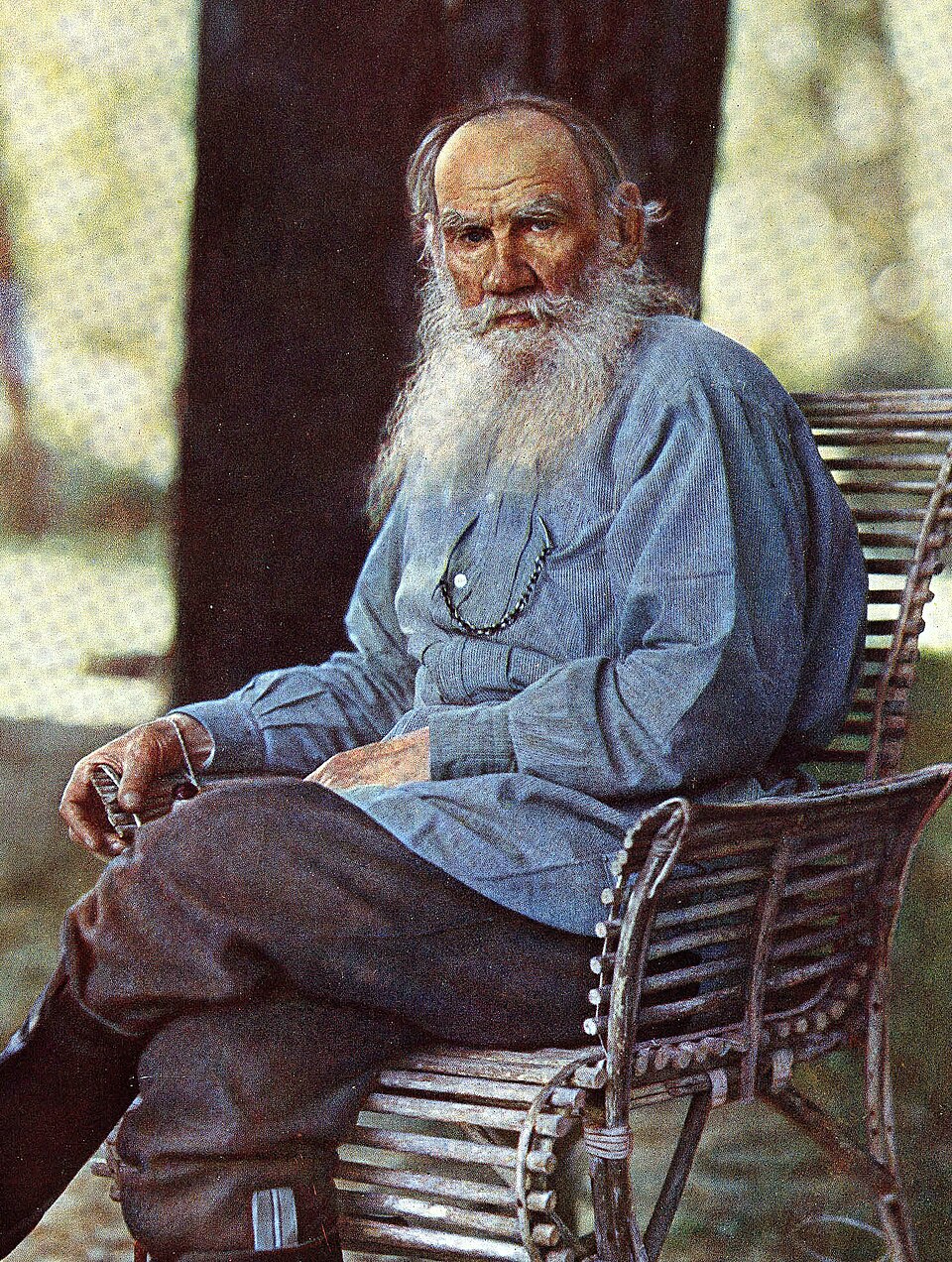
The Russian novelist who wrote two of the longest and most admired novels in world literature and then renounced art and aristocracy alike in favour of a moral philosophy he could not fully live by.
Leo Tolstoy wrote with a breadth and social density that no other European novelist has matched — War and Peace alone contains more than five hundred characters and traces the Napoleonic invasion of Russia across fifteen years — and then spent the second half of his long life arguing that fiction was a vanity and that what mattered was the moral reform of individual life.
Early life and military service
Tolstoy was born in 1828 at Yasnaya Polyana, his family's estate in the Tula region south of Moscow, into one of Russia's minor aristocratic families. He was orphaned young — his mother died before his second birthday, his father when he was nine — and was raised by relatives. He studied at Kazan University without graduating and then, after a period of dissolute life in St Petersburg and Moscow, enlisted in the army in 1851, serving in the Caucasus and then in the Crimean War. His experiences at the siege of Sevastopol produced the Sevastopol Sketches (1855–56), reportorial accounts of war that discarded heroism in favour of the soldier's actual physical experience. They announced the method he would apply at greater scale.
The major novels
Back in Russia after the war, Tolstoy managed his estate, established a school for peasant children, and wrote. War and Peace, serialised from 1865 and published in its final form in 1869, interweaves the private lives of several aristocratic families with the sweep of Napoleon's 1812 Russian campaign. Its historical argument — that great men do not drive events but that events generate the illusion of great men — runs against the grain of the Romantic historiography of its time.
Anna Karenina, published between 1875 and 1878, is more concentrated: the parallel stories of Anna's doomed love affair and Levin's tentative moral self-construction in rural Russia. The novel's moral seriousness and its psychological precision — particularly in rendering Anna's deteriorating mental state — gave it a different quality from the sprawling national panorama of War and Peace.
All happy families are alike; each unhappy family is unhappy in its own way.
The conversion and later work
In the late 1870s and 1880s, Tolstoy underwent a moral and spiritual crisis that he described in A Confession (1882). He became convinced that property, class, art, and institutional religion were all morally corrupt. He renounced the copyright to his later works, gave away money, attempted to dress and work as a peasant, and developed a philosophy — later called Tolstoyanism — centred on nonviolence, the rejection of state authority, and a simplified Christianity stripped of ritual and dogma. Mahatma Gandhi corresponded with Tolstoy and acknowledged a direct debt.
The friction between the converted Tolstoy and his wife Sophia, who managed the household and resented his give-aways of property, filled his later diaries. At the age of eighty-two, he left Yasnaya Polyana secretly in October 1910 and died of pneumonia ten days later at a railway stationmaster's house in Astapovo, having refused to return home.