Leonardo da Vinci
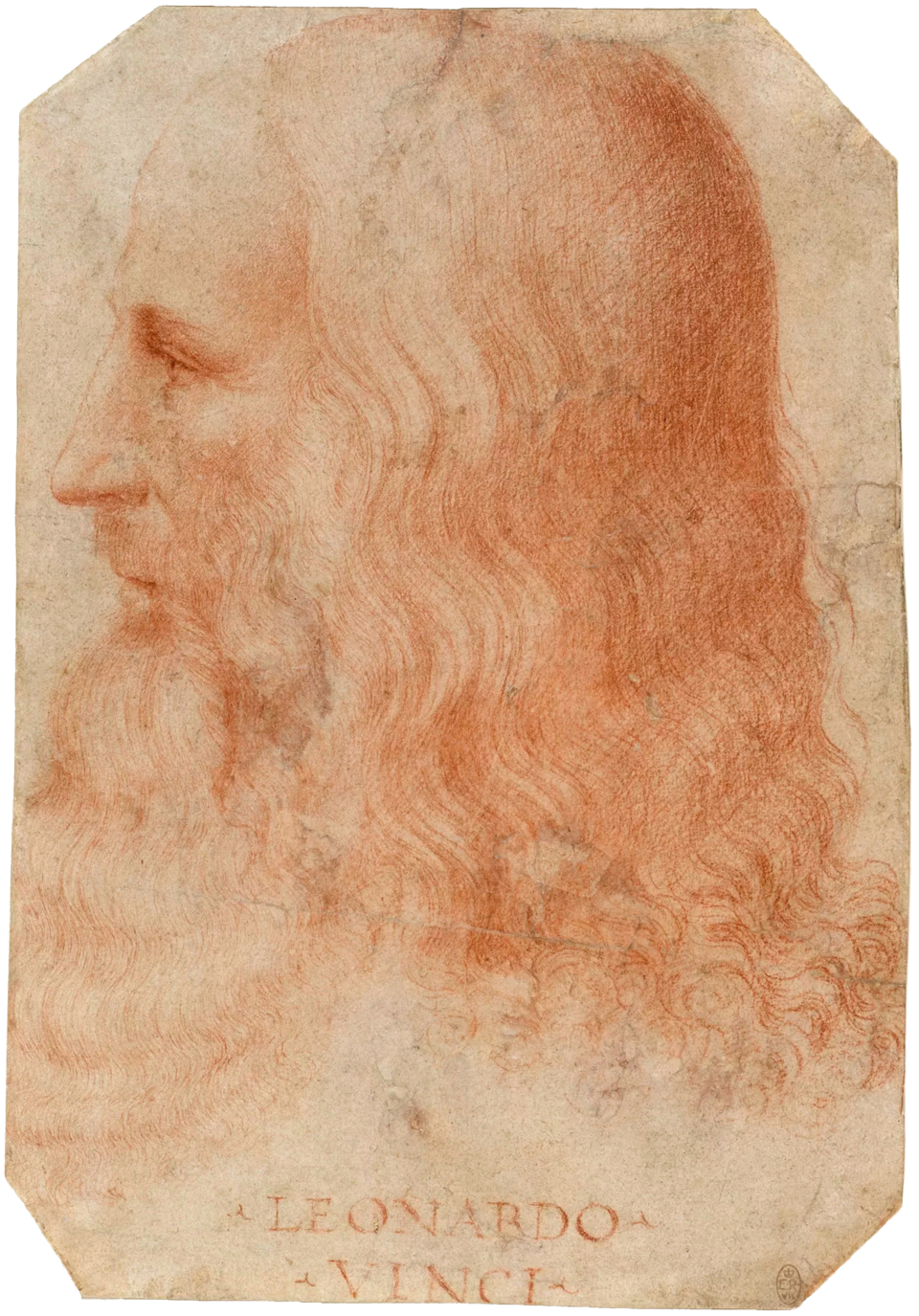
The Florentine polymath who made observation itself a discipline — turning the eye into an instrument of science and the hand into its most precise record.
Leonardo da Vinci is the most complete embodiment of the Renaissance ideal that art and science are a single inquiry. Over six decades he produced a body of paintings of incomparable refinement and notebooks of incomparable scope — drawings and writings on anatomy, hydraulics, flight, geology, optics, and architecture that remained largely unknown to his contemporaries yet mapped the questions that would preoccupy European thought for two centuries after his death.
Origins in Florence
Leonardo was born on 15 April 1452 near the town of Vinci, the illegitimate son of a Florentine notary and a peasant woman. His unusual legal status excluded him from the notarial profession, directing his ambitions elsewhere. Around 1466 he entered the workshop of Andrea del Verrocchio in Florence, the most technically ambitious bottega of the period, where he learned painting, sculpture, goldsmithing, and engineering in parallel. By the time he completed his apprenticeship, contemporaries already recognised him as the most gifted of Verrocchio's pupils.
He remained in Florence under the patronage of Lorenzo de' Medici until 1482, when he moved to Milan to serve Ludovico Sforza as a painter, engineer, and court entertainer — a role that gave him access to libraries, cadavers, and hydraulic problems on a scale unavailable in a painter's studio.
The defining works
The two paintings that secured his enduring reputation were both produced in Milan. The Last Supper, painted on the refectory wall of Santa Maria delle Grazie between 1495 and 1498, reorganised the traditional subject around a single psychological moment — Christ's announcement of the betrayal — and arranged the twelve apostles in groups whose gestures and expressions make visible the emotional shock radiating outward from the centre. The technique Leonardo chose, applying tempera and oil to a dry plaster ground rather than the standard fresco method, meant the work began to deteriorate almost immediately; it has been described as the most studied and most damaged painting in history.
The Mona Lisa, begun probably around 1503 and worked on until shortly before his death, is smaller and quieter than its fame suggests. Leonardo used sfumato — the gradual modulation of tone without hard contour — to give the sitter an atmospheric presence no earlier portrait had achieved. The landscape behind her recedes through geological ages. The smile is not a smile so much as a state of attention that the eye cannot fully resolve.
Method and notebooks
Leonardo's notebooks — some 7,200 pages survive from an estimated original of over 13,000 — record a mind that could not separate looking from understanding. He dissected more than thirty human corpses, collaborated with the anatomist Marcantonio della Torre, and produced drawings of the heart, foetus, and musculature that remained the most accurate in existence for a century. He designed flying machines, canal locks, military engines, and stage machinery, not as fantasies but as working proposals derived from observation of birds, water, and the mechanics of load-bearing structures.
The painter who draws by practice and judgement of the eye, without the use of reason, is like a mirror that imitates everything placed in front of it without knowledge of the same.
Legacy
Leonardo influenced every major Italian painter of the generation after him — Raphael studied his compositional methods directly in Florence, and the soft modelling of sfumato worked its way through Venetian and later Northern European painting. Yet his broader scientific legacy was delayed by the inaccessibility of his notebooks, which circulated only in fragments and copies. When they became more widely known in the nineteenth century, they revealed a programme of empirical investigation that made him appear a forerunner of the scientific method rather than merely an unusually clever artist.