Leonhard Euler
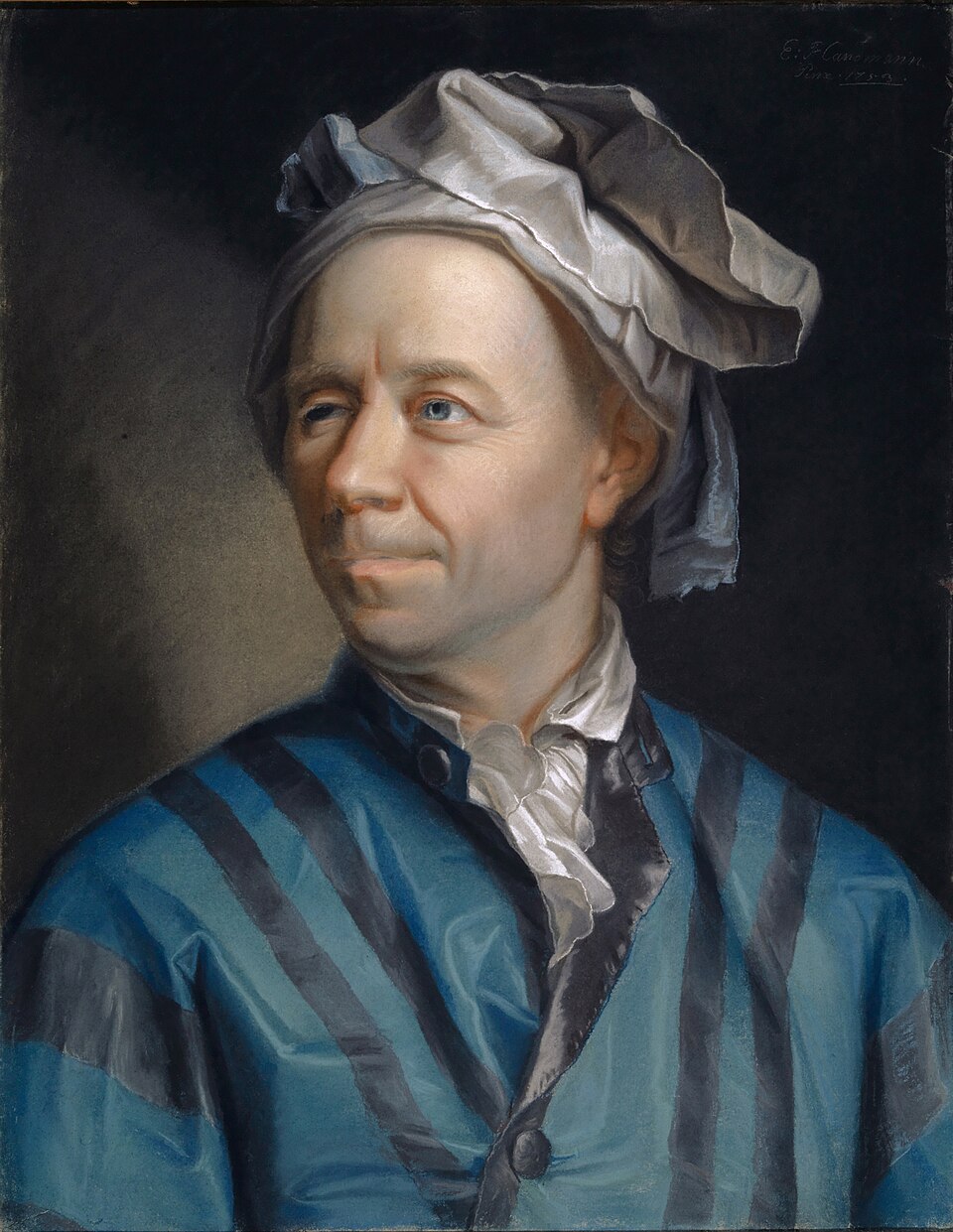
The Swiss mathematician who wrote more than anyone before or since and gave mathematics most of its modern notation.
Leonhard Euler was the most prolific mathematician in history. Blind in one eye from his thirties and totally blind from his fifties, he produced mathematics at an accelerating rate until his death at 76 — founding graph theory, formalising complex analysis, unifying mechanics and calculus, and giving modern mathematics the symbols π, e, i, f(x), Σ, and Δ that every student still uses today.
Basel and St Petersburg
Euler was born in Basel on 15 April 1707. His father, a Calvinist minister, intended him for the clergy, but arranged for him to study under Johann Bernoulli, the leading mathematician in Europe. Bernoulli quickly recognised Euler's ability and guided him toward mathematics. In 1727, at nineteen, Euler accepted an invitation to the newly founded St Petersburg Academy of Sciences, where he worked alongside Daniel Bernoulli.
He spent the next fourteen years in St Petersburg, producing work in number theory, mechanics, and analysis at extraordinary speed. In 1735 he lost sight in his right eye, attributed to overwork on an astronomical problem. He accepted an invitation from Frederick the Great to join the Berlin Academy in 1741, where he spent the next twenty-five years before returning to St Petersburg in 1766, already nearly blind. By 1771 he was totally blind. He dictated his work to assistants and continued publishing at the same rate until his death in 1783.
Mathematical contributions
Euler's output spans every area of mathematics as it then existed. He founded graph theory with his 1736 solution to the Königsberg bridge problem — proving that a walk crossing each of the city's seven bridges exactly once is impossible, and identifying the property of connected graphs that allows or prohibits such a path. He introduced topology as a discipline through the same work.
In analysis, he formalised the concept of a function, introduced the notation f(x), and developed complex analysis, proving the identity e^(iπ) + 1 = 0 — Euler's identity — which relates the five most fundamental constants in mathematics. His work on infinite series, including the Basel problem (the sum of 1/n² = π²/6), was foundational for analytic number theory.
He wrote the Introductio in Analysin Infinitorum (1748), Institutiones Calculi Differentialis (1755), and Institutiones Calculi Integralis (1768–70) — textbooks that defined calculus as a unified discipline for the following century.
He standardised the notation π for the circle constant, e for the base of natural logarithms, i for the imaginary unit, and Σ for summation — each of these now used worldwide without attribution because they have become invisible through ubiquity.
Although to penetrate into the intimate mysteries of nature and thence to learn the true causes of phenomena is not allowed to us, it can happen that a certain fictive hypothesis may suffice for explaining many phenomena.
Legacy
Euler's collected works — the Opera Omnia — fill more than 80 volumes. The Königsberg bridge solution is taught as the founding theorem of graph theory, the discipline underlying network science, computer science algorithms, and the mathematical study of the internet. His notation is not merely convention; it shapes how mathematics is thought.