Lewis Carroll
The Oxford mathematician who unlocked a parallel world of rigorous nonsense — and changed what a story for children could be.
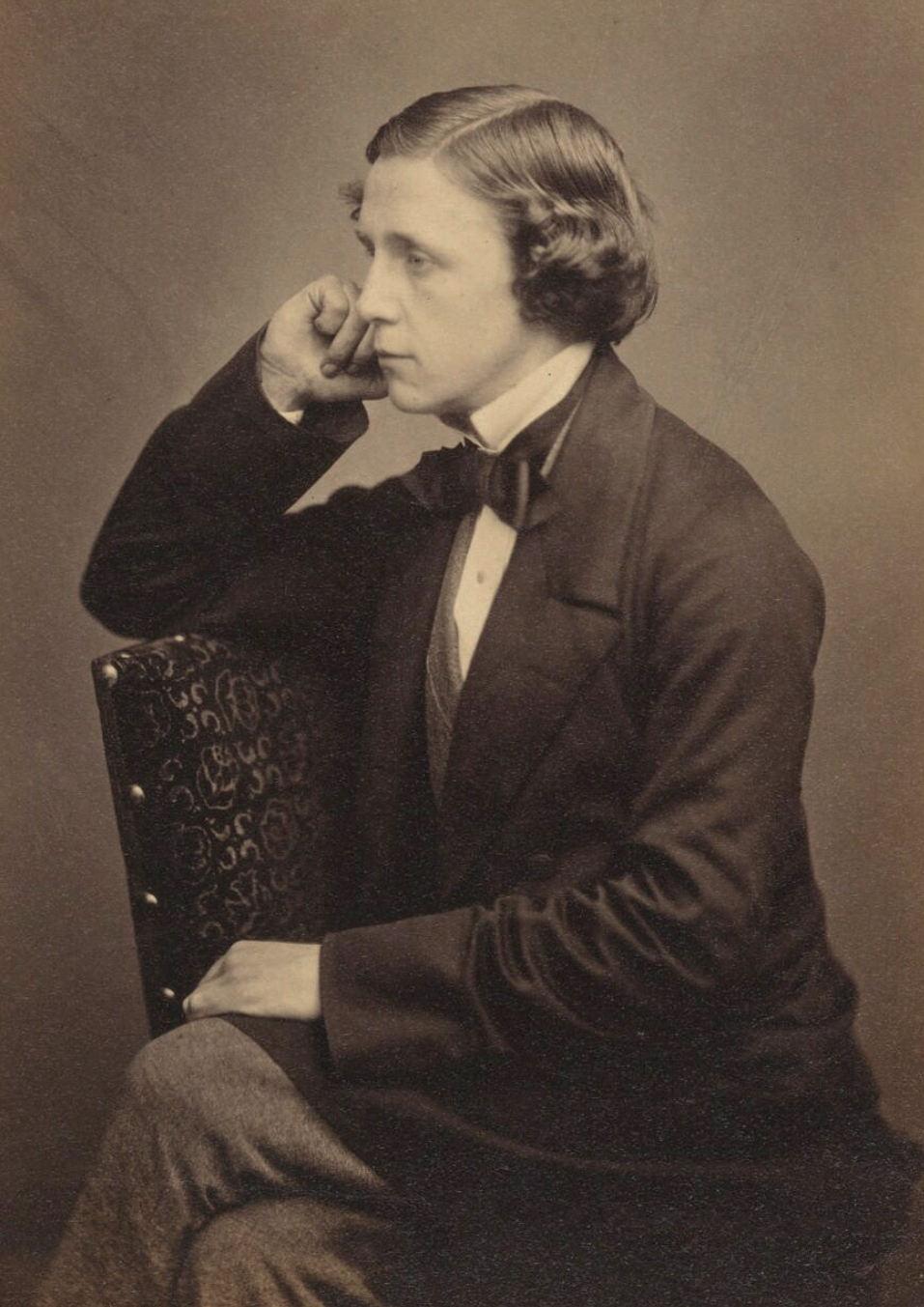
Lewis Carroll — born Charles Lutwidge Dodgson — was a lecturer in mathematics at Christ Church, Oxford, who wrote two of the most persistently strange and structurally daring works in English literature. Alice's Adventures in Wonderland (1865) and Through the Looking-Glass (1871) are built from the same logical machinery as his academic work: rules that hold perfectly within a system, and collapse magnificently when the system meets the real world.
The man behind the pseudonym
Dodgson was born in Daresbury, Cheshire, in 1832, the eldest son of a clergyman. He read Mathematics at Christ Church, Oxford, took a first-class degree in 1854, and remained at the college for the rest of his life as a lecturer. He was ordained a deacon in 1861. The pen name Lewis Carroll — a Latinised and reversed form of Charles Lutwidge — first appeared in 1856 when he began publishing comic verse. He was also an accomplished amateur photographer, at a time when the medium required exacting technical skill.
The Alice books
On 4 July 1862, Dodgson rowed on the Thames with a colleague and three daughters of the college dean — Lorina, Edith, and Alice Liddell — and improvised the story of a girl who falls down a rabbit hole. Alice Liddell asked him to write it down. The resulting manuscript, Alice's Adventures Underground, was expanded, illustrated by John Tenniel, and published by Macmillan in 1865 as Alice's Adventures in Wonderland. Its sequel, Through the Looking-Glass and What Alice Found There, followed in 1871.
Both books operate as inverted logic puzzles: the Cheshire Cat disappears leaving only its grin; the Queen sentences first and tries second; time stops at six o'clock in the Mad Hatter's perpetual tea party. The nonsense is systematic — Carroll derives absurdity by applying consistent rules to impossible premises.
The nonsense verse
Alongside the novels, Carroll produced two of the defining texts of literary nonsense. Jabberwocky (included in Through the Looking-Glass) invented words — "brillig," "slithy toves," "galumphing" — that feel grammatically real even when semantically void. The Hunting of the Snark (1876) is a mock-heroic narrative poem whose quarry may or may not exist. Both poems demonstrate Carroll's central preoccupation: the gap between the form of a sentence and the content it carries.
His mathematical publications, including Euclid and His Modern Rivals (1879) and work on symbolic logic, share the same analytic precision. The logical puzzles in his Pillow Problems and A Tangled Tale are puzzles with definite answers; the Alice books are puzzles without them.
"When I use a word," Humpty Dumpty said, "it means just what I choose it to mean — neither more nor less."
Legacy
Carroll's work shaped the literature of the absurd across the twentieth century. Surrealism, Lewis Carroll's own term "portmanteau word," postmodern metafiction, and the theory of language games all carry traces of Alice. The Tenniel illustrations fixed a visual iconography that has proved impossible to dislodge. Translations of Alice now run to well over a hundred languages, and the books have never been out of print.