Lord Byron
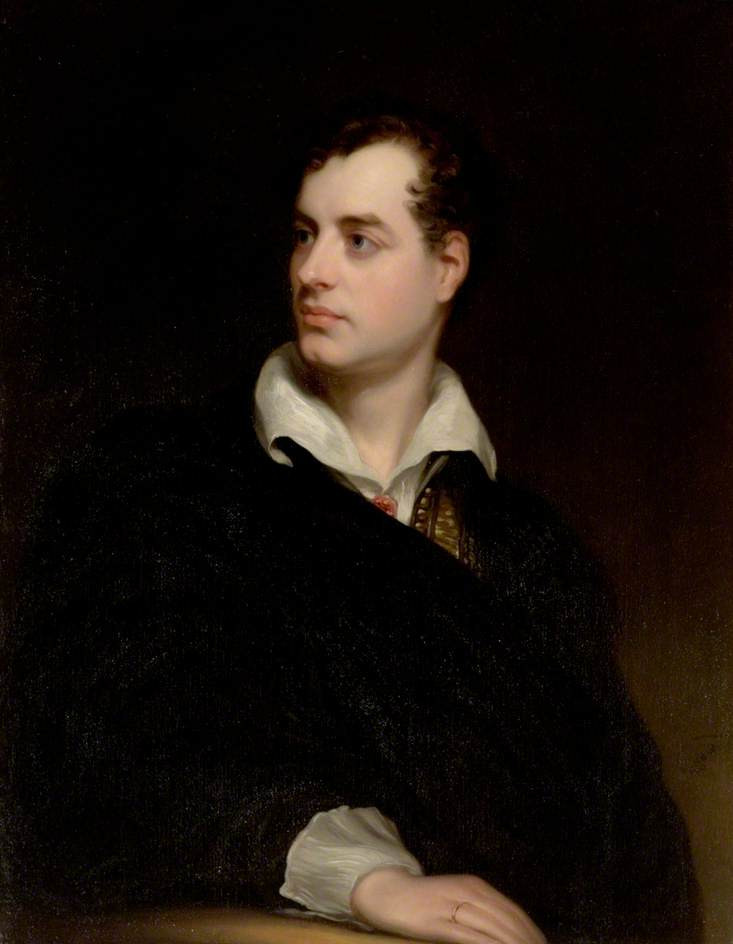
The Romantic poet whose scandalous life and radical verse made him the most famous writer in Europe at thirty.
Lord Byron became famous overnight with the publication of Childe Harold's Pilgrimage in 1812 and never escaped the legend that formed around him — that of the brooding, exiled aristocrat whose life and verse were equally transgressive.
Birth and early years
George Gordon Byron was born in London in 1788, inheriting the barony from his great-uncle at age ten. He was educated at Harrow and Trinity College, Cambridge, where he kept a bear in his rooms in protest of rules against dogs. His first collection, Hours of Idleness (1807), was savaged by the Edinburgh Review; Byron responded with the satirical poem English Bards and Scotch Reviewers (1809). He then spent two years travelling through Portugal, Spain, Albania, and Greece — a journey that provided the material for the first two cantos of Childe Harold's Pilgrimage.
Fame and exile
The publication of Childe Harold's Pilgrimage Cantos I–II in 1812 made Byron instantly famous. He wrote, famously, that he "awoke one morning and found himself famous." The poem's melancholy protagonist — a world-weary wanderer alienated from society — resonated widely and established the archetype of the Byronic hero. Hebrew Melodies (1815) followed, short lyrics set to music. Byron married Annabella Milbanke in 1815; the marriage collapsed within a year amid rumours of a relationship with his half-sister Augusta Leigh, and Byron left England in 1816, never to return.
He settled in Geneva, then Venice, then Ravenna, where he began his masterwork, the comic epic Don Juan (begun 1819). Unfinished at his death, the poem runs to sixteen cantos and stands as one of the most virtuosic and irreverent long poems in English.
I awoke one morning and found myself famous.
Greece and death
In 1823 Byron joined the Greek War of Independence, contributing money and his personal presence. He sailed to Missolonghi on the Greek mainland in January 1824. He died there in April — of fever following a bloodletting — at the age of thirty-six. In Greece he is still regarded as a national hero; his death made the Greek cause internationally sympathetic and accelerated European support for independence.
Legacy
Don Juan and Childe Harold established the Byronic mode — irony, sentiment, and self-dramatisation in simultaneous play — that influenced European Romanticism from Pushkin to Delacroix. The Byronic hero became a defining figure in nineteenth-century literature and persists, modified, in contemporary fiction.