Louis Pasteur
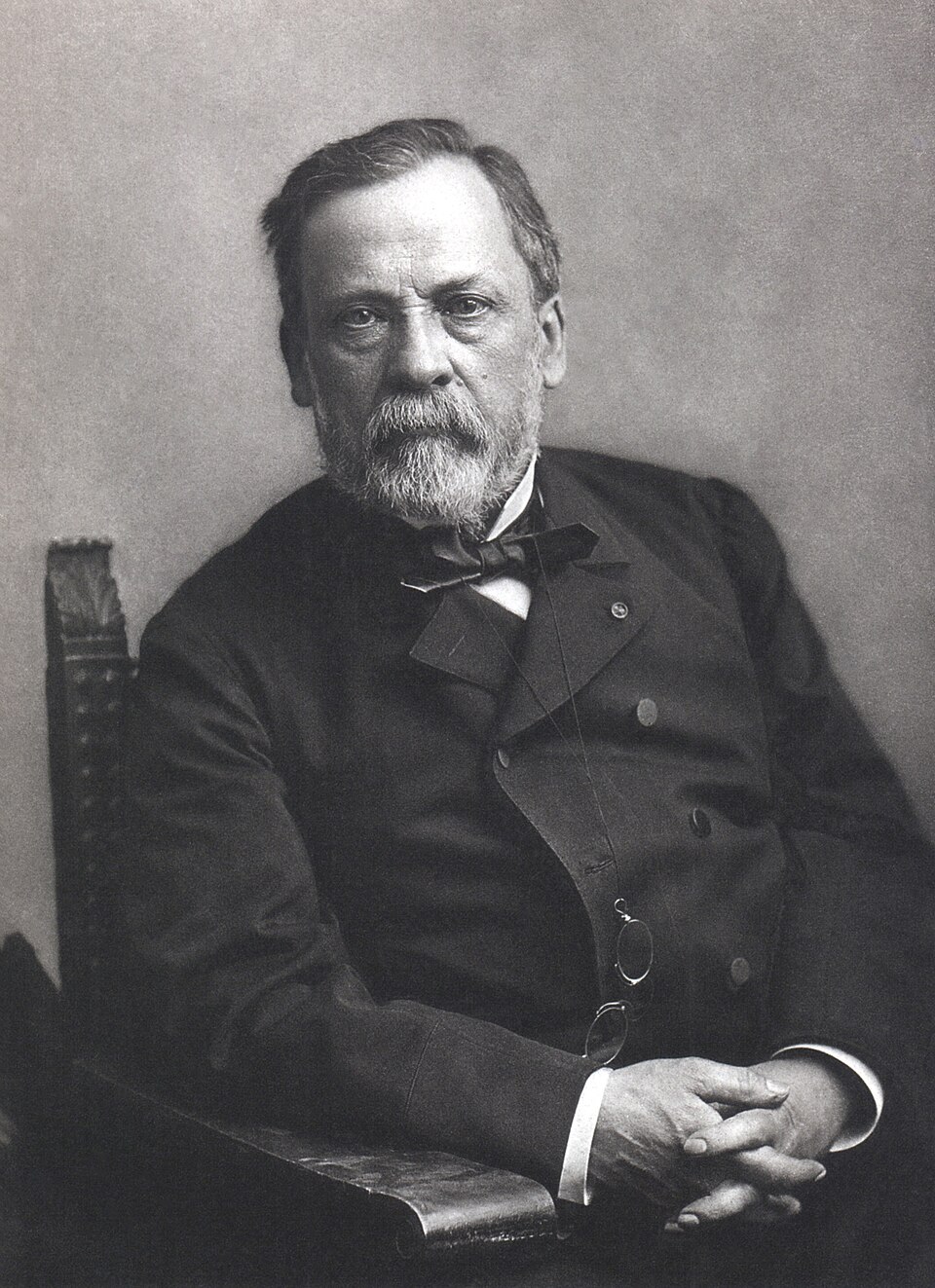
The French chemist who overturned two thousand years of received wisdom about disease, proved that life does not generate spontaneously, and applied the result to save millions of lives through vaccination and pasteurization.
Louis Pasteur began his scientific career studying the geometry of crystals and ended it having reshaped medicine, public health, and the food supply. His demonstration that microorganisms cause fermentation, spoilage, and infectious disease dismantled the doctrine of spontaneous generation and supplied the theoretical foundation on which modern germ theory, antiseptic surgery, and vaccinology were built.
From chemistry to biology — early career and molecular chirality
Pasteur was born in Dole in the Jura region of eastern France on 27 December 1822, the son of a tanner who had served in Napoleon's army. A moderate student in his early years, he became absorbed by science at the École Normale Supérieure in Paris, where he completed a doctorate in both physics and chemistry in 1847.
His first major discovery was crystallographic. Investigating tartaric acid — a by-product of wine fermentation — Pasteur found that chemically identical crystals rotated polarised light in opposite directions depending on their spatial arrangement. He manually separated two mirror-image forms of sodium ammonium tartrate using tweezers and a magnifying glass, demonstrating that molecular structure had a handedness. The field of stereochemistry traces one of its founding observations to this work.
The insight that life processes produced optically active molecules led Pasteur directly to fermentation. From 1857 he challenged the prevailing chemical view — associated with Justus von Liebig — that fermentation was a purely chemical decomposition. Through careful experiment he showed that fermentation was instead a biological process driven by living microorganisms. Different organisms produced different products: yeast produced alcohol, bacteria produced lactic acid. The specificity of the reaction depended on the specificity of the organism.
Germ theory and pasteurization
Pasteur's work on fermentation placed him in direct conflict with the doctrine of spontaneous generation — the idea, with roots in Aristotle, that living organisms could arise from non-living matter. He settled the question definitively with an elegant series of experiments conducted between 1859 and 1861. Using swan-necked flasks whose curved necks prevented airborne particles from reaching the broth inside while allowing air to enter freely, he showed that sterilised broth remained clear indefinitely — but clouded with microbial growth the moment the neck was broken and outside air made direct contact. Life came only from life.
The practical consequence was pasteurization. Pasteur showed that gentle heating — sufficient to kill spoilage organisms without altering the character of wine, beer, or milk — preserved beverages and foodstuffs that would otherwise ferment or putrefy. The technique, adopted first by brewers and winemakers and eventually by dairy industries worldwide, bears his name to this day. His 1865 work on pébrine, a silkworm disease devastating the French silk industry, demonstrated the same principle at an economic scale: a disease caused by a specific microorganism could be controlled by identifying and eliminating its source.
Pasteur extended the germ theory to human disease in the 1870s, identifying streptococcal bacteria in puerperal fever and contributing to the acceptance — alongside Joseph Lister's antiseptic methods — that infections were caused by contamination with specific organisms. His work gave surgeons and physicians a rational basis for sterile technique.
Vaccines — anthrax and rabies
Building on Edward Jenner's earlier work on smallpox, Pasteur generalised the principle of vaccination and gave it the name it retains. He developed attenuated — weakened — preparations of pathogens that stimulated immunity without causing full disease.
His anthrax vaccine was tested in a highly public trial at Pouilly-le-Fort in 1881. Twenty-five sheep, one goat, and six cows were vaccinated; a matched group of animals received no vaccine. All were then exposed to virulent anthrax. The vaccinated animals survived; the unvaccinated died. The result was observed by journalists, officials, and sceptical scientists, and it was unambiguous.
The rabies vaccine followed. Working with a disease whose causative agent he could not directly observe — the rabies virus was below the resolution of contemporary microscopes — Pasteur prepared attenuated spinal-cord material from infected rabbits. In July 1885 he used the preparation on nine-year-old Joseph Meister, who had been bitten severely by a rabid dog and faced almost certain death. Meister survived. The treatment worked, and Pasteur's name became known to a worldwide public. Within a year, patients were travelling from Russia and the United States to be treated in Paris.
In the fields of observation, chance favours only the prepared mind.
Legacy
The Institut Pasteur was founded in Paris in 1887, funded by international public subscription following the rabies vaccine's success. It has remained one of the world's leading biomedical research institutions, and has given its name to a global network of affiliated institutes. Pasteur himself directed it until his death in 1895.
His influence on public health is structural rather than merely historical. Pasteurization of milk eliminated bovine tuberculosis and other dairy-transmitted diseases; his vaccines directly inspired the development of preparations against cholera, typhoid, and diphtheria in the decades following his death. Antiseptic and aseptic surgical practice, rooted in the germ theory he helped establish, transformed operative mortality. The bacteriological laboratory — the discipline of identifying, culturing, and characterising specific pathogens — is largely a Pasteurian creation.
Pasteur was elected to the Académie française in 1881 and received the Grand Cross of the Légion d'honneur. He is buried in a crypt beneath the Institut Pasteur. His standing in French national memory is close to secular sainthood; in international scientific history he is one of a handful of figures who genuinely redirected medicine.