Madeleine Vionnet
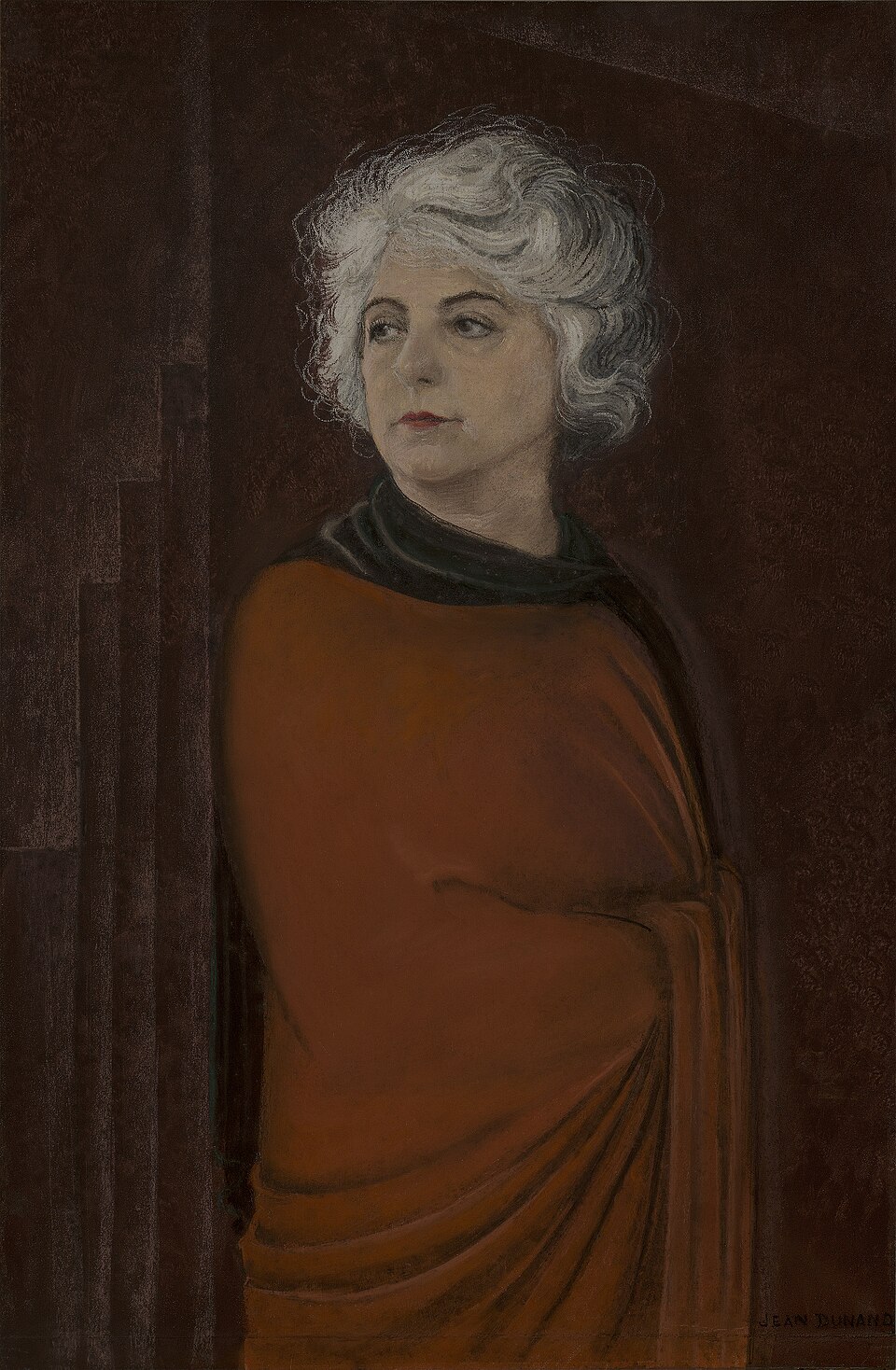
The designer who taught fabric to obey the body, not the other way around.
Madeleine Vionnet reimagined the relationship between cloth and body. Where her contemporaries imposed structure through boning, padding, and corseting, Vionnet devised a technique — the bias cut — that allowed fabric to move with the wearer. The result was a form of dress construction that felt less like engineering and more like architecture: precise in conception, effortless in effect.
Early training
Vionnet was born in 1876 in Chilleurs-aux-Bois to a working-class family in the Loire region. She left school at eleven and was apprenticed to a local dressmaker, arriving in Paris as a teenager to continue her training. By her early twenties she had crossed the Channel to London, where she spent several years at Kate Reily's court dressmaking house in Dover Street — a prestigious establishment that dressed aristocratic clients and gave Vionnet an education in precision cutting and high-volume workroom practice. She studied medieval and Renaissance dress construction during her time in England, an interest that would surface later in her handling of draped and unlined fabric. She returned to France at the turn of the century, working briefly at the house of Callot Soeurs and then at Doucet, where she was given latitude to experiment with uncorseted, bare-footed mannequins — a provocation her employer tolerated uneasily.
The bias cut
In 1912 Vionnet opened her own house on the rue de Rivoli in Paris. The timing was bold; so was the method. Her central innovation was cutting fabric on the bias — that is, at a 45-degree angle to the weave's grain — rather than along the straight or cross grain that conventional tailoring demanded. Bias-cut cloth stretches diagonally, clinging and falling in ways that follow the body's own geometry. Vionnet used this property to eliminate darts, seams, and internal supports: the cut itself created the fit. Her toiles were first worked out on small wooden mannequins, scaled miniatures on which she could drape, twist, and observe the fall of cloth before translating the pattern to full scale. She refused to sketch; the hand and the fabric were her drawing instruments. The result was garments of apparent simplicity that concealed extraordinary technical complexity — dresses that looked as though they had been poured rather than made.
Between the wars
The outbreak of the First World War forced Vionnet to close her house in 1914. She spent part of the war years in Rome. She reopened in Paris in 1919 and over the following two decades established herself as one of the dominant figures in French haute couture. The 1920s and 1930s were her peak: bias-cut evening gowns, cowl-necked day dresses, and sculptural draped silhouettes influenced by Greek classical dress and the Hellenistic sculpture she studied closely. She worked extensively with crêpe de chine, charmeuse, and silk satin — materials that rewarded the bias cut's tendency toward fluid movement. Her interest in geometric form led to dresses built from squares, triangles, and rectangles of fabric, assembled without traditional pattern-making logic. Her atelier on the avenue Montaigne employed over a thousand workers at its height, and Vionnet was notable among her contemporaries for providing workers with paid maternity leave, a nursery, and a canteen — practices that had no precedent in the French fashion industry.
When a woman smiles, her dress should smile with her.
Closure and legacy
Vionnet closed her house in September 1939 as the Second World War began. She retired definitively in 1940, at the age of sixty-three, and lived in Paris for another thirty-five years, dying in 1975 at ninety-eight. During her lifetime she donated her archive — toiles, pattern books, technical records, and photographs — to the Union Française des Arts du Costume, now held at the Musée des Arts Décoratifs in Paris, ensuring that her technical methods remained accessible to later generations. Her influence on twentieth-century dress is structural rather than stylistic: the bias cut became a permanent element of the designer's vocabulary. Azzedine Alaïa acknowledged her directly; John Galliano cited her repeatedly; the language of draped, body-following eveningwear that runs through late twentieth-century and contemporary fashion is substantially her inheritance.