Marcel Proust
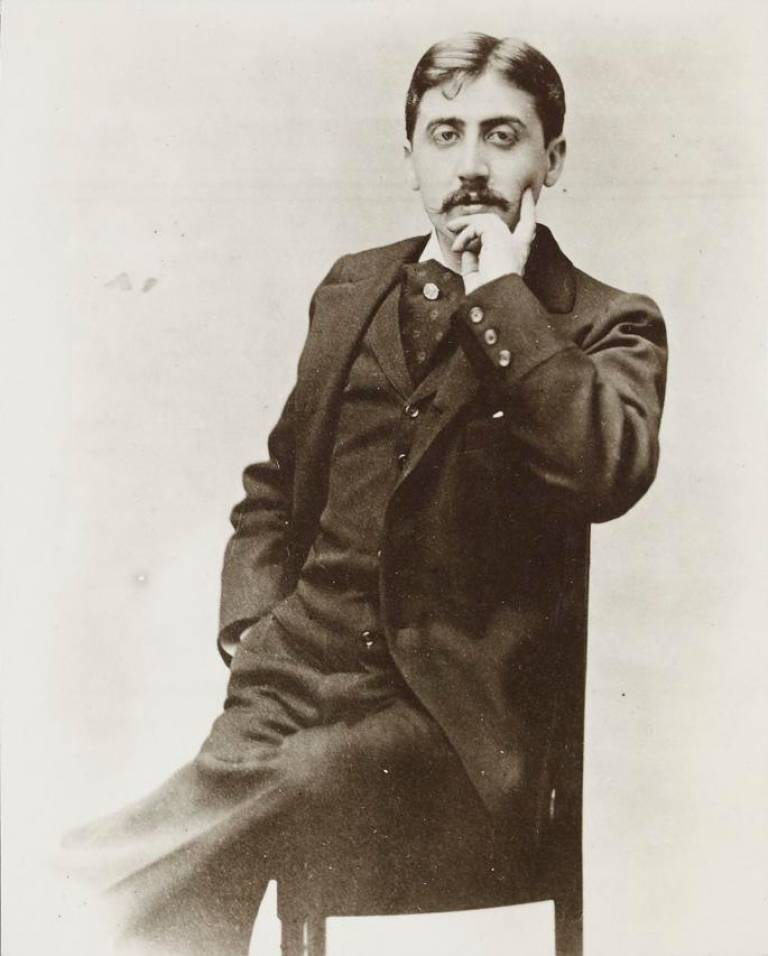
The French novelist who spent fifteen years writing a seven-volume account of involuntary memory and the passage of time, producing the longest novel in the Western tradition and one of its most influential.
Marcel Proust published the first volume of À la recherche du temps perdu in 1913, after it had been rejected by several publishers including Gallimard, whose reader André Gide later called his rejection the greatest mistake of his professional life. The seven-volume novel, completed before Proust's death in 1922 though not fully published until 1927, is among the longest in any language and the most sustained examination of consciousness, time, and memory in Western literature.
Formation
Proust was born in Auteuil, Paris, in 1871, the son of a prominent physician and a Jewish mother of considerable intelligence and cultivation. His relationship with his mother was the dominant emotional attachment of his life; her death in 1905 was the decisive blow that sent him into the years of seclusion during which the novel was written.
He studied law and philosophy at the École des Sciences Politiques and moved in the aristocratic and artistic salons of late nineteenth-century Paris, an education in social observation that feeds directly into the novel's anatomy of the Faubourg Saint-Germain. He published social sketches and criticism but remained a figure of promise rather than achievement until the publication of Swann's Way in 1913, at his own expense.
À la recherche du temps perdu
The novel is narrated by a figure named Marcel who recounts his life from childhood to old age, but its organising subject is not biography: it is the nature of memory, the unreliability of perception, and the way consciousness reconstructs the past in the act of trying to recover it.
The structuring device — involuntary memory triggered by sensation, most famously the taste of a madeleine dipped in lime-blossom tea — is not a literary technique so much as a philosophical claim: that the past is not gone but latent, and recoverable not by will but by accident. The novel unfolds this claim across seven volumes and some 2,000 named characters.
Within a Budding Grove won the Prix Goncourt in 1919, prompting debate: critics felt older, war-related work deserved the prize, and the award to Proust — a society figure of independent means — was controversial.
Method
Proust wrote at night, often in bed, in a cork-lined room in his Paris apartment, working in a condition of near-invalidism caused by severe asthma. He revised obsessively, adding material in the margins and on additional slips of paper pasted to his manuscript in what he called "paperoles." The accretive, self-correcting method produced a prose of extraordinary syntactic complexity: sentences that open one expectation and satisfy another, subordinate clauses stacked in a structure that mirrors the movement of consciousness.
The real voyage of discovery consists not in seeking new landscapes, but in having new eyes.
Legacy
Proust's influence on the twentieth-century novel is structural. The interiority of the novel — the subordination of event to consciousness — made available a mode of fiction that Virginia Woolf, William Faulkner, and Samuel Beckett developed in their different directions. Literary criticism has addressed À la recherche continuously since its publication; it remains one of the most read and the most annotated works in the tradition.