Marie Curie
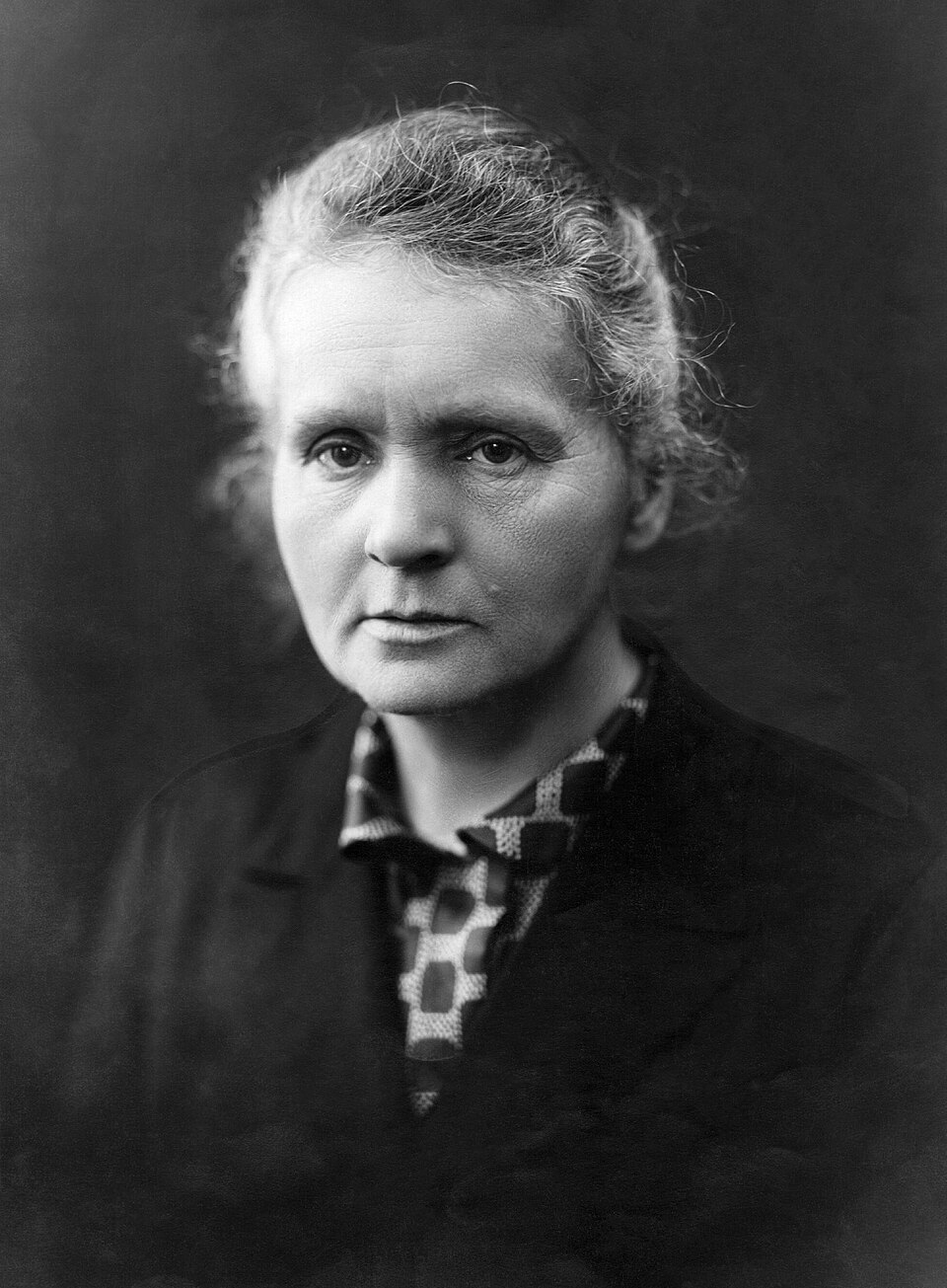
The Polish-born physicist who discovered two elements, defined the science of radioactivity, and remains the only person to have won Nobel Prizes in two different sciences.
Marie Curie arrived in Paris with almost no money, taught herself French, and became the most decorated scientist of her era — not despite the institutional barriers placed before women in nineteenth-century academia, but in the teeth of them. Her work on radioactivity opened a new domain of physics and chemistry that reshaped medicine, energy, and the understanding of matter.
Warsaw and Paris
Maria Salomea Skłodowska was born in Warsaw on 7 November 1867, into a family of teachers under Russian imperial rule. Access to higher education was denied to women in Russian-controlled Poland; she and her sister financed each other through a clandestine arrangement — one worked while the other studied — before Maria left for Paris in 1891. She enrolled at the Sorbonne, living in an unheated garret and eating so little that she sometimes fainted in lectures. She graduated first in her physics degree in 1893 and second in mathematics the following year.
In 1894 she met Pierre Curie, an established physicist; they married in 1895. The partnership combined Pierre's experimental ingenuity with Marie's extraordinary tenacity in quantitative measurement.
Radioactivity and the discovery of two elements
Curie's doctoral research, begun in 1897, focused on a phenomenon Henri Becquerel had observed in uranium salts the previous year: the spontaneous emission of rays that exposed photographic plates. She coined the term radioactivity and established through systematic measurement that the intensity of radiation was proportional to the amount of uranium present — and was an atomic property, not a chemical one. This was a conceptual shift of the first order.1
Working in a converted shed with inadequate ventilation — exposure to the materials that would eventually kill her — she and Pierre processed tonnes of pitchblende ore to isolate two new elements. Polonium, named for her occupied homeland, was announced in July 1898. Radium followed in December 1898. Isolating a gram of radium required processing roughly ten tonnes of pitchblende; the couple refused to patent the isolation process, making it freely available to the scientific community.
Nobel Prizes and the Sorbonne
In 1903 Marie and Pierre Curie shared the Nobel Prize in Physics with Becquerel — the first Nobel awarded to a woman. When Pierre was killed by a horse-drawn wagon in Paris in 1906, Marie was appointed to his professorship at the Sorbonne, becoming the first woman to hold a chair there. In 1911 she received the Nobel Prize in Chemistry, becoming the first person to win two Nobel Prizes and the only person to win in two distinct sciences.
The 1911 Nobel was clouded by a public scandal over her relationship with physicist Paul Langevin; the French press was hostile, and the Swedish Academy reportedly suggested she not attend the ceremony. She attended.
Later work and death
During the First World War, Curie developed mobile X-ray units — called petites Curies — that brought radiological diagnosis to frontline field hospitals. After the war she directed the Radium Institute in Paris and continued research until her health made it impossible. She died on 4 July 1934 from aplastic anaemia, almost certainly caused by decades of radiation exposure. Her notebooks remain so radioactive that researchers access them in lead-lined boxes.
Nothing in life is to be feared, it is only to be understood. Now is the time to understand more, so that we may fear less.
Footnotes
- The demonstration that radioactivity was an atomic rather than a molecular property was crucial: it implied that atoms were not indivisible, as classical chemistry assumed, but had internal structure. This conclusion anticipated the nuclear model of the atom by more than a decade. ↩