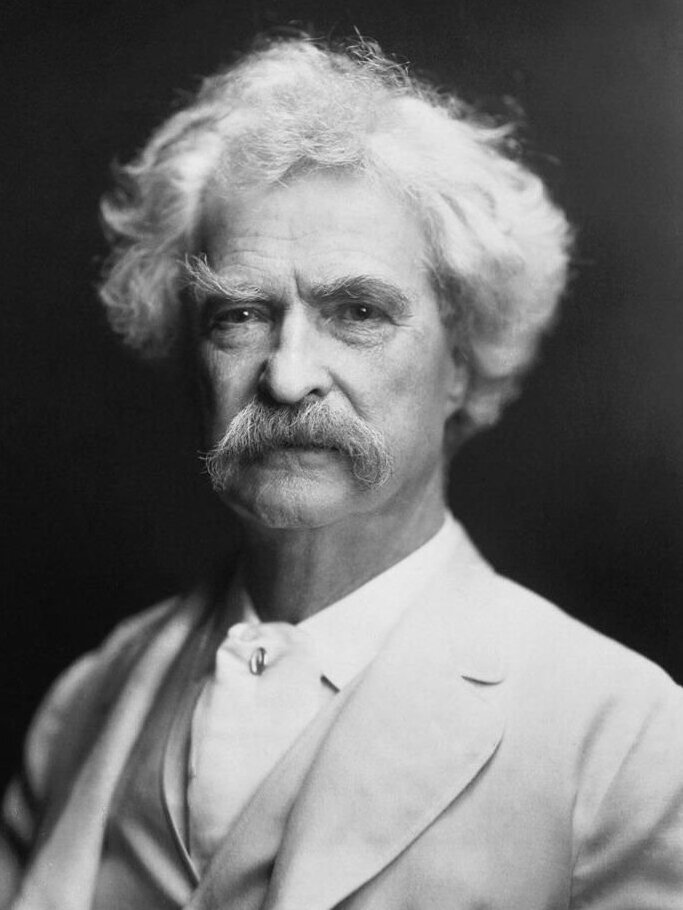
Mark Twain
The riverboat pilot who became America's sharpest satirist — and wrote the novel William Faulkner called the origin of American literature.
Mark Twain was born Samuel Langhorne Clemens in a small Missouri village and grew up on the banks of the Mississippi River, which supplied him with the voice, the characters, and the moral geography of his best work. He became the most celebrated American writer of his generation — a humorist, travel writer, polemicist, and novelist whose pen name is so famous that his given name is nearly forgotten.
Origins on the Mississippi
Clemens was born on 30 November 1835 in Florida, Missouri, and grew up in the nearby river town of Hannibal, which would become the model for St. Petersburg in The Adventures of Tom Sawyer and Adventures of Huckleberry Finn. His father died when he was eleven, ending his formal education. He worked as a printer's apprentice, then as a typesetter and journalist, and from 1857 to 1861 as a licensed Mississippi riverboat pilot — a highly skilled profession that gave him the pen name he adopted (mark twain is the river pilot's call for two fathoms of water, safe depth).
The Civil War ended his river career. He spent a brief, uncomfortable time with a Confederate militia unit, then headed west to Nevada with his brother, who had been appointed secretary of the Nevada Territory. He worked as a miner and journalist in Nevada and California, developing his comic voice in Western newspaper journalism.
The writing
Twain's first major success was the short story "The Celebrated Jumping Frog of Calaveras County" (1865), a tall tale that circulated widely. The Innocents Abroad (1869), a comic travel book based on a Mediterranean excursion, became one of the best-selling American travel books of the nineteenth century.
The Adventures of Tom Sawyer (1876) established the fictional town of St. Petersburg and its cast of boyhood archetypes. Its sequel, Adventures of Huckleberry Finn (1884), is the work for which Twain is now primarily remembered — a novel narrated by an illiterate boy travelling the Mississippi River on a raft with Jim, an escaped slave. Ernest Hemingway said all modern American literature comes from it. William Faulkner called Twain "the father of American literature." The novel was controversial from publication for its language and its unresolved relationship with race; that controversy has never fully abated.
A Connecticut Yankee in King Arthur's Court (1889) is a satirical fantasy in which a nineteenth-century American is transported to medieval England — a vehicle for Twain's critique of monarchy, aristocracy, and romantic idealism. Pudd'nhead Wilson (1894) addresses slavery, identity, and fingerprinting in antebellum Missouri.
The later pessimism
The final decade of Twain's life brought personal losses — the deaths of his wife and two daughters — and financial disasters, including bankruptcy after over-investing in a typesetting machine. The writing of this period is darker: The Mysterious Stranger (posthumously published), dark satires, and bitter essays. He dictated a long autobiography with the instruction that large parts not be published until a century after his death.
It is curious that physical courage should be so common in the world and moral courage so rare.
Legacy
Twain died on 21 April 1910, the day after Halley's Comet reached its perihelion — he had predicted this, noting he had arrived with the comet in 1835 and expected to go out with it. His cultural presence in the United States has been constant; his image, the shock of white hair and white suit, is immediately recognisable. Huckleberry Finn has been one of the most argued-over novels in American schools for more than a century.